Uncategorized

  • Fascinating Little Story

    Tonight I joined one of my dear Jesuit friends in watching the classic film (and Gregory Peck’s big-screen debut) The Keys of the Kingdom. It was an absolutely fabulous, moving and beautiful movie that I recommend to everyone. It’s depth and insight not only into humanity but also the life of priests and religious made me want to learn more about the author of the book the film was based on.

    Being a human, a sinner and forgiven in Christ I of course turned to Wikipedia and stumbled across this terrific gem regarding the author, A.J. Cronin and his journey into agnosticism and his rediscovery of God:


    “A number of Cronin’s novels also deal with religion, something he had grown away from during his medical training and career, and with which he reacquainted himself in the thirties. At medical school, as he recounts in his autobiography, he had become an agnostic: “When I thought of God it was with a superior smile, indicative of biological scorn for such an outworn myth”. During his practice in Wales, however, the deep religious faith of the people he worked among made him start to wonder whether “the compass of existence held more than my text-books had revealed, more than I had ever dreamed of. In short I lost my superiority, and this, though I was not then aware of it, is the first step towards finding God.

    He also came to feel that ”If we consider the physical universe,… we cannot escape the notion of a primary Creator…. Accept evolution with its fossils and elementary species, its scientific doctrine of natural causes. And still you are confronted with the same mystery, primary and profound. Ex nihilo nihil, as the Latin tag of our schooldays has it: nothing can come of nothing.” This was brought home to him in London, where in his spare time he had organized a working boys’ club. One day he invited a distinguished zoologist to deliver a lecture to the members. The speaker, adopting “a frankly atheistic approach,” described the sequence of events leading to the emergence, “though he did not say how,” of the first primitive life-form from lifeless matter. When he concluded, there was polite applause. Then, “a mild and very average youngster rose nervously to his feet” and with a slight stammer asked how there came to be anything in the first place. The naïve question took everyone by surprise. The lecturer “looked annoyed, hesitated, slowly turned red. Then, before he could answer, the whole club burst into a howl of laughter. The elaborate structure of logic offered by the test-tube realist had been crumpled by one word of challenge from a simple-minded boy.”

    From Wikipedia’s entry on A.J. Cronin

    “From the mouths of babes” indeed!

  • Purgatory

     Yes, folks, I’m still here! After a bout of traveling and then the busyness that follows being away from work for ten days I finally have time this rainy afternoon to do some blogging. Earlier in the summer when I canvassed everyone regarding their questions about Catholicism, two people asked about purgatory and I’m sure that many others would have asked had they thought about it. So here is my attempt at offering my thoughts on the Church’s teaching about purgatory.

    First, however, I want to lay out an important detail. One of the number one complaints I receive from non-Catholics regarding the ancient belief in and teaching on purgatory is that “it isn’t Biblical.” Understandable, considering that one of the most important Scriptural supports for this tradition come from 2 Maccabees and we touched somewhat on the issue of Biblical canon in the last post… Similarly they charge that the word “purgatory” doesn’t even appear in the Bible. Touché, but neither do the words “Trinity,” “Incarnation,” or–gasp–”Bible.” Likewise some apologists note the interesting fact that while historical evidence abounds regarding the Church’s teaching and belief regarding purgatory from ancient days there is no record of any protest against it until the Reformation.

    While there yet remains common to any Biblical canon Scripture support for purgatory (pray about 1 John 6:16-17, Matthew 12:32 regarding that “age to come,” or St. Paul’s prayer for the deceased Onesiphorus in 2 Timothy 1:16-18, 1 Cor. 3:15, 1 Pet. 1:7), I want to make something as clear as I can. You see, the Catholic Church does not look at the Bible, think about it, pray about it, and then decide what it says we ought to do and believe; the Bible is not an oracle for us. We do not base our doctrines and beliefs upon Scripture, though we do support them with Scripture. You see, Scripture is an inseparable partner of Sacred Tradition; it is neither greater nor lesser than Sacred Tradition and we cannot have one fully without the other. As the Catechism of the Church teaches:

    80
    “Sacred Tradition and Sacred Scripture, then, are bound closely together, and communicate one with the other. For both of them, flowing out from the same divine well-spring, come together in some fashion to form one thing, and move towards the same goal.” Each of them makes present and fruitful in the Church the mystery of Christ, who promised to remain with his own “always, to the close of the age”.
    81
    Sacred Scripture is the speech of God as it is put down in writing under the breath of the Holy Spirit.”
           ”And [Holy] Tradition transmits in its entirety the Word of God which has been entrusted to the apostles by Christ the Lord and the Holy Spirit. It transmits it to the successors of the apostles so that, enlightened by the Spirit of truth, they may faithfully preserve, expound and spread it abroad by their preaching.”
    82
    As a result the Church, to whom the transmission and interpretation of Revelation is entrusted, “does not derive her certainty about all revealed truths from the holy Scriptures alone. Both Scripture and Tradition must be accepted and honored with equal sentiments of devotion and reverence.”

     83    The Tradition here in question comes from the apostles and hands on what they received from Jesus’ teaching and example and what they learned from the Holy Spirit. The first generation of Christians did not yet have a written New Testament, and the New Testament itself demonstrates the process of living Tradition.
           Tradition is to be distinguished from the various theological, disciplinary, liturgical or devotional traditions, born in the local churches over time. These are the particular forms, adapted to different places and times, in which the great Tradition is expressed. In the light of Tradition, these traditions can be retained, modified or even abandoned under the guidance of the Church’s Magisterium.


    Sacred Tradition and Sacred Scripture are like the two lungs with which the Church breathes, or the two legs it stands on. You can see (and I don’t mean to insult non-Catholic Christians here) what has happened since the Reformation when Christians broke away from Sacred Tradition and endeavored to decipher true Christianity from Sacred Scripture alone: what began as one temporary group in protest has in these recent days become 40,000+. One former-Baptist minister who is now a Catholic Priest tells the story about how he grew up in a small town in Alabama where there was one Baptist Church. By the time he was older and a minister there were around a dozen and all of them occurred because the minister had one interpretation of Scripture and an influential member of the congregation had another, people chose sides, and there was no reconciliation. Rinse, repeat. However in Catholicism we have the teaching authority of the Magesterium which checks new developments and teachings against Sacred Tradition and Sacred Scripture for consistency so that as our understanding of Christ’s teaching, as given us by the Apostles, develops we do not begin laying new foundations elsewhere but rather continue to build upon the foundation as laid by the Apostles (Eph. 2:20). With all this in mind, then, we can see how there are beliefs and doctrines (as in essential beliefs that must be accepted even if not fully understood in order to be, truly, a Catholic Christian) within Catholicism that seem to have a “weak Biblical basis.” Well, that is because our beliefs and doctrines are not based on Sacred Scripture but rather in harmony with them. They are based on the deposit of faith received by the Church from the Apostles, just as the New Testament is based on the same, as is Sacred Tradition. So regarding purgatory we can see a few places in the New Testament where it seems there was a notion of a state of preparation “between” earth and heaven, yet it seems it was not really a matter of terrific concern among Early Christians since it is not absolutely 100% explicit. When one understands Scripture in its proper context, this is not a big deal; in fact it is perfectly natural. 

    So what does the Church teach about Purgatory? Let’s look at what the Church teaches about Heaven since, ultimately, Purgatory is awfully pointless without Heaven.

    1023    Those who die in God’s grace and friendship and are perfectly purified live for ever with Christ. They are like God for ever, for they “see him as he is,” face to face…

    1024    This perfect life with the Most Holy Trinity – this communion of life and love with the Trinity, with the Virgin Mary, the angels and all the blessed – is called “heaven.” Heaven is the ultimate end and fulfillment of the deepest human longings, the state of supreme, definitive happiness.

    1025    To live in heaven is “to be with Christ.” The elect live “in Christ,” but they retain, or rather find, their true identity, their own name. For life is to be with Christ; where Christ is, there is life, there is the kingdom.

    1026   By his death and Resurrection, Jesus Christ has “opened” heaven to us. The life of the blessed consists in the full and perfect possession of the fruits of the redemption accomplished by Christ. He makes partners in his heavenly glorification those who have believed in him and remained faithful to his will. Heaven is the blessed community of all who are perfectly incorporated into Christ.

    1027    This mystery of blessed communion with God and all who are in Christ is beyond all understanding and description. Scripture speaks of it in images: life, light, peace, wedding feast, wine of the kingdom, the Father’s house, the heavenly Jerusalem, paradise: “no eye has seen, nor ear heard, nor the heart of man conceived, what God has prepared for those who love him.”


    Notice that first line mentions “perfectly purified.” What’s this business? Remember that St. John taught, “…nothing unclean shall enter [heaven]…” (Rev. 21:27), and St. Paul touches on it similarly in Hebrews 12:14 when he teaches, “Strive for peace with everyone, and for that holiness without which no one will see the Lord.” According to these and other references regarding the necessary purity of those entering into the presence of God in Heaven it seems that we Christians here below are in a bad state!

    Now, I am no Protestant theologian nor am I terribly familiar with Protestant theology, so please forgive me if I say something incorrect. Martin Luther used the image of a “snow-covered dung heap” to describe the work of Christ’s grace upon the sinner; basically that Christ’s perfect life, passion and death “clothes” or “covers up” our sins in His own righteousness, He Himself becoming our wedding garment that gains us admission to that great and long-desired feast.

    Any parents of young children out there? Imagine your kid comes in from playing outside and is all filthy and gross (kids are adorable but can be awfully smelly!). You are soon to attend a formal event with your children in tow, be it a nice dinner, a conference, or even church. Are you just going to throw on clean clothes and call it good enough? Of course not; there is a stink and uncleaness that even brand-new out-of-the-dryer clothes cannot make clean or even cover up. Or how about dirty diapers; is it sufficient just to change the diaper? Nope! That baby must be made clean and, yes, it takes some effort.

    In Catholicism we hold that the whole person must be purified, not merely covered up or dressed appropriately. Jesus is not a bandage but medicine. Actually, more like chemotherapy and radiation all rolled into one. The view of Luther, at least as I understand it, presents this idea that we are dirty and God would not dare touch us or handle us lest He get our filth on His hands. So He covers us up, makes us presentable, and everything is hunky dory. That may very well work for God; after all, He is so loving that He could probably overlook a foul odor or sorts. But, you see, Heaven is not for God’s sake, but for ours.

    Imagine what it would be like to enter into Heaven in disguise like that. You know that when God in Heaven looks at you He sees only the goodness and perfection of His Son. Wonderful! But you know the awful truth that, sure, you have been forgiven but the stink, the dirt, the wounds of your past sins still persist under that garment. You know that feeling you have when you realize you forgot to put on deodorant before you went on a date? Or when you realize that awful smell creeping up from under the conference table is your sweaty feet? Or, worse yet, you know that feeling you have when you know you’ve done something awful but someone you care deeply about is completely oblivious? Perhaps they even know about it and you know they know, but they pretend like everything is OK? Torture!

    Could you imagine enduring that feeling for an eternity? Our sins, our wounded nature is not a problem that can be covered up. If it were, why would God need to become, fully, a human being? Would it not suffice simply to appear like a human being, or appear to die upon the Cross, as many Muslims believe? Covering up our sins, after all, is about appearances, isn’t it? Yet we know God say us wallowing in the pigsty of our sins and, pulling on the workboots of human nature, hopped right in (yeah, I’m from Iowa).

    Therefore, while it is not impossible for a person to go straight to Heaven when they die, it is not likely for some people. How often do we get the chance to reconcile and do justice for all our sins? Being forgiven is one thing, and accepting the forgiveness offered by Christ is absolutely crucial. But what about those who die with some unfinished business which, in all likelihood (since death is awfully hard to schedule into an appointment book), accounts for most of us? Remember, nothing unclean will enter! Think of all the Jewish traditions regarding purity, bathing, washing and such and recall, too, that all the Law was put in place in order to prepare the way of the Lord, to open the hearts and minds of the people to the fulfillment of what the Law promised. Do you think all that emphasis on clean and unclean was just about sanitation? 


    1030    All who die in God’s grace and friendship, but still imperfectly purified, are indeed assured of their eternal salvation; but after death they undergo purification, so as to achieve the holiness necessary to enter the joy of heaven.

    1031    The Church gives the name Purgatory to this final purification of the elect, which is entirely different from the punishment of the damned. (Councils of Florence and Trent, 1439 and 1563AD) The Church formulated (i.e. articulated it or defined it but did NOT “invent” it) her doctrine of faith on Purgatory especially at the Councils of Florence and Trent. The tradition of the Church, by reference to certain texts of Scripture, speaks of a cleansing fire: (cf. 1 Cor. 3:15, 1 Pet. 1:7)

    As for certain lesser faults, we must believe that, before the Final Judgment, there is a purifying fire. He who is truth says that whoever utters blasphemy against the Holy Spirit will be pardoned neither in this age nor in the age to come. From this sentence we understand that certain offenses can be forgiven in this age, but certain others in the age to come. (St. Gregory the Great, 540-604 AD)

    1032   This teaching is also based on the practice of prayer for the dead, already mentioned in Sacred Scripture: “Therefore [Judas Maccabeus] made atonement for the dead, that they might be delivered from their sin.” (2nd Macc. 12:46) From the beginning the Church has honored the memory of the dead and offered prayers in suffrage for them, above all the Eucharistic sacrifice, so that, thus purified, they may attain the beatific vision of God. (Council of Lyons II, 1274 AD) The Church also commends almsgiving, indulgences, and works of penance undertaken on behalf of the dead:

    Let us help and commemorate them. If Job’s sons were purified by their father’s sacrifice, why would we doubt that our offerings for the dead bring them some consolation? Let us not hesitate to help those who have died and to offer our prayers for them. (St. John Chrysostom, 349-407AD)


     You see, only because God loves us so dearly would He provide a “place” like Purgatory. He knows that we want to love Him in all purity, completely reconciled not only with Him and not only with all our neighbors, but with ourselves as well. To merely “cover” up our sins and pat us on the back would be absolutely awful in my mind and it seems to me that if God was all about quick and easy fixes, the Bible would be considerably shorter!

    Rather we are purified, and Christian Tradition attests to it. Heck, even St. Augustine, who was beloved by Martin Luther himself, was begged by his mother, Monica, to pray for her soul after she passed away and to offer Masses for her eternal repose. In his Confessions he writes:

    “I therefore, O God of my heart, do now beseech Thee for the sins of my mother. Hear me through the medicine of the wounds that hung upon the wood…May she, then, be in peace with her husband…And inspire, my Lord…Thy servants, my brethren, whom with voice and heart and pen I serve, that as many as shall read these words may remember at Thy altar, Monica, Thy servant…”

    Even far in advance of St. Augustine we have evidence of early Christian’s belief in purgatory and the importance of praying for those who have died. For example, take poor old Abercius who wrote in early Christian “code” (note the reference to the fish, for example, the wine, the bread, the holy virgin, etc.) his own epitaph before he died:

    “The citizen of a chosen city, this [monument] I made [while] living, that there I might have in time a resting-place of my body, [I] being by name Abercius, the disciple of a holy shepherd who feeds flocks of sheep [both] on mountains and on plains, who has great eyes that see everywhere. For this [shepherd] taught me [that the] book [of life] is worthy of belief. And to Rome he sent me to contemplate majesty, and to see a queen golden-robed and golden-sandalled; there also I saw a people bearing a shining mark. And I saw the land of Syria and all [its] cities; Nisibis [I saw] when I passed over Euphrates. But everywhere I had brethren. I had Paul … Faith everywhere led me forward, and everywhere provided as my food a fish of exceeding great size, and perfect, which a holy virgin drew with her hands from a fountain and this it [faith] ever gives to its friends to eat, it having wine of great virtue, and giving it mingled with bread. These things I, Abercius, having been a witness [of them] told to be written here. Verily I was passing through my seventy-second year. He that discerneth these things, every fellow-believer [namely], let him pray for Abercius. And no one shall put another grave over my grave; but if he do, then shall he pay to the treasury of [the] Romans two thousand pieces of gold and to my good native city of Hieropolis one thousand pieces of gold.”


    Notice that he asks any brethren who understands this somewhat cryptic message to pray for him; well, no one is going to read this until Abercius is dead! 


    I hope that this proves helpful in not only getting the Church’s teaching out there and establishing that this was not a recent fabrication but actually a very ancient, traditional belief. Life does not “end” at death but rather, in many ways, begins. Purgatory is evidence of God’s love and mercy, not some way for the Church to scare a few more bucks out of people. If you have difficulty with the idea of purgatory, ask yourself honestly:

    “If you died right at this moment, do you feel ready to sit at the Table of the Lamb’s Supper?”


    (A helpful article: http://www.catholic.com/library/Purgatory.asp)

  • The Bible in Brief

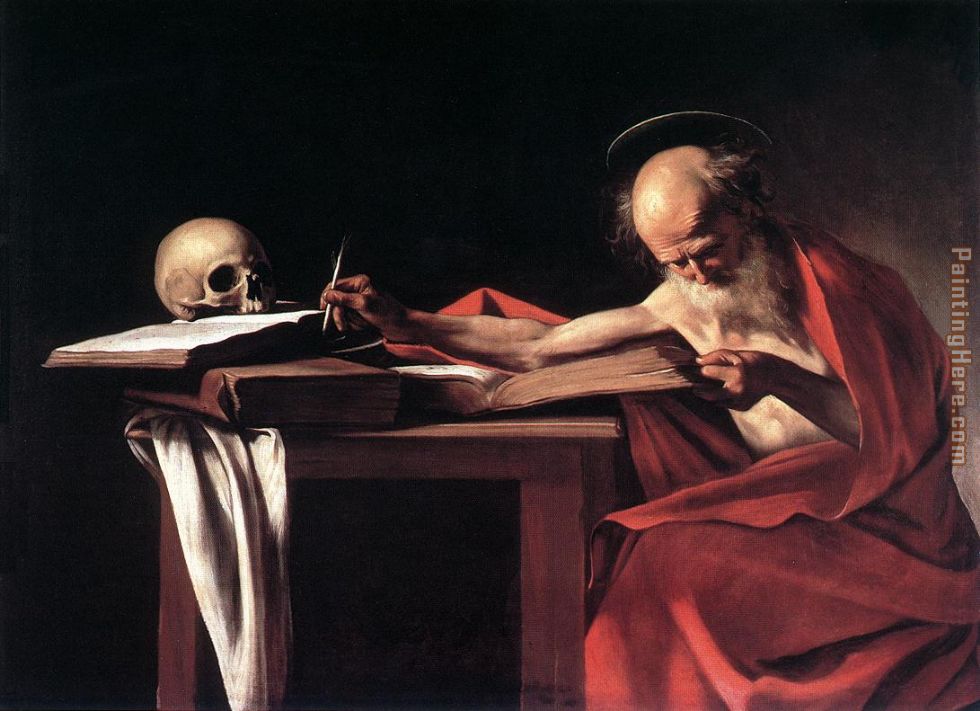
    (Caravaggio’s painting of St. Jerome, the man who led the effort to translate the Hebrew and Greek Bible into Latin)
    “Why do Catholics use another book in addition to the Bible? This seems wrong to me, just like Mormons using the Book of Mormon. (On that note, what do the Catholics think of the Book of Mormon?)” asks @MyTwoCentss. 
    It absolutely amazes me that this issue is consistently brought up in apologetics discussions between Catholics and non-Catholic Christians! I think there are two main problems that cause the constant tension here: one is a problem of not knowing history and the second is a matter of authority. The first problem is one that is beyond a lot of my own knowledge but there are good sources of information out there regarding the assembly of the canon of both the Old and New Testaments and then later attempts by Martin Luther and other Reformers to remove certain books from the Bible though they had been a part of it for many centuries. I would like to focus this post on the second problem, that being the issue of authority.
    Sadly I have heard not as a cheeky church joke but as a real experience that some preachers, being totally ignorant of history, have said from the pulpit, “If the King James Bible was good enough for Jesus (or Paul, Peter, etc.) then it should be good enough for us!” There are really some people who believe, more by ignorance than by any well-pondered decision, that the sky opened and the Bible descended from heaven, whole and entire. Well, start looking into the history and you’ll quickly learn otherwise! 
    Anyone looking at this history will begin unraveling a fascinating and complicated story of how the Bible, over the first few centuries of the Church, came to exist. There were many gospels, letters and other writings floating around Christendom, but even by the time of Irenaeus in the 2nd century the four Gospels we recognize today seem to have been pretty well universally accepted. But it probably wasn’t until the Synod of Hippo in 393 (a gathering of local churches from the surrounding area, therefore having implications only for those Christians and not the universal Church–yet!) that we begin to see a thorough canon of the Bible that looks like the one Catholics use today. The Councils of Carthage in 397 and 419 brought what was done previously at Hippo into the greater scope of the universal Church, and it is at this time, alongside St. Jerome’s efforts to translate–by the Church’s asking–the Old and New Testament writings into Latin, writings that while they were not “officially” set canonically, had already been generally accepted throughout the universal Church. While some books before these key times and afterward were disputed, still their importance and the sense of the faithful was such that they were nevertheless included and it wasn’t really until Martin Luther and other reformers began contesting them that the issue became a heated one again though it had rested for centuries. Interestingly the books Luther had the biggest problem with were precisely the ones that were giving his new theology and teachings the most trouble…
    At any rate, let’s put the history aside and just focus on those books of the Bible that Catholics and Protestants agree upon. 
    Both sides of the debate agree (praise God!) that God is the true Author of the Bible, inspiring men by the Holy Spirit to compose what they did. But if you look toward the front of any Bible you’ll notice at least one crucial bit of text that wasn’t written by a prophet, an evangelist or an apostle: the table of contents. You see, the Bible does not itself tell us what ought to be contained within it! Rather, it is only the authority of the Church given her by Christ through St. Peter, guided by the same Holy Spirit, upon which we can base our trust that if it is in the Bible it is meant to be there and if it isn’t in the Bible, then it oughtn’t be. 
    Think about it this way: Where did we learn that the Holy Spirit inspired Scripture, that what we are reading isn’t merely religious mythology but is the Word of God? Well two verses that come to mind are 2 Timothy 3:16 and 1 Thessalonians 2:13, in which St. Paul teaches precisely these things.
    But remember: the Gospels themselves likely weren’t written until the time between 68-110 AD while St. Paul likely wrote to the Thessalonians around 52 AD and to Timothy some years later; this means that when St. Paul is talking about the “scriptures” he is talking solely about the Old Testament, since they were the only scriptures that existed in his time! Yet all Christians believe that the New Testament as well was inspired by the Holy Spirit and is the Word of God. If St. Paul is only talking about the Old Testament, how did we come to expand his teaching to include the Gospels and even his own letters? 
    The Church.
    When you look at the Four Gospels, Catholic or not, you accept them as valid and belonging there in that Bible you hold. Nowhere does Matthew, Mark, Luke or John say, “God told me that this ought to be considered equal in importance and divine alongside the Jewish Scriptures.” Rather, the Church taught this, proclaimed it, and it was accepted by the faithful. The whole Bible–the “table of contents” if you will–is the product of the Church’s work and is based upon its own authority, entrusted to her by Jesus Christ. If you are not Catholic and you accept what books are in your Bible, even if there are some that were later removed or perhaps the order was switched around by someone’s preferences, you are basically saying, “As far as the presence of this text in this Bible is concerned, I accept the authority of the Catholic Church.” 
    Even when St. Paul teaches what he does about scripture, notice that he doesn’t say, “…and the Holy Spirit told me that this is the case.” No, he simply teaches. So, what; we are trusting that St. Paul knows what he is talking about? Of course we are to a degree, but it goes further; remember that he is an approved, bonafide apostle, sent by the CHURCH (as represented by Apostles like St. James, St. Peter, etc.) with the AUTHORITY to teach. We trust St. Paul ultimately because we trust the Church; if he was just some very charismatic guy with a good message he’d likely not have been included! Likewise we trust the Church that trusted St. Paul because we trust Christ who ALSO trusted His Apostles when He handed them the reins, if you will. 
    So when I look at Martin Luther and his treatment of the Bible, what crosses my mind? I see a man who, operating on his own, without any authority of his own (such as the authority that assembled the canon of the Bible in the first place) deciding what should go and what should stay. Now imagine if St. Paul was out doing things like Martin Luther, changing things and operating against the rest of the Church, even though there were practices and policies that were grating even him in those times (circumcision for example); would we have trusted his teachings at all? I certainly wouldn’t! For when I come across someone teaching about Christ and about the faith, I see unity with the Church as a sure sign that they are trustworthy. Again, in short, we know that Scripture is inspired not because of any divine revelation to us that it is so but because that is what the Church–through St. Paul and others throughout history–have taught us. If you trust the Bible, then whether you like it or not, then you trust the Catholic Church’s authority on the matter of its contents. After all, that same St. Paul teaches that we “should know how to behave in the household of God, which is the church of the living God, the pillar and foundation of truth” (1 Timothy 3:15). When I have a decision to make between trusting the Bible that the Church gives me or the Bible as Martin Luther has translated it and assembled it, I’m going to have to go with St. Paul and with history and chose the former.
    This connects, too, with the matter of the Book of Mormon. You see, the Bible is not a continued revelation of God; it is a closed matter. While the Holy Spirit can certainly reveal things about God to those who read it prayerfully or hear it proclaimed, no new scriptures will be written. You see, the Bible is a collection of writings written by those with authority to teach, be they a prophet, an apostle, etc. These men have since gone to their reward in heaven and are no longer writing; the Bible was written precisely so that their experiences and teachings could be preserved for the benefit of future generations. For a man named Joseph Smith to come along over fifteen hundred years after the final documents of the New Testament were written and claim that he had a third testament to add is highly suspect (not to mention the circumstances by which he claimed to receive inspiration for writing it, among other shady things about his story). Who gave him the authority to teach, and how is that authority rooted both in history and Christian tradition, and how are his claims supported by Scripture? I have the sense that he gets around these difficult questions by simply claiming all Christianity (including the Christianity by which he inherited any knowledge of Jesus and the Bible in the first place!) to be in apostasy, and with that said he could come up with anything he wanted. Granted, my knowledge of Mormonism is severely limited, but I wanted to at least touch on the matter a little, since it was part of the original question. 
    To answer the initial question, though, I would have to ask not why does the Catholic Bible add books, but why do Protestant Bibles remove them or reorder them so as to downplay their importance? What is their justification for doing so, and on who or what do they base their authority to do so?
     
  • Filler

    I was at the mall the other day and I saw this sign. I think I was the only person in the mall that found it funny, and I can’t decide if it is funny that the sign’s composer made a grammatical error or sad that no one seems to mind.


    I suppose many people are wearing their pants 40% off these days anyways.


    I hope to write up a quick post tonight before I REALLY go on vacation. Oy!

  • UPDATE

    THANK YOU ALL for your thoughts, prayers and support for my sister, who left the shores of Dover yesterday morning to make her attempt.


    SHE MADE IT! My sister swam the English Channel in 15 hours and 39 minutes, non-stop, never touching the boat!


    Now I imagine she will be taking a looooooooooong nap!

  • Mary, Mary Quite Controversial, Part III


    Finally, @pinktiger335 asked, “Why they (the Church) don’t mention the Virgin Mary too much but we have so much faith in her? And a lil about her appearances… like the one she made in Mexico with Juan Diego.”

    Having discussed two of the major doctrines regarding Mary, as well as her significance as highlighted by the New Testament, I hope to discuss some of the places we see Mary in the Church, chiefly the Mass and the Rosary.


    Mary in the Mass

    While she can be hard to pick out unless you are paying extra close attention, Mary makes several key appearances in the Liturgy. First I should mention, however, that I will only be speaking about the Liturgy of the Roman Church; I am not familiar enough with the beautiful rites of the other 22 Churches in communion with Rome save that they make my heart ache with how deep and powerful they are in their richness! I should say, I suppose, 21 of the other Churches since #22–those Anglicans who have entered into the Catholic communion recently (welcome home!!)–probably has pretty similar devotional practices regarding Mary. 

    In the Roman Rite, which is by far the most popular and recognizable way that the Mass is celebrated throughout the world, finds its origins in the way the Eucharist was celebrated in the Church of Rome and was carried out along the Roman highways all over the western world. The Mass that you would likely find if you stepped into a Catholic Church on any given day (yes, daily Mass!) will bring Mary into the celebration in the following usual ways:


    First, if it happens to be a Marian Feast Day such as the Solemnity of Mary, Mother of God on January 1st, the Annunciation on March 25th, the Assumption on August 15th, etc., you may very well begin Mass singing a song that features Mary. Heck, you may even walk into a church named in her honor, as was the name of the parish I was baptized in as well as the parish I grew up in (a different town, too) and later received First Communion, First Reconciliation and Confirmation!

    Ordinarily, however, Mary’s first appearance comes during the Penitential Rite when, after we have all greeted one another, we take time as a congregation not only to think about our sins but to confess, publicly and to one another, that we have indeed sinned and only Christ can do anything about it. Every man, woman, child (who can) and even the priest(s) say aloud:

    “I confess to almighty God, and to you, my brothers and sisters, that I have sinned through my own fault in my thoughts and in my words, in what I have done, and in what I have failed to do; and I ask blessed Mary, ever-virgin, all the angels and saints, and you, my brothers and sisters, to pray for me to the Lord our God.”

    Right away we seek, even before and above the other saints and the angels, the prayers and intercession of Mary, our mother. Remember in the previous post that she is the mother of the Church, the mother of every Christian. Remember also her important role at Cana when she demanded Jesus to do something for the poor people at the wedding feast, and He absolutely did it! Even the Gospel here attests to the power of Mary’s intercession, for in becoming human Jesus became subject to the Commandments as well and He will always, always honor His mother. This does not mean that we need not go to Jesus with our prayers and requests; this simply means that we may, if we wish, if it helps us even more so to love Christ, to know Him (who better to teach us than the woman who raised Him?), seek the help of Mary. When we honor Mary, remember, we honor Him as well! So, yes; here in the first part of the Mass we are already entering into that “cloud of witnesses” of which St. Paul wrote (Heb. 12:1), seeking the help, prayers and love of our heavenly mother and our many brothers and sisters, renewing the covenant of our baptism, washing our garments in the blood of the Lamb once again so that a “perfect offering may be made to the glory of His name” (a later part of the Mass, at the end of the Offertory). 

    Next Mary may, depending upon the day, appear in the readings. She is mentioned directly in Acts remember, as well as the Gospel, but even St. Paul refers to her indirectly at least one time when he speaks of Jesus being “born of a woman, born under the law” (Gal. 4:4). Sometimes the psalm in between readings may be a musical arrangement of Mary’s Magnificat. The subsequent homily may of course make reference to Mary, too.


    Mary’s next appearance comes during the Creed, which normally is only recited on Sundays and feast days. The Creed is not only a public profession of what are the basic, non-negotiable beliefs of the Church and thus (hopefully!) our own beliefs, but they tie us in with our history; Catholics are a people, like their Jewish predecessors, that remember where they came from. In addition to our history as we just recalled in the readings of the day the Creed takes us back to our persecuted origins, our martyr beginnings, as well as showing us in a nutshell how God–Father, Son and Holy Spirit–labored for our salvation. Mary is, quite literally, at the very heart of the Creed:

    “For us men (meaning mankind here, not just men and not women!) and for our salvation he (meaning the Son) came down from heaven: (here we all bow our heads in honor of the Incarnation of God, the greatest moment in all of human history) by the power of the Holy Spirit he was born of the Virgin Mary, and became man.” 


    During the Liturgy of the Eucharist Mary again appears. Depending again on the feast day, or even on occasion during Ordinary Time, she may appear mentioned in the preface prayer (the prayer right at the beginning of the Liturgy of the Eucharist), for example this preface for Sundays in Ordinary Time:

    “Father, all-powerful and ever-living God, we do well always and everywhere to give you thanks through Jesus Christ our Lord. Out of love for sinful man, he humbled himself to be born of the Virgin. By suffering on the cross he freed us from unending death, and by rising from the dead he gave us eternal life. And so, with all the choirs of angels in heaven we proclaim your glory and join in their unending hymn of praise:”

    And then we burst into the “Holy, Holy, Holy…” It isn’t every day you get to sing along with the whole choir of heaven using the same words they are! 

    On the Feast of the Annunciation the preface prayer mentions: “He came to save mankind by becoming a man himself. The Virgin Mary, receiving the angel’s message in faith, conceived by the power of the Spirit and bore your Son in purest love.” 

    On the Feast of the Assumption is perhaps my favorite preface prayer in which Mary appears: “Today the virgin Mother of God was taken up into heaven to be the beginning and the pattern of the Church in its perfection, and a sign of hope and comfort for your people on their pilgrim way. You would not allow decay to touch her body, for she had given birth to your Son, the Lord of all life, in the glory of the Incarnation…”


    After the Sanctus fades away we enter into the Eucharistic Prayer, generally one of four prayers. Mary appears in all four of them in different places. 

    One thing I love about the first Eucharistic Prayer, one that often is used on big feast days or the feast days of martyrs, is that it ties us in again with our roots. We see Mary in this prayer at the head of a whole army of martyrs:

    “ In union with the whole Church we honor Mary, the ever-virgin mother of Jesus Christ our Lord and God. We honor Joseph, her husband, the apostles and martyrs Peter and Paul, Andrew, James, John, Thomas, James, Philip, Bartholomew, Matthew, Simon and Jude; we honor Linus, Cletus, Clement, Sixtus, Cornelius, Cyprian, Lawrence, Chrysogonus, John and Paul, Cosmas and Damian and all the saints. May their merits and prayers gain us your constant help and protection.”

    In Eucharistic Prayer II, probably the most commonly-used of the four, the priest says to the Father, we similarly see her in relation with the rest of the saints in heaven, as well as her role in praying for we living pilgrims here on earth: 

    “Remember our brothers and sisters who have gone to their rest in the hope of rising again; bring them and all the departed into the light of your presence. Have mercy on us all; make us worthy to share eternal life with Mary, the virgin Mother of God, with the apostles, and with all the saints who have done your will throughout the ages. May we praise you in union with them, and give you glory through your Son, Jesus Christ.”

    Eucharistic Prayer III is very similar but reminds us that we, too, are meant to share in a similar life as she, remind us as well of her important role as help and intercessor:

    “May he (Jesus) make us an everlasting gift to you and enable us to share in the inheritance of your saints, with Mary, the virgin Mother of God, with the apostles, the martyrs, and all your saints, on whose constant intercession we rely for help.”

    The fourth Eucharistic Prayer reminds us not only of all the above but really, I feel, of Mary our Mother and how we hope to be with her and everyone else in heaven, in her “company” as the prayer asks:

    “Remember those who take part in this offering, those here present and all your people, and all who seek you with a sincere heart. Remember those who have died in the peace of Christ and all the dead whose faith is known to you alone. Father, in your mercy grant also to us, your children, to enter into our heavenly inheritance in the company of the Virgin Mary, the Mother of God, and your apostles and saints. Then, in your kingdom, freed from the corruption of sin and death, we shall sing your glory with every creature through Christ our Lord, through whom you give us everything that is good.”


    After the Liturgy of the Eucharist, the Our Father, Agnus Dei, communion and such, Mary would only appear again either in the music or perhaps in the closing prayer, as always depending upon the occasion. As the saying goes “lex credendi, lex orandi;” in English, basically, “the Church believes as she prays,” so you can see that the prayers of the Church are not only prayers but professions of faith. So if you really want to find out what the Church believes regarding Mary, come to Mass and pay attention!


    Christ’s Mother, Our Mother: the School of the Rosary


    The Rosary is perhaps the most popular and most recognizable devotional practice of the Catholic Church. It has almost become synonymous with Catholicism and I have heard old stories that Martin Luther even had a strong devotion to Mary and to praying the Rosary, and that he prayed it even while on his death bed. Really if you look at the casts of his hands that accompany his death mask, it seems to me that he was doing precisely that, holding the Rosary in his right hand while keeping track of the beads with his left:

    So what is the Rosary? Without going into the stories and legends of its origins I will focus primarily on “what it does,” and what it does is it teaches you about the life of Jesus Christ and, through the patient instruction of the one person in the entire world who knew Him best, teaches you to see Him more clearly, love Him more dearly and follow Him more nearly (words popularized for certain by Godspell but first attributed to an English saint and even referred to by St. Ignatius of Loyola in his Spiritual Exercises!). 

    Most people think of the Rosary and think also of so many Our Fathers and so many Hail Marys (itself a very scriptural prayer!). Well, yes and no. These prayers, I feel, serve two primary purposes: first, to honor God our Father as well as to honor the Incarnation and second to help dispose our minds to contemplating the life of Christ. They are (especially the Hail Marys) like background music to the real prayer of thinking and praying very deeply upon the matter of Jesus’ life, passion, death and resurrection.

    The Rosary is not merely a series of rote prayers but an opportunity to mediate on four sets of Mysteries: the Joyful, the Luminous, the Sorrowful and the Glorious. Each category breaks down into five mysteries of Christ’s life as follows, the contemplation of which is “set” to ten Hail Marys apiece:

    The Joyful Mysteries: The Annunciation (Lk. 1:26-38), the Visitation (Lk. 1:39-56), the Nativity (Lk. 2:1-20, Mt. 2:1-11), the Presentation of Our Lord at the Temple (Lk. 2:21-40) and the Finding of Our Lord in the Temple (Lk. 2:41-52).

    The Luminous Mysteries: The Baptism of Our Lord (Lk. 3:21-22, Mt. 3:13-17, Mk. 1:9-11, Jn. 1:29-34), the Wedding at Cana (Jn. 2:1-11), the Proclamation of the Kingdom (Mk 1:15, 2:3-13, Lk. 7:47-48, Lk. 4:16-21), the Transfiguration (Lk. 9:28-36), and the Institution of the Eucharist (Lk. 22:15-20, Mt. 26:26-29, Mk. 14:22-25).

    The Sorrowful Mysteries: The Agony in the Garden (Mt. 26:36-46), the Scourging at the Pillar (Lk. 22:63-65, Jn. 19:1, Isaiah 52:14-15), the Crowning With Thorns (Mt. 27:27-30, Jn. 19:2-5), the Carrying of the Cross (Lk. 23:26-32, Mt. 27:31-34, Mk. 15:20-24, Jn. 19:16-17), and the Crucifixion (Jn. 19:18-30, Mk. 15:25-37, Mt. 27:28-50, Lk. 23:33-46).

    The Glorious Mysteries: The Resurrection (Lk. 24:1-12, Mt. 28:1-10, Mk. 16:1-7, Jn. 20:1-17), the Ascension (Acts 1:6-11), the Descent of the Holy Spirit (Acts 2:1-4), the Assumption of Mary (Rev. 11:19-12:1), the Coronation of Mary as Queen of Heaven (Rev. 12:1 again, Genesis 3:14).

    As you can see, the Rosary is quite Scriptural! Very nearly every mystery here can be found in Scripture, and contemplating each mystery in silent prayer or even communal prayer can only help you better to know Jesus and to imitate His example. I believe the close association of the Rosary to Mary is primarily because she was present with Christ at every step, from the Annunciation through His public ministry, from the Passover (surely He would celebrate the Passover with His mother for crying out loud!) all the way to the Cross, rejoiced with the apostles at His resurrection (many ancient beliefs professed that after His rising He first went to see His mother), and was present in the Upper Room at Pentecost. You cannot separate Mary from the Gospel or from Christ; to contemplate the life of one is to contemplate the life of the other!

    Finally the Rosary ends with a beautiful prayer:

    “Hail Holy Queen, mother of mercy, our life, our sweetness and our hope. To thee do we cry, poor banished children of Eve, to thee do we send up our sighs, mourning and weeping in this valley of tears. Turn then, most gracious advocate, thine eyes of mercy toward us; and after this our exile show unto us the blessed fruit of thy womb, Jesus. O clement, O loving, O sweet Virgin Mary!”

    You see, she is indeed our Queen if she is the Mother of our King; the Queen-Mother, in fact! She is the mother of mercy, for she gave birth to our Merciful Lord; mother of our life for only through Jesus do we come to have life; mother of our sweetness for without Christ life is drab and wearisome; and mother of our hope because without Christ, we have none whatsoever.


    (In the interest of time and the length of this post already, I’m afraid I’m going to forgo touching upon various Marian Apparitions…)

    I hope that this series on Mary has proved enlightening, interesting and helpful! As you can see, Mary is extremely important in the lives not only of Catholic Christians, but ought to be vital for every Christian. While Catholics are often told that our Marian doctrines are made-up, un-biblical and utter nonsense I hope that such people can see more clearly that they are not that at all but, considering what all true Christians believe about Christ, we can come to know a great deal about Mary that must be true, and while her Immaculate Conception and Assumption are not explicitly stated in Scripture, neither does Scripture deny them. We also can see in the Gospel itself how important Mary truly is; we see this in the parallel with Genesis as Jesus becomes the New Adam and reestablished the entire human race as the Chosen People of God. Finally we see that Mary plays an important role in the worship and devotional life of the Church, but always in order to help us better know and love Jesus Christ, keeping the focus always upon Him and never herself, that her soul might always “proclaim the greatness of the Lord!”


    NOTE: I will be on vacation until August 13th, so I won’t be able to update until after then! I think, however, that this entry and the previous offer a lot for you all to ponder, so please do spend some time with them! Next I hope to move on to the next most popular inquiry regarding *gulp* Purgatory!

  • Mary, Mary Quite Controversial, part II

    This (apparently massive) post will continue on to the following request left in the comments of Part I (thank you all, by the way, for the generous response!), as suggested by @OutOfTheAshes:

    “I’d love if you addressed Jesus’ own comments about Mary. Mary doesn’t make all that many appearances in the Gospels, and several times when she does, Jesus seems to downplay her role (as in Mark 3:32-35 or Luke 11:27-28). The Church’s emphasis on the role of Mary always seemed to me to be at odds with his statements, which seem to place her no higher than any who “does the will of my Father.”

    Don’t worry @pinktiger335; your questions will be addressed in Part III! I realized that, in light of the above request, it might be worthwhile to go through some Scripture and talk about the importance of Mary so that once we start talking about her place in the life of the Church, we can see at least how important she is in the Gospels and (gasp!) the Book of Acts.


    Mary first appears in the Gospel in Matthew 1:16 as part of Christ’s genealogy: “…Joseph, the husband of Mary. Of her was born Jesus who is called the Messiah.” 

    This should tell us right away that Mary is incredibly important. INCREDIBLY important! After all, if it wasn’t for Jesus being the Messiah, why would the author of Matthew write anything further? And note that King David–whose presence in Christ’s genealogy is crucial for the sake of prophecy–does not have his mother mentioned at all! Also, back in that time what was most important when it came to ancestry was who your father was, and his father, and so on. Here we see the break; Joseph is not the father of Jesus. But MARY is His MOTHER, as we are reminded in v. 18.

    She appears two verses later when the evangelist basically tells us what we just saw at the end of the genealogy: that Mary is the mother of the long-awaited Messiah and “Joseph her husband, since he was a righteous man, yet unwilling to expose her to shame, decided to divorce her quietly” (v. 19). Thankfully, an angel put a stop to that. But if he was truly righteous (which he must have been if it was noted in the Gospel!) he would be utterly in awe when he was told that his wife, this virgin girl from Nazareth, was pregnant with the Messiah that he and that long genealogy of ancestors we just read had been waiting for. So of COURSE he took her into his home and did not divorce her; to divorce her would be to divorce the Messiah, too. 

    Next we see her in chapter 2, verse 11 when the Magi come to visit and “they saw the child with Mary his mother.” One would think that, considering the culture of the time, the Magi (kings or at least foreign dignitaries) would have dealt directly with the man of the house, Joseph. But we don’t hear about Joseph until the angel tells him to “Rise, take the child and his mother, flee to Egypt,  and stay there until I tell you” (v. 13). From here on (I think) Mary is no longer referred to as Joseph’s wife, but Jesus’ mother. Remember, too, how incredulous people in Jesus’ hometown would later refer to Him as “the son of Mary” (Mt. 13:65, Mk. 6:3).

    Mary makes a big entrance in Luke’s Gospel as well when the archangel Gabriel, sent by God to speak on GOD’S behalf–the angel’s words were not his own, but God’s mind you–says, “Hail Mary, full of grace! The Lord is with you!” (1:28). Incredible! God, though an angel, is HAILING HER and saying “I am with you!” And when the angel relays to her God’s plan for the salvation of the world, she delivers–by the special grace of her afore-discussed sinless state in Part I of this blog–a “yes” that echoed across the whole world and changed human history for all time. Then her relative, Elizabeth, calls her “most blessed among women” (1:42) before Mary launches into a beautiful “it-isn’t-about-me” exclamation, a true magnificat that reminds us an essential truth that the Church teaches though many forget it: the Church’s devotion towards and reverence of Mary is not about Mary, but rather about her Son. In her magnificat (vs. 46-55) Mary tells us this in her own words.

    Note, too, in Luke’s second chapter when the shepherds came it was Mary who kept the incident in her heart, and at Jesus’ circumcision it was to her, not Joseph, that Simeon spoke (vs. 34-35). Then when they finally find Jesus in the temple twelve years later, it is Mary who speaks to Him and expresses the anxiety she and Joseph felt and it was also her who treasured His upbringing in her heart; Joseph and his memory of those years aren’t mentioned at all. It seems, looking at the synoptic Gospels, that Mary was not only important, but her words, actions and even her EMOTIONS were worthy of note. But it is in John’s Gospel, I would say, that Mary begins to take on an even greater importance in the life of the Church.


    I am sure that most people who read the beginning of John’s Gospel think instantly of the Book of Genesis:

    “In the beginning, when God created the heavens and the earth, the earth was a formless wasteland, and darkness covered the abyss, while a mighty wind swept over the waters. Then God said, “Let there be light,” and there was light. God saw how good the light was. God then separated the light from the darkness. God called the light “day,” and the darkness he called “night.” Thus evening came, and morning followed–the first day” (Genesis 1:1-5)

    “In the beginning was the Word, and the Word was with God, and the Word was God. He was in the beginning with God. All things came to be through him, and without him nothing came to be. What came to be through him was life, and this life was the light of the human race; the light shines in the darkness, and the darkness has not overcome it” (John 1:1-4)

    What happens when we carry on with this pattern? We see a second  day (v. 29) when John sees Jesus and says, “Behold the Lamb of God!” and recounts his baptism of the Messiah (notice the references to the sky and water, similar to Genesis: Day 2!) , as though everything previous to that moment was a long, primordial “first day.” In verse 35 we are told of yet a third day when John dispatches two of his disciples to go follow that Lamb, and verse 43 again tells of a fourth day when Jesus goes to Galilee and finds a few more disciples, including Nathan. 

    Looking back to the third and fourth days of Creation in Genesis we see that on the third day all the fruit-bearing trees come into existence; what does the Gospel note with unusual specificity is the particular type of tree that Jesus finds Nathaniel under on the “fourth day?” A fig tree. But the relevance of that find is that it happened on the fourth day, the day during which Genesis tells us that:

    “…God said: “Let there be lights in the dome of the sky, to separate day from night. Let them mark the fixed times, the days and the years, and serve as luminaries in the dome of the sky, to shed light upon the earth.” And so it happened: God made the two great lights, the greater one to govern the day, and the lesser one to govern the night; and he made the stars. God set them in the dome of the sky, to shed light upon the earth, to govern the day and the night, and to separate the light from the darkness. God saw how good it was. Evening came, and morning followed–the fourth day” (v. 14-19).

    Now, what does John says Christ is a little earlier in his Gospel? “What came to be through him was life, and this life was the light of the human race; the light shines in the darkness, and the darkness has not overcome it…The true light, which enlightens everyone, was coming into the world. He was in the world, and the world came to be through him, but the world did not know him” (vs. 3-5, 9-10). You see, before that “fourth day,” Nathaniel lay beneath that tree in darkness but once the “true light” came into the world and shone upon him, that is when he began to see clearly, and suddenly the world truly came to be; the fifth and sixth days all mash together and this chapter ends with Nathaniel referring to Jesus as “the Son of God” (v. 49) and Jesus refers to Himself as “the Son of Man” (v. 51), both of which remind us of Adam who came into being on the sixth day of Creation (see Luke 3:38 and, of course, “son of man” means “son of Adam!”). Thus we see Jesus as the New Adam (see Romans 5:14, 1 Cor. 15:22, 45), fully revealed to us to the world not only as the Messiah or even as the Son of God (as John testified earlier) but also the Son of Man, a human being.

    ALL THAT to arrive at Cana in John chapter 2 and, yes, this has everything to do with Mary, too! 

    Genesis 2:1-2 tells us “Thus the heavens and the earth and all their array were completed. Since on the seventh day God was finished with the work he had been doing, he rested on the seventh day from all the work he had undertaken.”

    John 2:1-2 tells us “On the third day there was a wedding in Cana in Galilee, and the mother of Jesus was there. Jesus and his disciples were also invited to the wedding.” Remember in John 1 we saw four days? This is three days later; the seventh day. What is Jesus doing after all His work rounding up His disciples and preparing to build up His Church? He’s relaxing at a wedding celebration with His family and friends.

    But then, crisis! The newlyweds have run out of wine; their day of bliss and plenty is in jeopardy! Likewise if we skip past the retelling of Creation in Genesis 2:4-25 we come to the crisis of the seventh day when the serpent appears and claims that while God may have provided everything for their life of bliss on the eternal Sabbath, He’s holding back. In both crises we see the women in the spotlight; they are the ones who come to know about the crisis and make the first move. Paul describes the actions of the latter woman well in his first letter to Timothy when he writes, “Further, Adam was not deceived, but the woman was deceived and transgressed (2:14). What did Mary, the woman in John’s “New Genesis” do?

    John 2:3-5 “When the wine ran short, the mother of Jesus said to him, “They have no wine.” (And) Jesus said to her, “Woman, how does your concern affect me? My hour has not yet come.” His mother said to the servers, “Do whatever he tells you.”

    We see here that instead of trying to solve this crisis on her own, Mary goes straight to God. As one ancient Christian writer said, “Mary’s obedience undid the knot of Eve’s disobedience.” Some people, as @OutOfTheAshes began to point out, see Jesus’ response of “woman” as Him downplaying the importance of His mother. However, when we look back at Genesis to the creation of Eve, what do we find?

    “This one, at last, is bone of my bones and flesh of my flesh; This one shall be called ‘woman,’ for out of ‘her man’ this one has been taken” (2:23).

    John calls this to mind when Jesus looks at His mother, she who is coming on behalf of the troubled and sorrowing, and calls her “woman;” here we see the New Adam naming the New Eve! And look at the beautiful reversal here, where it is in fact MARY that could say of Jesus, “This one, at last, is bone of my bones and flesh of my flesh; This one shall be called ‘the New Man,’ for out of ‘His woman’ this one has been taken.” Instead of man and wife becoming one flesh (Genesis 2:24), were not Jesus and Mary one flesh during her pregnancy? Were they not completely revealed to one another, feeling no shame (Genesis 2:25)? We see, then, that Jesus calling His mother “woman” is not snippy or insulting at all but rather a tremendous honor and an awe-inspiring revelation to us. But a revelation of what?

    Fast forward from this beautiful day of rest to John 12:1. The evangelist notes that Jesus’ journey to Jerusalem begins by his return to Bethany where he had raised Lazarus from the dead, after which He went to hide out in a town called Ephraim (11:54). This return to Bethany and the beginning of His one-way trip to Calvary, occurs “six days before Passover;” literally six days before He would die. What do we see, then, six days later?

    John 19: “Standing by the cross of Jesus were his mother and his mother’s sister, Mary the wife of Clopas, and Mary of Magdala.”

    We see the New Eve standing beneath the New Tree–the Cross–and looking upon the very Fruit of her Womb (Luke 1:42), now hanging above her head. Whereas the first Eve “saw that the tree was good for food, pleasing to the eyes, and desirable for gaining wisdom” (Genesis 3:6), the Cross before Mary likely was seen by many as a tree of death, a horrific sight and a testimony to the folly of a foolish man.

    So there she stands, the mother of Jesus, and again the New Adam speaks to the New Eve…

    “When Jesus saw his mother and the disciple there whom he loved, he said to his mother, “Woman, behold, your son.” (v. 26)

    Do you remember Cain and Abel, when the first Eve lost her son? Soon enough she received Seth and what was it that she said?

    “God has granted me more offspring in place of Abel,” she said, “because Cain slew him.” (Genesis 4:25)

    Jesus (GOD!) grants Mary another son in place of Himself, her son who (remember Abel’s offering in Genesis 4:4!) was offering Himself as a lamb to God, who was likewise brutally slain.” This beloved disciple is the first of many children; just as it was through Seth that the whole line of men would spring up from which would come the Messiah Himself (Luke 3:23-38) so this disciple was the first entrusted to the motherhood of Mary, the New Eve, the new mother of the new humanity of which that disciple was the first member. Where are the rest? Now we leave John and move ahead to Acts, written (as has long been believed) by the same author of Luke’s Gospel.

    After God rested on the seventh day (that terrible, dark day when Jesus lay dead in the tomb!), and after Jesus had appeared to them several times, the Book of Acts tells us that they returned to Jerusalem and “when they entered the city they went to the upper room where they were staying, Peter and John and James and Andrew, Philip and Thomas, Bartholomew and Matthew, James son of Alphaeus, Simon the Zealot, and Judas son of James. All these devoted themselves with one accord to prayer, together with some women, and Mary the mother of Jesus, and his brothers” (Acts 1:13-14). 

    Notice here that in that time of fear, hiding out in the Upper Room (see John 20:19), Mary the mother of Jesus was with them; it seems like she has been given more children since that beloved disciple! See here as well the primordial Church, the Mystical Body of Christ, beginning to be formed from the dust. Then, once all the dust is collected with the election of Matthias to take over for Judas, new life is breathed into that dead body and the Mystical Body of Christ–the Church–is born! 

    What about Mary? Here is something amazing: remember in the beginning of Luke’s Gospel when Jesus is conceived? Gabriel says to her in Luke 1:35 that “”The holy Spirit will come upon you, and the power of the Most High will overshadow you. Therefore the child to be born will be called holy, the Son of God.” Later in Acts Luke, when describing the Holy Spirit at Pentecost, uses this same image of the Holy Spirit descending upon the fledgling Church and suddenly the children of God are born into the world, Mary there in their midst when it all happens. Not only is she the mother of Jesus, but also of the Mystical Christ, alive in His Church. And no, we haven’t stopped looking at Genesis! While Luke did not use a lot of Genesis imagery (in fact I can’t think of any!) in either of his texts (his Gospel and Acts), what happens after this “rebirth” of Christ into the world reminds me of Genesis 4:26…

    “To Seth, in turn, a son was born, and he named him Enosh. At that time men began to invoke the LORD by name.”

    At Pentecost we see Mary, formerly only the mother of Jesus, then the mother of the beloved disciple, then the mother of them all, now come fully into her motherhood of Christ both really as well as mystically, and we see that her “Seth” was the first of many “Enosh’s” and it was upon the birth of all those children into the world, by the Holy Spirit, that men began to evoke the LORD by name–the name of Jesus Christ.


    For if the Church truly, really, is Christ’s Body–in other words, the Church = Christ–is not Mary truly His mother, as the Gospels attest time and time again? By virtue of her motherhood of Christ both by giving birth to Him but then being entrusted with His Mystical Body just before His death, she is also the mother of the  Church, of each and every baptized Christian. 

    My Christian brothers and sisters, Catholics and non-Catholics alike, if you are baptized you belong to Christ’s Body; you are a part of Him. If by Him you have come to have a Father in God just as He has a Father, then by virtue of the same you also come to have a mother, just as He does. We can see this in the Gospels, as I’ve tried to illuminate here. She is the mother of Jesus to whom we belong; she is the New Eve of the New People of God. Hopefully by all of this you begin to see why she plays such an important role in the life of the Church and has since ancient times. 

  • Mary, Mary, Quite Controversial (Part I)

    @pinktiger335 asked, “Why they don’t mention the Virgin Mary too much but we have so much faith in her? And a lil about her appearances… like the one she made in Mexico with Juan Diego.

    On a similar topic @DraculVanHelsing asked, “Also maybe a couple of posts on the Marian dogmas of the Catholic Church- the Immaculate Conception and the Assumption as I’m always being asked by my Protestant friends about those 2 doctrines.”


    It was when I was a student at the University of Northern Iowa that I was first called a “Marian worshipper,” and ever since then whenever I enter into an apologetics dialogue with another Christian or am “attacked” for being Catholic, the first stone flung against Catholicism is aimed right at poor Mary’s head. So I thought that as I go about offering my thoughts as they relate to your previously-asked questions, I would start with Mary since she tends to be, for some reason, so controversial. My goal is not to convince anyone of anything mind you, but merely to offer my thoughts and, where I can, the teaching of the Church for the benefit of those who did not know anything before and those who want to know a bit more. Oftentimes those same people who charge me with worshiping Mary are surprised when I tell them that, yes, I would be just as angry about someone worshiping Mary as they are because, in fact, Catholics do not worship Mary.

    To go about this I will try and address DraculVanHelsing’s questions as best I can and then talk about Mary’s role in the prayer and devotional life of the Church, followed by some of her better-known appearances at Guadalupe, Lourdes and Fatima in part II.


    The New Eve: the Doctrine of the Immaculate Conception of Mary

    It is so fitting that I would at least start writing this post on the Feast of Joachim and Anne, traditionally believed to be the parents of Mary.

    What is the basic idea of this doctrine of the Immaculate Conception? Basically that Mary was conceived without Original Sin. Here’s a synopsis of the teaching straight from the Catechism:

    490: To become the mother of the Savior, Mary “was enriched by God with gifts appropriate to such a role.” The angel Gabriel at the moment of the annunciation salutes her as “full of grace.” In fact, in order for Mary to be able to give the free assent of her faith to the announcement of her vocation, it was necessary that she be wholly borne by God’s grace.

    491: Through the centuries the Church has become ever more aware that Mary, “full of grace” through God, was redeemed from the moment of her conception. That is what the dogma of the Immaculate Conception confesses, as Pope Pius IX proclaimed in 1854: 

    “The most Blessed Virgin Mary was, from the first moment of her conception, by a singular grace and privilege of almighty God and by virtue of the merits of Jesus Christ, Savior of the human race, preserved immune from all stain of original sin.”

    492: The “splendor of an entirely unique holiness” by which Mary is “enriched from the first instant of her conception” comes wholly from Christ: she is “redeemed, in a more exalted fashion, by reason of the merits of her Son.” The Father blessed Mary more than any other created person “in Christ with every spiritual blessing in the heavenly places” and chose her “in Christ before the foundation of the world, to be holy and blameless before him in love.”

    493: The Fathers of the Eastern tradition call the Mother of God “the All-Holy” (Panagia) and celebrate her as “free from any stain of sin, as though fashioned by the Holy Spirit and formed as a new creature.” By the grace of God Mary remained free of every personal sin her whole life long.


    The first charge often thrown at this teaching is that it isn’t found in Scripture and is therefore made up. However, a Scriptural basis for the Trinity is a bit fuzzy as well, so let us not jump the gun!

    We recall that when the archangel Gabriel appears to Mary and speaks to her on God’s behalf, he says, “Hail Mary, full of grace!” So we see right off that this Mary is considerably special, for the angel is not speaking his own message here, but God’s; through the angel, God Himself is saying, “Hail Mary, full of grace!” In the Greek the word for “full of grace” is kecharitomene which literally means “having been blessed” or “having been filled with grace,” implying that the angel is referring to something that has already taken place as opposed to something that is happening in that very same moment or will happen soon. Likewise the Church points out in this first paragraph that in order to give that complete “yes” to God’s will, she would need to be completely and perfectly in the grace of God; would a sinner be able to give the perfect, complete consent needed to conceive the very Word of God not only in her heart and mind, but in her very body?

    Let us continue on with the following general rule: when you are learning about something the Church teaches regarding Mary, realize that everything the Church believes, knows or teaches about Mary comes from what the Church believes, knows or teaches about Jesus Christ.

    Working on this presupposition, then, we can move on to the second paragraph which quotes Pope Pius IX’s proclamation. The importance of Mary’s unfallen nature is because of Christ’s sinlessness; remember that original sin–our fallen human nature–is an inherited condition! Jesus was conceived in Mary’s womb as a single-cell, attached to the wall of her uterus and all that just as you and I did at one time; save for His miraculous conception everything else went as normal. The immaterial God took His flesh, His human nature from Mary; if she was “just a sinner like everyone else” as some Christians contend, then Jesus would inherit that sin from her as well. 

    “Not so fast!” they tell me, “for couldn’t Christ have been conceived immaculately? Why did it have to be her?” True, I suppose He could have conceived Himself immaculately and been born of a sinner without Himself being one, but realize a few things here. First in becoming human God subjected Himself to His own laws, including the commandment to honor one’s father and mother as well as loving another as you love yourself, etc. What better way to honor His mother than to save her from sin the moment she was conceived? After all, God is unique among all that He created His own mother; would not a loving God who was to take on flesh for the redemption of all people not start first with His mother? Notice, too, that the Church does not teach she was conceived free of sin because of anything she did or was about to do; she was saved by Jesus Christ just as we all are save for the fact she was saved in her first moment. Likewise if it is Jesus Christ that saves us from sin, then if He conceived Himself immaculately we would see Him basically saving Himself. Does this seem like something He would do considering He refused obstinately to do so when captured by the officials of Jerusalem and beaten, or when He refused to come down off of the Cross? I think not! But would Jesus save His own mother? I think so, and so have Christians for a very long time! And this is what paragraph three is getting at. 

    Finally in paragraph four the Church holds up the example of our ancient Eastern brethren, stating also that Mary not only began sinless, but ended sinless as well. This only makes sense given what we’ve previously discussed; had she fallen into sin later she would not have been able to give her perfect consent to the will of God at the Annunciation, and who could possibly sin with the Son of God in their very womb, in their home? And remember, too, that she was very much the mother of Christ in every sense of the word “mother;” she nursed Him, clothed Him, burped Him, bathed Him and, yes, taught Him right and wrong. Would you trust a sinner to teach the little Jesus right from wrong? And if you think that little Jesus just knew such things because He is the Son of God so we needn’t worry about it, then why would the Devil bother tempting Jesus in the desert? Just a thought…


    Besides all of this we must also remember that Mary’s Immaculate Conception is not all that much an aberration; after all, where not Adam and Eve conceived without original sin? Granted they were crafted by the very hand of God but remember that human beings, truly, were meant to be free of sin period. Mary is simply a human being as human beings were always meant to be; in fact there is an ancient, ancient tradition in which Jesus is seen as the New Adam (hinted at in 1 Cor. 15:45-49). Paired with this tradition is seeing Mary as the New Eve; for example Justin Martyr states around the year 155AD:

    “[Jesus] became man by the Virgin so that the course that was taken by disobedience in the beginning through the agency of the serpent might be also the very course by which it would be put down. Eve, a virgin and undefiled, conceived the word of the serpent and bore disobedience and death. But the Virgin Mary received faith and joy when the angel Gabriel announced to her the glad tidings that the Spirit of the Lord would come upon her and the power of the Most High would overshadow her, for which reason the Holy One being born of her is the Son of God. And she replied, “Be it done unto me according to your word” (Luke 1:38) (Dialogue with Trypho 100).

    Similarly St. Ambrose (a Doctor of the Church no less!) wrote in the fourth century:

    “See how the selfsame knots that were tied in condemnation are now undone, and how the old footprints are trodden again in the work of salvation: Adam was from the virgin earth, Christ from a virgin; Adam was made in the image of God, Christ is the image of God…; folly came from a woman, wisdom from a virgin; from the tree came death, from the Cross came life.”


     A Safe Assumption

    From here we can move on to the Doctrine of Mary’s Assumption into Heaven. Again the Catechism offers:

    966 ”Finally the Immaculate Virgin, preserved free from all stain of original sin, when the course of her earthly life was finished, was taken up body and soul into heavenly glory, and exalted by the Lord as Queen over all things, so that she might be the more fully conformed to her Son, the Lord of lords and conqueror of sin and death.”The Assumption of the Blessed Virgin is a singular participation in her Son’s Resurrection and an anticipation of the resurrection of other Christians:

    ‘In giving birth you kept your virginity; in your Dormition you did not leave the world, O Mother of God, but were joined to the source of Life. You conceived the living God and, by your prayers, will deliver our souls from death.’ (From the Byzantine Liturgy)


    What we see in this doctrine is the Church’s belief that Mary was taken, body and soul, into heaven without dying (or, as some of the Eastern traditions belief, she simply fell asleep). 

    Again the charge of not-being-in-the-Bible is levied, but we must recall that in Matthew 27:52-53 we read that after Christ was crucified many who were dead came back to life and wandered around Jerusalem (no, not a zombie invasion or anything), and in 2 Kings 2:11 we read that Elijah was caught up, body and soul, into heaven via a fiery chariot. Also it is important to note the link between the end of Revelations 11 and the beginning of 12 in which we read:

    “Then God’s temple in heaven was opened, and the ark of his covenant could be seen in the temple. There were flashes of lightning, rumblings, and peals of thunder, an earthquake, and a violent hailstorm.” Then: “A great sign appeared in the sky, a woman clothed with the sun, with the moon under her feet, and on her head a crown of twelve stars. She was with child…She gave birth to a son, a male child, destined to rule all the nations with an iron rod…”

    It is important to note that the chapter/verse feature of Scripture is a fairly recent convention, the New Testament in particular only really being solidly divided into chapters around the 13th century and divided into verses in the 16th. In the earliest centuries of Christianity–before the Bible was even assembled as we know it today–the Gospels, letters and Revelations of the New Testament were simply pages and pages of text. They were, after all, meant to be read aloud so what did it matter if things were divided into chapters? 

    When we read chapter 11 right into 12 without pause, we read: “Then God’s temple in heaven was opened, and the ark of his covenant could be seen in the temple. There were flashes of lightning, rumblings, and peals of thunder, an earthquake, and a violent hailstorm. A great sign appeared in the sky, a woman clothed with the sun, with the moon under her feet, and on her head a crown of twelve stars. She was with child…She gave birth to a son, a male child, destined to rule all the nations with an iron rod…” Makes sense, doesn’t it? Consider this as well: is not Christ Himself the New Covenant?

    Think back to the Old Covenant and its signs. We remember the Ark that contained a jar of manna, the Ten Commandments and Aaron’s staff. Christ, however, is not merely a sign of the New Covenant but is the Covenant itself and is He not also the new manna, the bread come down from heaven? Is He not the Living Law of God, the Law fulfilled? Is He not the High Priest, the fulfillment of Aaron’s own priesthood? Christ is the fullness of all the signs of the Old Covenant, and what (or who) was the ark, the vessel that contained the signs of the promise? Mary, a pure and living vessel far more precious than gold! In John’s vision was seen Mary, the Ark of the New Covenant, praying for her children–all of us–as they were being persecuted by the beast. 


    We also, based on our earlier discussion regarding her origin as being sinless can see why early Christians could believe (besides being taught it by those who likely witnessed it) she would be assumed into heaven, for it is by our fallen human nature (“through Adam,” so to speak) that we come to die (1 Cor. 15:21-22, Romans 5:12-12. But if Mary did not inherit a fallen human nature but rather never knew sin period, she would not be subject to death at all. Given the Church’s belief in her Immaculate Conception, her belief also in Mary’s Assumption into heaven follows. Besides, there is no record in history or tradition of her grave, tomb or bones; one would think that if such things ever existed it would be a major site for pilgrimage, one that would rival St. Peter’s in Rome, St. James’ in Spain and others!


    In the upcoming part II I will offer thoughts on Mary’s place in the prayer and devotional life of the Church. I hope part I proves helpful for everyone!

  • On Being Pruned


    John 15:2

    “He takes away every branch in me that does not bear fruit, and everyone that does he prunes so that it bears more fruit.”

    6/25/11


    God has, in the past several years, selected those branches in me that bore the most fruit and, out of love for me, invited me to offer them freely to His shears that they might bear even more fruit.

    First He beheld how my heart swelled in love for Laura (think back to the Mystery Girl “saga” of Xanga yesteryears) and the fruit this “branch” bore. But He saw, in His wisdom, the fruit that same branch could bear if I would offer it to be pruned. And though the pain was nearly the death of me, I could never have foreseen the fruit that has come of it thus far. All because I said “Yes” to Christ offering His very own Bride, the Church, to love as I would my own, I am already the father of many daughters (older and younger than myself!), the son of so many mothers (again, older and younger than myself!) and brother to countless sisters. But ever and always my Bride will be eternally young, eternally virgin, will bring me joy, will call me to be all the man I can possibly be, will demand my very life day in and day out, will grant me so many children through baptism to care for, protect and raise, to feed with the Bread and Wine that grants them everlasting life…I could never have imagined at the time what fruit I would bear by letting God prune that one branch, and I have never known a greater joy.

    He asked of me the branch upon which I bore nearly every friend, including my best friend (who now will soon be betrothed to Christ!), and He pruned nearly every single one of them away, but never in all my life have I been surrounded by so many true friends. Wherever I go in the world now there are people who know me at least to some degree, will help me and care for me. And I have made so many friends within and without the Order as well, so many I cannot keep track of them all. As before, I could not imagine earlier how many friends would be granted me when I permitted God to prune that branch of me; I lost all my high school friends save one (though two more have, by His grace, begun to sprout anew) and in their stead a whole army of friends have filled in the gap.

    He asked me for my family, and likewise I cannot believe how He has replenished me by granting me so many more mothers and fathers, sisters and brothers, aunts and uncles, and even in His mercy He has renewed or deepened many existing relationships I had with my kin.

    He has even asked for seemingly silly things, such as my past love of Star Wars, in order to prune it and turn that interest into an even deeper love for and fascination with the ancient Catholic faith, the sacraments and so much else, that my pursuits might not only be for my benefit but the benefit–ETERNAL benefit!–of others as well.

    He most recently asked for me father (whenever my father, brothers, friends and I play Settlers of Catan, one must ALWAYS wear a silly hat)…

    …and lastly He has asked to prune away my childhood home of 25 years, now to be put up for rent as my father moves away.

    What has God given me in place of my father and my home?

    Himself.


    How could I have even imagined?


  • Thoughts from the Retreat, Part 2

    John 20:21-22- Trinity. Jesus invites the disciples into the Trinity, initiating it just as the Father “spoke” the Son (the Word) into being on the breath of the Holy Spirit. We live Trinitarian love among one another through forgiveness. 


    The resurrected Christ is not recognized because the glorified are not seen but known, as God “knew” Adam and Eve before the Fall, before they were “clothed” and became opaque. Notice in all the appearances of the Risen Lord it is when a meaningful memory of their past life with Christ is triggered (the call of Mary’s name, the celebration of the Eucharist, the showing of His wounds, etc.) that they realize who He is.


    In Christ’s baptism He makes Himself as much like we are as possible, identifying with us sinners though He is not a sinner Himself. With this the only difference between us is His sinless nature and our fallen one. But it is good, for from this height He is able to pour Himself into us as the Father–being higher than the Son by the Son’s humility and obedience–pours Himself into Christ.


    While in the chapel tonight I was sitting before the tabernacle talking to Jesus and during a quiet moment I thought of how much I would love to see Him. It then struck me that He promised if I asked anything in His name, He would do it. I had never before felt such an absolute conviction in my faith so powerful as this, and I realized that if I asked Him then and there, in His name, to show Himself He absolutely would; I had no doubts about this whatsoever.

    I was terrified and overwhelmed at how powerful I felt and thought, “Lord, you have given me so much power over you…I would so love to see you with these eyes, the same by which I look on others with so little love…but I am afraid…I don’t think I am ready to see you yet. I hope that someday I am and then it can be an invitation rather than a command.”

    My eyes were blurry with tears, but what a gift to be that much more in awe of God. Now only is He Almighty, but in the love of the Trinity which He extends to me, He gives me even a little power over Himself because His love for me compels Him to obey me; He does what I ask not because He must, but because He chooses to. I can hardly comprehend this kind of love.

    How terrifying and consoling and heart-achingly beautiful all at once!