Uncategorized

  • In Books, No One Can Hear You Scream

    Just wanted to let everyone know why I won’t likely be reading your entries and leaving comments, nor posting anything new for a few weeks.

    While finals and due dates aren’t for a couple of weeks yet, I am working ahead. My grandfather is terminally ill and is not expected to live even until Christmas, so I will be going home for Thanksgiving break to be with my family. In light of this, that is four days of potential work time I will not have, so I have to use what time I have before and after to work, work, work. Xanga takes up at least an hour a day total (sometimes more), so at least putting it to the side will buy me a little extra time. Know that I will be praying for everyone regardless, and if anyone needs to get in touch about anything, leave a comment or a message and I will be happy to get back to you. God bless you all, and I’ll see you on the other side!

    Yours in Christ,

    Jacob

  • Hail Mary, Full of Grace!

    I just read this amazing story from the Catholic News Agency:


    After a series of dreams about Mary, Hindu couple joins the Church
    By Katie Bahr

    .- It was three years ago when Uma Krishnan, a devout Hindu, says she first dreamed of the Virgin Mary. It was January 2006 and she was living in Singapore with her husband, Kumar, and her son, Karthi. In her dream she saw a “very humble lady” surrounded by candles.

    She and Kumar knew the lady in Uma’s dreams was not a Hindu god. They knew little of Christianity, but they thought this lady might be the Blessed Mother. Still, because they came from a long tradition of Hinduism in India, they didn’t give the dream much thought.

    Later that year Kumar got a job that took him to San Diego. A few months later, he found a new job in McLean. Uma and Karthi joined him that December.

    This past April, Uma began to have more dreams of Mary.

    One night she dreamed she was walking into a church she’d never seen before. Once inside, she turned right and found a little room where there were red candles and a statue of Mary.

    The second night, she was in the same room, but this time she saw a big cross made of palm leaves.

    Another night, she dreamed she was in a boat. On her right was a black woman with dark hair and on her left, a lady wearing a blue scarf and holding a Bible. The woman in blue showed Uma some verses to read to make her worries disappear. In her dream, Uma read the Bible verses and both women disappeared.

    Uma and Kumar talked about the dreams and, by the fourth night, they decided to visit a church to see what was happening.

    Kumar typed “St. Mary Church Fairfax” into Google and entered the address from the first result into his GPS device. The address was for St. Mary of Sorrows Church in Fairfax.

    When they got to the church, Uma was shocked. On the outside, it looked just like the church she had dreamed about the first night. When they went inside and turned right, there was a small chapel with red votive candles, a statue of Mary and a cross. It was just like her dreams. Uma started to cry.

    “The moment was so touching,” Kumar said. “We were not even Christians and we were not even worshipping when we got such a thing. We were Hindus and we didn’t exactly know how to pray, but we just sat there and said, ‘Thank you. Thank you for all these visions and thank you for bringing us here. We don’t know what to do, you tell us, you guide us, show us what has to be done.’”

    After the first visit to the church, a few days passed and Uma and Kumar didn’t return. Instead, they went to their Hindu temple.

    Uma had another dream. She saw the statue of Mary on the outside wall of the church. Mary’s arms were out and there was a bright light coming from behind. In Uma’s mind, the statue seemed to be saying, “Come back to me.”

    When Uma told Kumar, they decided to go to St. Mary of Sorrows that day. It was a Wednesday, and this time, they went into the main meeting room, where the Charismatic Prayer Group gathered. They shared their story and prayed with them.

    After that, Uma and Kumar began to attend Mass and the Charismatic Prayer Group every week.

    Uma’s dreams continued, but the couple also started experiencing strange “spiritual disturbances.” Uma would have nightmares, and during the day, alone at home, she would hear strange laughing, heavy breathing or footsteps. Sometimes she would feel a pressure on her neck and would have trouble breathing.

    The disturbances were so bad that Uma was afraid to be alone. Kumar would drop her off at St. Mary of Sorrows when he went to work in the morning and she would stay at the church all day.

    Frightened, Uma and Kumar talked to Father Stefan Starzynski, St. Mary of Sorrows parochial vicar.

    Starzynski told them the disturbances might be coming because they were moving away from Hinduism. He told them not to worry and that they’d be okay if they just went toward the one, true God.

    “Even as Hindus they were coming to the prayer groups and the healing Masses and praying the rosary every day, so I think something was trying to stop them from entering the Faith fully,” Father Starzynski said.

    Kumar and Uma decided to get rid of all of their Hindu belongings and devote themselves entirely to Catholicism.

    Because of their circumstances, the parish had a team of four parishioners teach the couple a condensed version of the traditional yearlong Rite of Christian Initiation for Adults program. Uma and Kumar went to the program every Saturday to learn about the sacraments and to discuss the Bible.

    “It sounded like Mary was calling them to us and I felt like we had a responsibility to them,” said Father Starzynski. “They told me they wanted to become Catholic and they were so excited and eager that I thought this was an opportunity to be flexible.”

    By the end of August, the group decided the family was ready to become Catholic. Sept. 12, Uma, Kumar and Karthi were baptized and the couple received the sacraments of confirmation, Communion and marriage.

    In the days leading up to the ceremonies, Uma and Kumar feel they received lots of help from Mary.

    Though they had a very limited budget and hardly any time to plan, Uma and Kumar wanted to have a nice wedding ceremony. They only had $400 to spend on a wedding dress for Uma, but their son found a perfect dress for $399.

    Then, after deciding wedding photographers would be too expensive, a photographer from the parish offered his services for free.

    Before the baptism and wedding day, Uma had another dream. This time Mary was standing outside the historic St. Mary of Sorrows Church, with a big smile on her face. She was holding two wedding rings and three rosaries — red, orange and yellow.

    The couple decided to use those colors in Uma’s bouquet and on the wedding cake, all donated by fellow churchgoers.

    On the actual day, the whole parish was invited to see Uma and Kumar receive the sacraments. A reception was held in the hall of the historic church, decorated with red, orange and yellow flowers.

    “Even though we hadn’t planned things, God had planned for us,” Kumar said. “He planned everything so perfectly and he took care of everything, right down to the photographs. It was like he has predicted this marriage for us. We are so glad and so thankful and so lucky to be here.”

    Father Starzynski said Uma and Kumar’s conversion story shows that God works in mysterious ways. He felt honored that he could be there to help the family.

    “I think it speaks to how beautifully God can work and does work,” he said. “It makes you think, are we flexible enough to understand the ways God may work that are outside the box that we have constructed?”

    Since they received the sacraments, Kumar and Uma say the disturbances and nightmares have stopped. Uma feels stronger and is able to stay home by herself with no fear.

    “We feel like the Holy Spirit in her has just given her this total protection,” Kumar said.

    The couple says they are constantly impressed with the parish community.

    “I feel like I’ve been wandering all over the place and that I’ve come home,” Kumar said. “I never heard of such good people, such good Catholic people.”

    And through it all, Uma’s dreams of Mary continue.

    “Whether it’s good or bad, we want to share them with everybody so everybody knows about it,” Kumar said. “Some may take it badly, but we want to share it. We are very fortunate. I feel lucky, I feel honored and I feel blessed.”

    Printed with permission from the Arlington Catholic Herald, newspaper from the Diocese of Arlington, Va.


  • What I Did on 4/20…

    …apparently, I was having deep thoughts, according to this journal entry I apparently wrote on that otherwise ignominious day. I hope it proves thought-provoking for y’all!


    We are told to lay up our treasures in Heaven, to entrust all things we hold dear to God. This is the nature of sacrifice, offering up a valued, dear thing to God, that he may share in the joy you receive in the object. When God receives our offering, it becomes his and because God is eternal, the gift in some way becomes eternal.

    Yet I wonder how it is we are later able to enjoy these sacrifices in heaven?

    I believe that, for example, when I offer a material possession, say, when I gave away a large portion of my music collection, it was not the music itself that I enjoyed, but it was rather the pleasure I received through the music.

    All pleasure, truly, is the tangible love of God reaching us through the pleasing object, or even person (to differentiate people from objects, of which people certainly are not!). When we sacrifice something that pleases us and choose to receive no more pleasure from it, that pleasure lies in trust with God, to be found again once we are in heaven, for God is himself our greatest pleasure, the very source of pleasure. When I listen to pleasing music, eat my favorite foods, or in the past when I enjoyed the pleasure of a kiss, these were, knowingly or not, experiences of God. When I go without music to attain to poverty, when I fast from my favorite foods, when I make a vow of celibate chastity, I offer these pleasures back to God, seeking him no longer through created things but endeavoring to find him as he is, where he is, seeking instead of fleeting pleasure an everlasting one. How could one be satisfied with even the most pleasurable experience when Pleasure itself awaits us in paradise?

  • Being Catholic in America

    While it is not often discussed and oftentimes not even noticed, it can be very difficult to be Catholic in this country. I am by no means comparing the Catholic struggle with that of African-Americans or other minorities (and I never, ever would), but there is a long history in this country of not liking Catholics. In fact, even as recent as a hundred years ago it was almost fashionable to refuse a Catholic work, insurance, a home, schooling, etc., and thus we had to form our own neighborhoods, insurance companies (Knights of Columbus, for example), and schools. Since World War II, and especially since the election of John F. Kennedy, Catholics have become for the most part treated like “everyone else.”

    Still, though, there is a lot of anti-Catholic sentiment out there, as though we were the last cultural group it was OK to bash, whether it is the Simpsons or Family Guy throwing punches at the Eucharist and the Pope, the negative portrayal almost always given the Church in Hollywood films, or the media frenzy surrounding anything any priest does wrong, and the little things that I notice day-to-day, even here on Xanga. But I look to my ancient brothers and sisters persecuted in Rome, Nazi Germany and elsewhere and count myself fortunate that I will never be thrown into the football arena to be eaten alive by the Detroit Lions.

    I bring this issue up because on November 1st the Church throughout the world celebrates All Saints Day, and a vast majority of those saints were martyred for their faith. Everyone from St. Agnes, martyred at the age of thirteen to St. Zelotes, who is known only because he was martyred, is celebrated. You see their names everywhere, on church buildings, in the New Testament, ancient writings of the Church, on medals, in history books, the names of religious orders, and even the names of people. They are our brothers and sisters who pray for us and await us in heaven.

    But like the saints did when they dwelt here on earth, the Body of Christ must suffer some, and so again I take comfort in the fact that things are not as bad as they were under Rome and (hopefully) will never be so in this country (though it is as bad or worse in some places in the world). But as Timothy Dolan, the archbishop of New York recently wrote, things are not easy. The following is an editorial he wrote for the New York Times which, of course, they declined to publish.

    A blessed All Hallow’s Eve to you all! I promise the next update will be more cheery.


    FOUL BALL!
    By Archbishop Timothy M. Dolan
    Archbishop of New York
     
    October is the month we relish the highpoint of our national pastime, especially when one of our own New York teams is in the World Series!
     
    Sadly, America has another national pastime, this one not pleasant at all: anti-catholicism.
             
    It is not hyperbole to call prejudice against the Catholic Church a national pastime. Scholars such as Arthur Schlesinger Sr. referred to it as “the deepest bias in the history of the American people,” while John Higham described it as “the most luxuriant, tenacious tradition of paranoiac agitation in American history.” “The anti-semitism of the left,” is how Paul Viereck reads it, and Professor Philip Jenkins sub-titles his book on the topic “the last acceptable prejudice.”
             
    If you want recent evidence of this unfairness against the Catholic Church, look no further than a few of these following examples of occurrences over the last couple weeks:
     
    On October 14, in the pages of the New York Times, reporter Paul Vitello exposed the sad extent of child sexual abuse in Brooklyn’s Orthodox Jewish community. According to the article, there were forty cases of such abuse in this tiny community last year alone. Yet the Times did not demand what it has called for incessantly when addressing the same kind of abuse by a tiny minority of priests: release of names of abusers, rollback of statute of limitations, external investigations, release of all records, and total transparency. Instead, an attorney is quoted urging law enforcement officials to recognize “religious sensitivities,” and no criticism was offered of the DA’s office for allowing Orthodox rabbis to settle these cases “internally.” Given the Catholic Church’s own recent horrible experience, I am hardly in any position to criticize our Orthodox Jewish neighbors, and have no wish to do so . . . but I can criticize this kind of “selective outrage.”


    Of course, this selective outrage probably should not surprise us at all, as we have seen many other examples of the phenomenon in recent years when it comes to the issue of sexual abuse. To cite but two: In 2004, Professor Carol Shakeshaft documented the wide-spread problem of sexual abuse of minors in our nation’s public schools (the study can be found here). In 2007, the Associated Press issued a series of investigative reports that also showed the numerous examples of sexual abuse by educators against public school students. Both the Shakeshaft study and the AP reports were essentially ignored, as papers such as the New York Times only seem to have priests in their crosshairs. 
    On October 16, Laurie Goodstein of the Times offered a front page, above-the-fold story on the sad episode of a Franciscan priest who had fathered a child. Even taking into account that the relationship with the mother was consensual and between two adults, and that the Franciscans have attempted to deal justly with the errant priest’s responsibilities to his son, this action is still sinful, scandalous, and indefensible. However, one still has to wonder why a quarter-century old story of a sin by a priest is now suddenly more pressing and newsworthy than the war in Afghanistan, health care, and starvation–genocide in Sudan. No other cleric from religions other than Catholic ever seems to merit such attention.


    Five days later, October 21, the Times gave its major headline to the decision by the Vatican to welcome Anglicans who had requested union with Rome. Fair enough. Unfair, though, was the article’s observation that the Holy See lured and bid for the Anglicans. Of course, the reality is simply that for years thousands of Anglicans have been asking Rome to be accepted into the Catholic Church with a special sensitivity for their own tradition. As Cardinal Walter Kasper, the Vatican’s chief ecumenist, observed, “We are not fishing in the Anglican pond.” Not enough for the Times; for them, this was another case of the conniving Vatican luring and bidding unsuspecting, good people, greedily capitalizing on the current internal tensions in Anglicanism.


    Finally, the most combustible example of all came Sunday with an intemperate and scurrilous piece by Maureen Dowd on the opinion pages of the Times. In a diatribe that rightly never would have passed muster with the editors had it so criticized an Islamic, Jewish, or African-American religious issue, she digs deep into the nativist handbook to use every anti-Catholic caricature possible, from the Inquisition to the Holocaust, condoms, obsession with sex, pedophile priests, and oppression of women, all the while slashing Pope Benedict XVI for his shoes, his forced conscription — along with every other German teenage boy — into the German army, his outreach to former Catholics, and his recent welcome to Anglicans.


    True enough, the matter that triggered her spasm — the current visitation of women religious by Vatican representatives — is well-worth discussing, and hardly exempt from legitimate questioning. But her prejudice, while maybe appropriate for the Know-Nothing newspaper of the 1850’s, the Menace, has no place in a major publication today.
    I do not mean to suggest that anti-catholicism is confined to the pages New York Times. Unfortunately, abundant examples can be found in many different venues. I will not even begin to try and list the many cases of anti-catholicism in the so-called entertainment media, as they are so prevalent they sometimes seem almost routine and obligatory. Elsewhere, last week, Representative Patrick Kennedy made some incredibly inaccurate and uncalled-for remarks concerning the Catholic bishops, as mentioned in this blog on Monday.   Also, the New York State Legislature has levied a special payroll tax to help the Metropolitan Transportation Authority fund its deficit. This legislation calls for the public schools to be reimbursed the cost of the tax; Catholic schools, and other private schools, will not receive the reimbursement, costing each of the schools thousands – in some cases tens of thousands – of dollars, money that the parents and schools can hardly afford. (Nor can the archdiocese, which already underwrites the schools by $30 million annually.) Is it not an issue of basic fairness for ALL school-children and their parents to be treated equally?
     
    The Catholic Church is not above criticism. We Catholics do a fair amount of it ourselves. We welcome and expect it. All we ask is that such critique be fair, rational, and accurate, what we would expect for anybody. The suspicion and bias against the Church is a national pastime that should be “rained out” for good.
     
    I guess my own background in American history should caution me not to hold my breath.

    Then again, yesterday was the Feast of Saint Jude, the patron saint of impossible causes.

  • The Feast of the Archangels

    Other than being my birthday, September 29th is the Feast of the Archangels (Sts. Michael, Gabriel and Raphael). I had a thought during Mass today, “Why did God even create angels in the first place? Couldn’t he just do all their work himself?” I knew the answer to the second question to be, “Yes, he could.”

    I thought further on the first question and decided that God would never do something himself if he could, instead, ask someone else to do it for him, that they may receive the gift of serving God. If God did everything himself, he would deny the opportunity for anyone else to serve the God they love so much.

    For example, back when I was young and in love oh so many years ago (ha!), I jumped at any opportunity to serve the woman for whom my heart beat. Can you imagine, then, the joy an angel must experience when it is missioned by God or asked to do something for him? Can imagine St. Gabriel’s joy when God asked him to deliver a certain message to Mary?

    So it seems to me that he created angels because he is so giving that he wished to reserve nothing for himself, save for being God (an important thing!). He didn’t create the heavenly host because he is a huge bum with lots of power and a disdain for sweat, but because he knew the joy that others would experience in serving him and he wanted to give them that opportunity.

    Our God is so loving and so giving that he deigns to act upon the world through the choices and actions of his creatures, of angels and humans, because he knows how much they wish to serve him out of love. As his servants rejoice in serving him, he shares in their joy.

    My two or three cents on it anyways.

  • How Can I Keep From Singing?


    Ten years ago today, on September 25th, 1999, I, BrowneyedGirl1017, and one of our brothers received the Sacrament of Confirmation in our home town parish. I don’t remember too much of the preparation classes we had to take that summer, except for free pizza and picking out a patron saint.

    I remember also being a little nervous in meeting the bishop but, finding him to be a humorous and light-hearted man, that tension was quickly done away with. I remember his crosier, a big wooden one that a relative had made for him, and I remember my godfather being my sponsor, and how much older he seemed to look from the last time I saw him. I remember very clearly the smell of the chrism (olive oil), mixed with balsam.

    While the day in itself was pretty special, I didn’t really think much about it after that, as I imagine many Catholics who are confirmed don’t. It just seemed like one of those things that your parents make you go through.

    I am so happy that I was made to go through it, though I didn’t understand what was going on.

    While there is certainly theology and Church teaching behind the Sacrament (of course!), I just wanted to share with you my personal experience of the graces I have received so far, at least those that I have been aware of.

    In 1999 I was a high school sophomore, just getting ready to really fall in love for the first time (here). As those of you who read about that in an entry from last year and then the entries following, that started off a whole chain of events that brought me, in its way, to where I am today. I am so grateful that, albeit without me realizing, that I had the graces of Christ through the Sacrament of Confirmation working within me to lead me along the path God wished me to walk, as difficult as it was at times. However, I gained another companion who helped me in surprising ways: St. Gregory the Great.

    When I was preparing to receive the Sacrament, we were asked to pick out a patron saint. When we are confirmed, there is a tradition that we are confirmed with the name of a patron saint, a role model of sorts that we would look up to as an example of how to live our lives as Christians. Many girls, for example, pick St. Joan of Arc, like my sister BrowneyedGirl1017 did. At the time, I was very big into music, being very fond of playing the tenor saxophone in band and fancying myself to be a “true musician.” I also fancied being a professional musician, even classical (since at the time I held that classical music was the only real music, a view that has since matured considerably), though I did not realize how meager the prospects were for “classical saxophonists.” Nevertheless, I aspired to pick out the patron saint of music. Can you even imagine my disappointment when I discovered this saint to be the lovely but girly St. Cecilia? Granted, I love her greatly now, but at the time the thought of being confirmed “Cecilia” or, worse, “Cecil” got all my boyish nerves in a bunch. So, settling for second-best, I chose St. Gregory the Great, the patron saint of singers (Gregorian chant, anyone?). I figured that a singer is a musician, and I’m a musician, and music is universal. So, Gregory. Fine. Better than St. Hubert, which my brother went with and I teased him about, until I found out that St. Hubert is the patron of hunters and has a very cool conversion story.

    The teasing ceased.

    So I was indeed confirmed “Gregory,” and then forgot about him. Sometimes when I was really nervous in high school choir I would ask him to pray for me, but that was about it.

    It is funny to think about my views on singing while I was in the latter half of grade school (6-12 grades). When I was very young, maybe fourth or fifth grade, I remember singing at Mass one time and after we were missioned to “go in peace to love and serve the Lord,” my sister turned to me and said, “You sing like a girl.” (Sister, don’t feel bad; we cannot regret the things we said to each other so long ago and so young!!) However, even though I never really took anything my sister told me in those years seriously, that one for some reason cut me deep, and I never really sang alone in front of anyone ever again, unless made to in choir rehearsal. I hid in the group, sang my part, and deflected the compliments of my classmates and choir instructor with polite thank yous and “well I’m not that good.”

    It wasn’t until I was at the Newman Center in Laramie, Wyoming and started going to the joint Catholic/Lutheran praise and worship gatherings that I started to sing and not be too self-conscious about it. From that small degree of freedom came the increased freedom of singing to my girlfriend, who adored it (and mourned the fact openly that she couldn’t sing herself, though she loved musicals), and when her mother heard that I could apparently sing, she asked me if I would sing her a song someday, something that I never did and sometimes would like to do, if I had the chance to see her again. But, water under the bridge (several bridges, gosh, five years now!).

    When I was at the University of Northern Iowa, I got involved with the Mass choir at the student center there and a weekend came up when a cantor was unavailable and, somehow, I was asked to do it.

    “Umm… ok?”

    Terror!!

    I was so nervous; not only was I asked to solo in front of a few hundred people, but being a cantor is different from being a soloist performer; it is a ministry. You are helping to lead the prayer and worship of everyone present, you are helping to enrich it. When we as Catholics sing the “Sanctus” (Holy, holy, holy Lord, God of power and might, heaven and earth are full of your glory! Hosanna in the highest! Blessed is he who comes in the name of the Lord! Hosanna in the highest! Is. 6:3 and Rev. 4:8), the song is prefaced by the priest who says, “And so we join the angels and saints in proclaiming your glory.”

    No pressure!

    So there I was, getting ready to sing the psalm. The cantor sings the antiphon, which the people echo, and then sings the verse alone, signaling to the people when to repeat the antiphon. Repeat. The antiphon that day was, “This is the day that the Lord has made. Let us rejoice and be glad!”

    Looking out into the crowd I scanned desparately for a familiar face, and I found one- a high school classmate who I had sung with many times in choir. So I focused on her and everything went fine. Phew!

    I received many kind comments for my singing that day, but took none of them seriously. I of course thought I was horrible!

    But then a year later I was encouraged to try out for the university choir and, somehow, was chosen to be in the top two choirs on campus. I also began taking voice lessons and, to my great surprise, unearthed a treasure trove of vocal gift that I never realized I had. (story here) As I transitioned to novitiate and beyond, I have come more and more to love singing, and when I took this to prayer and looked back on my life, I can definitely see how the Holy Spirit has been working through me ever since receiving that “boost” of grace in the Sacrament of Confirmation, and I know that St. Gregory the Great has been praying for me non-stop since that day I picked him or, rather, Our Lord picked him for me. As a priest, I know that this gift will bring a lot of joy to many people and will help them to pray. Thank you, Jesus Christ, for the outpouring of your Spirit upon me!

    So as a thank you to Him and to share the gratitude with all of you, I wanted to post a recording of me singing, “How Can I Keep From Singing?” which in itself is a motto for my life. For “if Christ is Lord of heaven and earth, how can I keep from singing?” Please pardon the quality; it isn’t like I had a professional studio (instead my bedroom), and I haven’t been able to do any high-quality choral work for a few years now. So my voice isn’t in top shape, but, people still enjoy it. I hope that you do, too, and God bless.

    PS- for any Catholics commenting here, I would LOVE to know your Confirmation saint, if you chose one, and why!


  • One Flock, One Shepherd

    Note: All those little dots are people at World Youth Day in Cologne; this is not a work by Georges-Pierre Seurat!

    I just HAVE to post this; I hope I can finally go! What a testament to the Catholic faith that not only can millions of us from around the world gather in peace, but cities and countries are willing to host us! Has anyone here ever been to World Youth Day?

    (From catholic.org)

    MADRID, Spain (Zenit.org) – The archbishop of Madrid says he’s preparing to welcome some two million young people for the 2011 World Youth Day — half of whom are expected from outside Spain.

    Cardinal Antonio Rouco Varela spoke with the Spanish daily ABC about preparations for the youth event. The preparations were officially kicked off on the feast of the exaltation of the cross, with the beginning of the pilgrimage of the World Youth Day Cross and icon through the archdiocese, and throughout Spain.

    The cardinal affirmed that the sites for the main activities with the Pope are already confirmed: the Vigil and closing Mass on Aug. 19 and 20, 2011, will be held at the Cuatro Vientos airport, and the opening Mass to welcome the Pope on Aug. 16 will be held at the Plaza de Cibeles.

    A solemn Way of the Cross is also being considered, to be held Aug. 18 on the Paseo de la Casstellana.

    Cardinal Rouco Varela observed that World Youth Days “have conditioned the history of the evangelization of the world’s youth” by helping to create “a distinct youth culture, fresh air for young people’s lives in their environments and ecclesial groups.”

    He continued, “For thousands of youth, they have meant an encounter or a re-encounter with the faith; others have discovered their vocations; and all of them have caught sight of ways to be young, to want to live with dignity, with nobility and with clear horizons.”

    Under way

    The cardinal explained that the organizing committee is already at work, collaborating with the Spanish episcopal conference.

    The committee has already approved the official logo and theme song, and is coordinating catechesis sessions in more than 300 language groups.

    According to initial data, more than 1,000 bishops are expected to attend, as will half of the Church’s cardinals.

    Families of Madrid will be opening their homes to accommodate pilgrims, though the cardinal acknowledged that this won’t be sufficient to house all of the pilgrims. Thus, every ecclesial institution has been asked to provide every available space, and regional and local government offices have received the same request.

    Cardinal Rouco Varela noted the “magnificent response” to this petition, and the “absolute availability.”

    Finally, the archbishop mentioned the financial cost of the event, affirming that the majority will come from “private contributions and donations from the faithful.” He also said that there is a need for 15,000 volunteers in the six principal language groups.

    “The tradition of the Church in Spain,” the cardinal concluded, “will be a grand and positive novelty for youth from many parts of the world, where the Church is very young, where the great Christian past is languid, or the reality of the contemplative consecrated life that so much attracts youth of our time is not as vigorous as here.”

  • Mother Mary


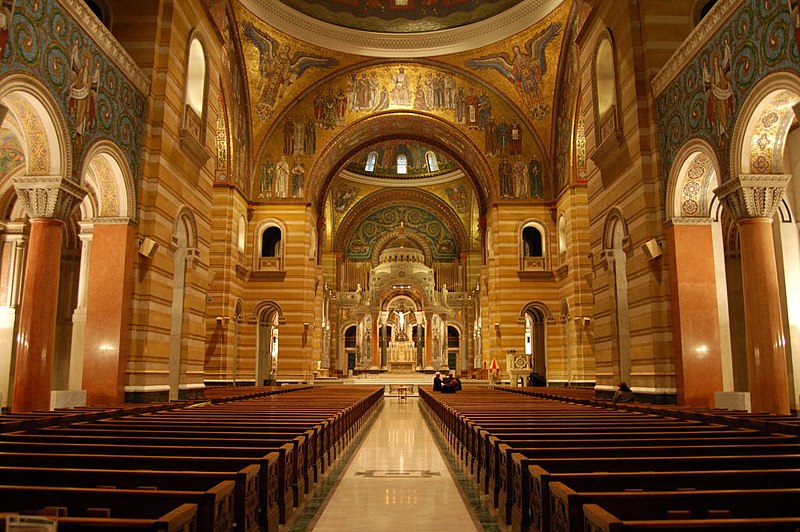
    This is a view from the main entrance of the Cathedral Basilica of St. Louis, just down the street from where I live in the city with which the magnificent building shares its name.

    I was attending the 12:05pm Mass here with maje_charis on Thursday and though I have attended Mass here many times over the last year, I was struck seemingly for the first time by this often looked upon but never-before-seen (much like the difference between hearing and listening) depiction of the crucifixion. Looking in the center of the above picture, you can pick out the stark, white marble of Christ on the Cross. Here is a closer look:

    This scene depicts Christ on the Cross, with his mother Mary on our left and the disciple John on the right, as is mentioned also in the Gospels that the two were present there with Him.

    Anyways, it struck me first of all how moving this really is, in particular when I considered it during the Eucharistic Prayer…

    In memory of his death and resurrection, we offer you, Father, this life-giving bread, this saving cup. We thank you for counting us worthy to stand in your presence and serve you. May all of us who share in the body and blood of Christ be brought together in unity by the Holy Spirit.

    Lord, remember your Church throughout the world; make us grow in love, together with Benedict our Pope, Robert our bishop, and all the clergy.

    Remember our brothers and sisters who have gone to their rest in the hope of rising again; bring them and all the departed into the light of your presence. Have mercy on us all; make us worthy to share eternal life with Mary, the virgin Mother of God, with the apostles, and with all the saints who have done your will throughout the ages. May we praise you in union with them, and give you glory through your Son, Jesus Christ.

    During the Mass I began considering that, in such a depiction with Christ, His Mother, and His disciple, I could see represented the Body of Christ in three ways that not only existed then in that actual event nearly two-thousand years ago, but exist yet today in mystery, by the power of the Holy Spirit.


    I. This is my body, which will be given up… for you…

    Particularly in the starkness of white marble, we can see Christ’s body; the Body of Christ in the most obvious sense of the phrase. God took on human flesh; the bodiless now had a body, the formless had form. Quite a mystery indeed. But where do we see this reality today? For we say in the creed that He sits at the right hand of the Father. Yet, he said he would be with us until the end of the age.

    We have the great mystery of the Eucharist, his Body now “true food” and his Blood “true drink” (John 6), separated in the appearance of Bread and Wine as his Body and Blood were separated on the Cross.


    II. Stabat Mater

    When a woman bears a child, it seems to me, that her body becomes the child’s body. It not only is from her own body that the child receives their own body, her blood by which the child receives their blood, but also it is through her own body that the child first experiences the world, moves within it and is known. For many people, their first encounter with the child is the beautiful, round belly of the mother, full of life.

    Likewise was Mary the Body of Christ, even before he had his own body. By the Holy Spirit was he conceived within her; to think that the infinite God, creator of the universe, was once microscopic within the womb of Mary! Also she was the first disciple of Christ, his first follower. Though as his mother she was his teacher, she also was instructed by him, even from his first moments. Remember all that Gabriel revealed to her at his conception, and remember the lesson the infant Jesus taught her when she went to visit Elizabeth? “Mother, I am the hope of the world!” And she sang for joy with a song that will echo through the millennia to come, and truly, “all generations call her blessed.” So as a follower of Christ, as we are, she was our first glimpse into what would later come to be known as the Mystical Body of Christ.


    III. St. John Christendom (a pun, if you are clever)

    This is when we come to St. John.

    It seems to me that in St. John we see the only one of the Twelve that did not abandon our Lord. We see a man who began as a disciple, was chosen as an apostle and never once left our Lord’s side, not even in the darkest hour. He is united in love, the very Spirit of God, to Jesus Christ, a singular image of the Mystical Body that we witness today. Also in becoming Man, Christ shares a common humanity with St. John and all human beings. When St. John and the other apostles receive the Holy Spirit in the Upper Room, they already shared a common humanity and then came to share in a common divinity; a complete likeness to Christ, being God and Man. As the formless, bodiless God took flesh and became Man, so does this mystery continue in the Mystical Body of Christ, through the Holy Spirit we receive at Baptism. Really, at least in this artistic portrayal, that is not only St. John standing at the cross, but each and every Christian.


    IV. Altogether Now

    We come back to Mary.

    Just as we see in Mary the very vessel that bore God throughout the world, the Ark of the New and Everlasting Covenant, just as we see how she cared for, revered, instructed, loved, mourned and rejoiced in the physical Body of Christ, so do we see the Marian mystery in the Church today, and here again we must mention St. John and his role in representing the Christian.

    From his place upon the Cross, Jesus said, “Woman, behold your son,” and then to St. John, “Behold, your mother.” (John 19) It seems to me that, knowing his own body was about to give way to his Mystical One, Jesus (being God) entrusted the Virgin again with the task of caring for his Body in its infancy, charging her with a sort of spiritual motherhood. So also is the Church a spiritual mother, for within her each human being is born into Christ’s body through baptism. So, too, do her priests and bishops teach us and raise us, along with the other faithful, so are we healed in the anointing and laying on of hands, cleansed in confession, and most importantly fed with the Body and Blood of Jesus Christ, becoming further united with Him and with each other, the Body becoming more and more truly one, as He is One. Like Mary in her pregnancy, it is the Church that is Christ visible in the world, the Church through which Christ moves and interacts in the world, and too his Mystical Body when we are born into the Church through our baptism and are sent by Christ to, “go in peace to love and serve the Lord.”. As Catholics, we not only see the Church carrying on the role of Mary, but we believe that Mary carries on that sacred mission entrusted to her at the cross from heaven still today. But that is perhaps a blog for another day.

    So the next time you are at Mass and you see the priest elevate the broken Host above the full cup, remember that you are witnessing our Crucified Lord, “broken for you,” that you might have life. The next time you walk by your parish or another, think of your Mother Church and all she has done to care for you, as Mary did her Son and does now by her prayers and through the grace of her Son. The next time you gather with your Christian brother or sister, remember St. John at the cross, standing at our Lord’s side, inviting all of us to come and worship him who gave everything for your sake and calls all to communion with him. As he was there, so are we there, and so are all invited to come, no longer afraid because unlike the one who betrayed him and the ten who fled him, we now have what St. John had- the consolation of the perfect mother, and a love of Christ that will endure all trial.

    For, “[w]hat will separate us from the love of Christ? Will anguish, or distress, or persecution, or famine, or nakedness, or peril, or the sword?… No, in all these things we conquer overwhelmingly through him who loved us(Romans 8: 35 and 37).

  • Miracles


    I remember a moment from when I was probably around six years old. I was at the Tipton park with the youngest daughter of my babysitter, Holly. We were standing on top of the big wooden jungle gym, ready to go down the slide, and I happened to notice the sunbeams coming through the clouds. Naturally, it reminded me of a scene from Disney’s “The Sword in the Stone.” 

    Yeah, that part. Remember? When the sun is streaming down on the sword? Anyways, I remember the big mean guy with the walrus mustache who bossed Arthur around during the moment when everyone witnesses Arthur pull the sword from the stone. He just says, “It’s a miracle…”

    So here I was, this little kid, pointing at the sunbeams in the distance and I said to Holly, “It’s a miracle!”

    Being a very practical person, even at such a young age, she promptly replied, “That’s just sun shining through clouds, stupid.”

    So I still have yet to witness a full-blown miracle. However, in my few years as a Jesuit, I have met priests who have been witness to some amazing things. Here are a few that I have picked up from sane, trustworthy priests who have no reason whatsoever to make things up.

    The Healing Power of the Eucharist

    A priest told me of a time when he received a phone call about a man who was close to death. The priest was tempted to say “no” because he felt he was very busy but his nagging conscience prevailed and he went. It was a very hot day, it had been a long day, and everything about that day was just tiresome; his heart was not in it.

    When he arrived at the address, he noted that it was a three-story building and immediately hoped there was an elevator. He went inside and asked a random person where Mr. So-and-So lived.

    Third floor.

    And the elevator?

    There isn’t one, Father.

    Thanks.

    Being a slightly heavy man, not in terrific shape and already sweating, this priest was an out-of-breath, dripping grump by the time he got to the third floor. Finding the man’s apartment, he knocked and was invited in.

    The man lay on his bed, his daughter near at hand. The man was breathing in short gasps, eyes closed, not really responding. The daughter explained that doctors had done all they could, and the man’s wish was to die at home. The priest took out the oils, anointed him, said the prayers and then opened the little golden pyx. (A pyx is a small, golden vessel used to safely and reverently transport the Eucharistic Body of Christ).

    When he placed the Eucharist on the man’s tongue, to the priest’s utter amazement, it dissolved instantly and vanished. The man’s hectic breathing slowed to a peaceful rhythm, and a gentle smile spread over his face. Peace fell over the whole room. The man passed away quiety not long after, and the priest’s life was changed forever.


    The Power of the Rosary

    When I was on Hospital Experiment at our Jesuit Infirmary in Wisconsin, I had several conversations with an elderly Jesuit priest who has since passed on. He spent most of his life on the reservations in South Dakota and was witness to many tragic events. I don’t know, and I doubt anyone could count the number of suicide victims he has buried, how many scenes of death he has had to cross to comfort family and friends… the priest, though, was one of the most peaceful and prayerful men I’ve ever met.

    Once there was this native woman who would come to speak with him once in a while. She struggled tremendously with drugs and alcohol and would try quitting, only to get right back into it a short time after. But each time she would be sober a little longer, a little longer until once it finally seemed like she’d kicked her bad habits. She continued to visit the priest, and he would always give her advice on prayer and the like, and even helped her to get a job.

    Just when everything seemed to be going well for her, however, she had a relapse and soon died. The priest attended her wake, finding sadly that only two other people were in attendance.

    “Father,” one of them asked, “she always had a rosary. Do you have a rosary we could put in her hands?”

    “I have one in the rectory; I’ll go get it.”

    “We’ll wait right here,” the two women said.

    When he returned, the two women were gone, so he went to the open casket and reached for the hands of the woman who would be buried tomorrow. As he brought the rosary to them, he was shocked to find that her hands, in spite of having been dead for several days and embalmed, were warm and supple as though she were only asleep. He suddenly became aware of someone else in the room with him, and recognized it as the woman who used to visit him, the woman he would bury tomorrow. He remembered very distinctly sensing that she was assuring him that she was overjoyed and free and grateful for all of his help. The sensation passed and he placed the rosary reverently around her hands before departing for the evening. He spoke with an undertaker soon afterward, asking if he’d ever experienced such a phenomenon in all his many years of work. Taking the priest quietly aside he said “yes, but I rarely talk about it; it is the most strange thing and I can’t explain it.”


    I AM the Bread From Heaven

    The priest telling me this story is famous throughout my province for his tall tales. But after a few weeks, I learned all of his “tells” and knew when he was serious, and when he was not.

    He was serious when he told me this one.

    When he was stationed out at the Pine Ridge Reservation in South Dakota, he became acquainted with a British author who had recently written a book on the importance of forgiveness. The topic became especially relevant when the priest, the author and a mutual friend were talking about the Wounded Knee Massacre. The priest decided that he would take his guests to the Wounded Knee Church, right at the site of the mass grave and across the road from the massacre itself, and have Mass.

    They arrived only to find the church locked and a complete downpour of rain. With no key and no time to go anywhere else, the priest decided they would have a “dashboard Mass.” Parking with the mass grave before them, the priest opened his Mass kit and set up the dashboard as best they could in their circumstance.

    During the intercessory prayers, the author asked if they could pray for and forgive all those responsible for the massacre and all those who had inflicted suffering on the Lakota, and he also wished to pray for and forgive all the Lakota who had their part, whatever it might have been. Basically, he felt moved to ask for God’s total forgiveness of everyone involved in the tragic events that began long before the massacre, included it, and continued on to that day.

    Keeping these intentions and prayers in mind, the priest began the Eucharistic prayer, and as it proceeded on toward the Agnus Dei he swears he began to see people appearing out of the grave, dressed in traditional Lakota garb and, smiling, rising up into the sky.


    Humble in Appearance, Mighty in Power

    Catholics, as most people know, believe that the Eucharist is the actual, living, Body, Blood, Soul and Divinity of Christ- the full and real presence,though shrouded in deep mystery and under the “appearance” of bread and wine. Even in a little fragment we believe it is fully Christ, capable of all that Christ was capable of in the Gospel. The power of the Eucharist has been told throughout the ages as stories of miracles became known. Some stories, like these, don’t circulate very far. This one in particular amazed me, though it is more spectacular than the moving stories above.

    I lived in community with an interesting priest for two years. He would often travel and do retreats all over the United States and South America and when he was home, if you were lucky, you could get him to tell a story about himself. For instance, he once met a man who pleaded with him to anoint his daughter who was born with a spinal deformity that paralyzed her from the chest down. The priest anointed her and told the father to lay his hands on his daughter’s back every night and pray an Our Father. One night a few years later, the father was doing just that, as he had done since then, and suddenly during the prayer he and his daughter heard a loud pop and, suddenly, she could move her legs, and was walking within the month.

    But that isn’t the story I wanted to tell. This story is very short, but because of its nature I didn’t want to pry!

    Exorcism, specifically Catholic exorcism, is something that is very misunderstood and is almost entirely obscured by superstition and Hollywood. It is 99.99% of the time not at all like Hollywood. Period. But there are occasions when the miraculous and the terrifying happen to occur during this ancient prayer.

    This priest was asked by a young girl’s parents to come and pray over their daughter. He did, and in the conversation the young girl indicated that she desired exorcism, and explained her reasons behind it. The priest judged that one should be done soon, so he spent some time preparing himself.

    He wouldn’t give much detail, save for this one: there was a moment when things were very intense and things started moving around the room. The priest had set a small monstrance on a table near at hand which contained a small Eucharistic host in it. During this time a book went sailing straight for the monstrance, much to the priest’s dismay. To his surprise, however, the book stopped in midair, mere inches from the monstrance, was lifted a few inches above it, and allowed to continue its flight into the wall.


    So no, I have not seen any bonafide miracles. Perhaps someday I will have stories of my own like this to share. But every day there is one Miracle that I witness time and time again, and I am so grateful for it.

    Oh my Jesus, who am I that you would deign to become the very Bread I eat, the Wine I drink? Lord, receive me and consume me; make me whole in your Body. Thank you for the bounty of your Precious Blood, that I might drink from the Cup of your Suffering, the Cup of my Salvation.

  • Have a Little Faith…

    I just wanted to share this story I found at catholic.org:

    The Miracle of Tommy: An Opus for God

    By Tom Kneier
    8/23/2009
    PITTSBURGH, Pa. (Catholic Online) – We had negotiated our mid-life passage without the proverbial crises. My wife pierced another hole in her ears for a second set of earrings. I started wearing contact lenses because she told me it made me look younger. That was about it.The youngest of our six children was then 9 years old. Each milestone he had passed gave us a growing sense of freedom: last one out of diapers, last to tie his shoes, ride a bike, learn to swim, go to school. There was a sense of anticipation. What might we do with the next chapter of our life? After 20 years of marriage, I sensed we were on the verge of a whole new direction in 1996.

    My wife, Madeline, had been to the doctor to determine the reason she had been skipping her periods every so often. One of those visits fell on June 17. It was her 44th birthday, but I’m the one who got the surprise: Madeline was pregnant. I stifled the question “How is that possible?” as it tried to force itself past my lips. (After six children, I guess I knew pretty well.) We walked around for the next week in a daze. This can’t be happening, I thought. We have to start all over again? What about the new season for our marriage? I’m not ready to accept another child!

    Don’t misunderstand me. I love our children. I love family life. And I love my wife. Ever since our dating years in college, we had tried to cooperate with God’s will for us. But it took this unwanted announcement to show me how much selfishness was still in my heart, and how much I still preferred my will. Yet as each day passed, I became less resistant, more accepting.

    My fledgling hope soon confronted a new challenge. The sonograms indicated that something might be wrong with our baby. We were sent to specialists with more sophisticated equipment.

    “I’m sorry,” the doctor said. “There appear to be multiple complications. The ‘fetus’ appears to have club feet. There is no sign of the presence of a bladder. It may be external to the body. And the brain is not developing as it should. There is an empty space at the base of the brain. They rarely make it to full term in cases like this. Those that are born are likely to die within the first year.”

    Madeline began to quietly cry. “I presume you’ll want to talk with our genetic counselor about terminating the pregnancy,” he added. His comment ignited an anger in me that fashioned an instant determination. “No,” I quickly responded. “That is not an option!”

    Still, something in me grasped at his bleak outlook. It’s better that our baby die than to live with so much suffering. Lord, please don’t let our baby suffer long. Let death come quickly. It’s better that way. But better for whom? I thought. Better for me, of course. For Madeline and me. I didn’t want us to go through the pain of watching a child suffer. As I look back now, it is so humbling to see how quick I was to accept the word of a man, and how slow to seek and accept the word of God.

    A more definitive diagnosis could not be made without an amniocentesis. At Madeline’s age, this was considered a high-risk pregnancy. She decided that she would rather be prepared than live with uncertainty for the remaining six months. The results came back on August 30; our 21st wedding anniversary. Our child was a boy – and he had Down Syndrome. The brain diagnosis was described as possible Dandy Walker Syndrome. His urological condition was called Bladder Exstrophy. It had no connection to his Down Syndrome. This rare disorder occurs in only one out of every 30,000 births. The prevalence of Down Syndrome is approximately one in every 800-1,000 births. The odds of a child being born with both is exceedingly rare. We began to affectionately refer to our son as “one in a million.”

    These newest developments forged a stronger bond between me and my son. He was so fragile and weak. He would need me perhaps more than any of my other children. Then it dawned upon me. I could give him my name. Although I had five other sons, it had never seemed appropriate before. Now it seemed perfect. I would be proud to have him take my name; proud to identify with him. That same day my wife came to me with an idea she had gotten in prayer—the notion of naming our son after me. His name would be Thomas. It was a small sign to us that God was very much involved in the details of our lives. He was still in control of this seemingly uncontrollable situation.

    The months went by in slow motion. We passed the time trying to learn all we could about our son’s genetic and medical conditions. One specialist who would be on the team in the delivery room tried to prepare us for the many possibilities. “Don’t worry about his urological condition,” he offered in a helpful tone. “If there’s not enough tissue for male genitalia, we will be able to form female genitalia instead. With hormone treatments, you will be able to raise a daughter, and she will never know the difference.”

    We nodded our heads stoically. When we got in the car, we looked at one another in disbelief, and suddenly started to laugh. It was either that or cry. He acted as though this were the most normal thing in the world, never considering that we might oppose such a procedure. On January 28, our waiting ended. At 6:45 p.m. he was delivered without complications. I was the first one to hold him. I held my breath as I checked for all the abnormalities. Hands, feet, fingers, toes—everything looked normal. He was breathing on his own, too. Not an automatic thing for babies with Down Syndrome.

    “You made it, Thomas. You did it! You proved them wrong,” I kept telling him. I wanted to take him right then and there to the prenatal specialist and say, “Look at our beautiful son. You didn’t even want to give him a chance!”

    His bladder was indeed outside of his abdomen, but the urologist had assured us that this could be surgically repaired in the first 48 hours. As I drove home that night, it occurred to me that it was the very day of St. Thomas Aquinas’ feast, after whom our son was named. He may have disabilities, I thought, but he knows how to honor his patron.

    Thomas was in the hospital for three weeks during which time the neurologist tested for brain anomalies. At last the results came back—no Dandy Walker malformation, no apparent brain dysfunction. We thanked God for the many family members, friends and unknown prayer warriors who had interceded for our son’s healing in utero.
    Still, his first year was not without difficulties. The urology surgery required that he be immobilized from the waist down for six weeks. During that period he developed a serious urinary tract infection and had to be hospitalized again. At six months, the audiologist who tested him told us that he wasn’t hearing. Three months later that diagnosis was reversed. Initial misdiagnosis, or the results of prayer for his healing?

    In his first four years, Thomas had four surgeries, five outpatient surgical procedures, and an untold number of tests and examinations. But he made progress, too. He sat up for the first time at 12 months. He took his first steps when he was 3 years and 2 months. He needed a walker for a while, but now only requires braces on his ankles. He said his first word at 2 1/2 years. He has yet to put together words in a sentence. It is too early to assess the level of his mental retardation. Still, each minor development feels like a major victory to us.

    One day I was reflecting with Madeline that we were back to checking off milestones again. I joked that God was like an orchestra conductor saying, “One more time, with feeling.” Then I saw that the image was more fitting than I realized. Our family has been our life’s work—our “Opus” for God. In a symphony, the ending often slows down significantly to emphasize each note and bring the piece to its dramatic culmination and conclusion. The musical term for this is “ritardando” (the double meaning was not lost on me). Thomas is the culmination of the Kneiers’ Opus. He has already brought us some of our greatest joys and our deepest sorrows. But then, tears and jubilation are inextricably entwined with any great masterpiece!

    An update from the author: Tommy recently celebrated his eleventh birthday party at the bowling alley with three of his best friends from school. He is in the fifth grade, and his favorite subjects are music and computer. One of the teacher aids nicknamed him “The Senator” for the way he works the lunchroom every day, going from table to table shaking hands and giving high fives. A big red pimple showed up on his nose last month as an unwelcome reminder to his parents that he is now a preteen—a notion quite incongruent with the diapers we still change daily, waiting for modern medicine to devise a surgery that will end his incontinence.

    Dichotomies like these have typified Tommy’s growing up years He still can’t tie his own shoes over his orthotics, but he runs with the best of them in gym class. His speech is barely discernible, but one classmate wrote in Tommy’s Star of the Week notebook, “You’re lucky to make friends as easily as you do.” He passes the milestones more slowly and less frequently than did his six siblings, but each one generates a Super Bowl-worthy celebration from Mom and Dad. Like riding a two-wheeler in the driveway at age six—okay, it had training wheels (and still does). That first hit playing Challenger baseball at age eight followed by his fist-pumping arrival at first base. And, last May standing at the altar of St. Thomas More church with ten other boys and girls who had just received their First Communion, proudly displaying his honorary certificate in his slightly askew black suit and tie.

    During this last time through the Opus, we’ve come to realize slowly (there’s that word again) that it isn’t as important to reach the end as it is to enjoy each movement to the fullest.

    ———-
    Tom Knier is the Director of Operations at Catholic Charities of the Diocese of Pittsburgh. His beloved wife Madeline is a para-educator in Tommy’s school district.