Uncategorized

  • The Lamb’s Supper

    Anyone who knows me (and probably those who look at my profile pic!) knows or can at least guess that I absolutely love my Catholic faith. The source and summit of this faith is Jesus Christ, especially as He deigns to come to all mankind (even me!) in the Eucharist. My primary encounter with the Eucharistic Christ, then, always will be the Mass. What I hope to do in this post and the next (and possibly a third) is to share some of my thoughts and reflections on the Mass, sort of my own non-musical version of a “few of my favorite things.” For the sake of simplicity I will be referring mainly to the ordinary Sunday Mass, though I may on occasion point out characteristics of other liturgies.

    1. “The Announcement”

    The Catholic person who attends Mass regularly, at least those most familiar with the Roman Rite, probably will be nodding their head with almost everything I point out. While my name for things may not always coincide with their name for it, they will know we are on the same page. The Announcement, I call it, is innocent enough and varies from parish to parish, and sometimes does not occur at all and things start at #2. The Processional Hymn.

    The Announcement happens when a member of the parish, sometimes the cantor but almost always a very sweet lady, welcomes the people to such-and-such parish, usually announces the particular feast day or the whatever Sunday of Ordinary Time, and may even remind people to turn off or silence cell phones, watch alarms and pagers. The hymn is often announced at this time as well.

    Really, though, the only reason I even bother mentioning The Announcement is because even this tiny little experience of the Mass can be a crucial one. For instance my mother, at the very wise age of 12 (or thereabouts), attended Mass with her Catholic friend (my mother was raised Southern Baptist). My little mother, though she would indeed grow to raise quite a bit of hell, remembers her experience of being Baptist as quite sad, and even at so young an age she was convinced that hell was her final destination, and no amount of going to church ever changed that. 

    So there she was with her friend, standing in the pew as some lady announced, “Welcome to the celebration of the Mass!” “Celebration?” my young mother thought. Sure enough, there was a celebration, with candles and music, with reading from the Bible and sung psalms, with a loving message, with a beautiful communion service…everything she longed for in her own church. When she got home however, my grandparents quickly dashed her hopes of becoming Catholic! Fortunately she married one later, after a certain blogger (me!) came along. It is so strange to think of my mother back then, longing to celebrate her faith in Christ and looking to her own church for that but finding only fear and condemnation, then coming to the Catholic Church with its ancient traditions, its touch of solemnity and all else and realizing that these strange folk she’d been warned about were celebrating the life, death and resurrection of Jesus not just every Sunday, but every single day of the week! Now her whole week is spent waiting for Sunday to celebrate the gift of Christ to the world, to her, and to receive Him personally in the Eucharist, to unite herself to the Lord she loves. So even this technical little step is super important!

    2. “The Processional Hymn”

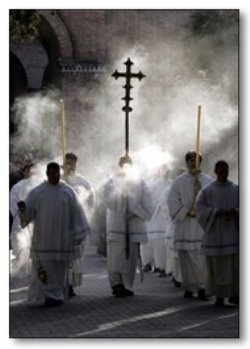
    When I think of the beginning of the Mass, that short moment of silence when the Announcer is silent and before the organ/piano/choir begins, after everyone has stood up, I can smell the burning scent of charcoal and the faint traces of incense already being carried on the breeze. Children’s eyes are darting everywhere, trying to figure out what is about to happen. Sunlight streams in through stained glass. I imagine God’s first words in Genesis, “Let there be light!” And just as the angel’s surely sang and rejoiced in that first light, so the whole church erupts in song. Soon comes the thurifer, usually a young man swinging the thurible full of incense (though not every parish uses incense). I love the smell of incense, and it is wonderful to imagine the ancient days of the Temple in Jerusalem, when incense was offered to God daily and to connect the Temple of God of those days with the Living Temple of God today.

    Then comes the man or woman bearing the Processional Cross, a crucifix of some kind, reminding us all that we are here first and foremost because of His sacrifice, and we are all called to follow Him to that Cross. Our attention and our hearts are led by the Cross to the sanctuary (the front where the altar is) as the Procession continues. Sometimes the cross bearer is led, flanked, and/or followed by people bearing candles, and I think of how Christ is our light.

    Next often comes a man or woman bearing the Book of the Gospels from which the Gospel reading will come. I think of John 1:1- “In the beginning was the Word, and the Word was with God, and the Word was God.” You can almost imagine the creation of the world: the haze of the formless waste in the smoke of the incense and the sweet promise borne upon the wind, the light of the candles being like the first light of creation, and the Book of the Gospels reminding us of that Living Word there present at the beginning of time.

    Then come any other altar servers, deacons, priests, and finally the celebrant/presider (usually the pastor of the parish, a visitor, or a bishop), all of them in their various liturgical garb, colors and designs depending upon the season: purple for Advent and Lent (and a different shade for each), rose for Gaudete and Latare Sundays during the aforementioned seasons, white for the highest celebrations (Easter!!!!!) and some saints/events (Transfiguration, Mary, St. Joseph, etc.), green for Ordinary Time (though the Mass is HARDLY ordinary!), and red for martyrs or certain “sad” occasions, such as Good Friday. Altar servers often wear a black cassock (a robe-like outfit) with a surplice (a white thing that looks like the top half of a robe). 

    The Procession enters the sanctuary, reverences the altar with a bow, and assumes their places, again depending on their liturgical role. The celebrant usually incenses the altar, blessing it and preparing it for the sacrifice that will come later. Once the hymn is completed, there is another period of anticipatory silence.

    3. “Context”

    The Catholic Mass, as also with most devotions and prayers in the Church, always always always begin the same: “In the name of the Father, the Son and the Holy Spirit.” This is SO important, for what is about to take place cannot be done in any other name! Then the celebrant says, “The Lord be with you,” to which the congregation replies, “And also with you.” There sometimes follows a short message about the day’s feast, the readings, or some other kind of brief welcome, before an invitation for everyone present to reflect on their sins.

    4. “The Penitential Rite”

    A let down after so lovely a start? Not so! I am always reminded of the advice of St. Paul in 1 Cor. 11:27-28- “Therefore whoever eats the bread or drinks the cup of the Lord unworthily will have to answer for the body and blood of the Lord. A person should examine himself, and so eat the bread and drink the cup.” Here the Church offers us all a chance to follow the teaching of the Apostle and consider our sins. Then we follow the advice of yet another Apostle, James, who says in his letter (5:16)- “Therefore, confess your sins to one another and pray for one another, that you may be healed,” when we say aloud:

    “I confess to almighty God,
    and to you, my brothers and sisters,
    that I have sinned through my own fault,
    in my thoughts and in my words,
    in what I have done,
    and in what I have failed to do;
    and I ask blessed Mary, ever virgin,
    all the angels and saints,
    and you, my brothers and sisters,
    to pray for me to the Lord, our God.”

    The celebrant says, “May almighty God have mercy on us, forgive us our sins, and bring us to everlasting life,” to which the people reply, “Amen!” Oftentimes there will be a spoken or sung call-and-response of “Lord, have mercy. Christ, have mercy. Lord, have mercy.” If you are super blessed (which you are anyways just being at Mass!) you might even get to speak it or say it in the ancient, ancient Greek, the last remnant of when the whole Mass was in that language: Kyrie eleison. Christe eleison. Kyrie eleison. Some musical arrangements of this part of the Mass are incredibly somber, and sometimes (especially if you’d been particularly sinful, but not so much so that you should have gone to confession before Mass!) you are feeling pretty down on yourself.

    5. “Gloria!”

    Turn that frown upside down, for Christ forgives you! For Christ gave authority over sin to His Apostles (His first priests!) when He breathed the Holy Spirit upon them and said “Whose sins you forgive are forgiven them, and whose sins you retain are retained. (John 20:23)” Now, what should any soul say after being forgiven of their sins? Why say anything when you can sing:

    Glory to God in the highest, 
    and peace to his people on earth. (Luke 2:14)
    Lord God, heavenly King,  almighty God and Father,
    we worship you, we give you thanks, we praise you for your glory.
    Lord Jesus Christ, only Son of the Father, 
    Lord God, Lamb of God,
    you take away the sin of the world:  have mercy on us;
    you are seated at the right hand of the Father:  receive our prayer.
    For you alone are the Holy One,  you alone are the Lord,
    You alone are the Most High,  Jesus Christ,
    with the Holy Spirit,  in the glory of God the Father.  Amen.

    Not only is the Gloria just a wonderful, exultant song of praise, but especially with the opening line we are reminded by the very words of the angels that our God, for the forgiveness of our sins, deigned to descend from heaven and “emptied himself, taking the form of a slave, coming in human likeness; and found human in appearance, he humbled himself, becoming obedient to death, even death on a cross. (Philippians 2:7-8)” We have come out of the Old Testament desert of sin and sorrow and receive our first glimpse of God’s promise fulfilled!

    6. “Let us pray”

    After this beautiful and very ancient hymn there is another brief silence before the celebrant invites everyone to prayer. He then offers the particular prayer for that day, and each day of the year is different, often incorporating some theme relating to the feast/occasion/Gospel for the day. After an “amen” from the people, everyone is seated.

    7. “The Liturgy of the Word”

    Then is proclaimed the First Reading, most often from the Old Testament, though during the Easter Season it is taken from the Acts of the Apostles. Notice I used the word “proclaimed” and not “recited,” “read,” “reenacted” or otherwise related. The way I understand it, Jesus Christ is the Living Word of God; He is not the letters on a page, He is not a wrote recitation of said text, nor is He something to be memorized and repeated to an audience. Rather, and this can be tricky for many lectors, one must lend their powers of speech to the purpose of God, permitting the Living Word to become incarnate in your very body. You become not merely a messenger, but more like an instrument upon which the Song of Salvation is played. So the book with the readings is always present; one never memorizes the reading (you are not offering YOUR word, but the Word of God which is for everyone!). This is what proclamation is for me, just like in ancient days when a man went out into the center of town with a scroll containing the words of the king, crying out in a large voice what are not his own words, but the very word of the ruler, with all the power and authority of that man as though he were there proclaiming his will in person. 

    Thus not only should one proclaim and do so as humbly as possible, but “whoever has ears to hear ought to hear! (Mark 4:9)” I also love how the First Reading always takes us back to our ancestry, to the first workings of God as He lay the foundation for our salvation.

    At the end of the reading the lector says, “The Word of the Lord,” after which the people say, “Thanks be to God!”

    8. “The Psalm”

    Next is the psalm, which is always sung antiphonally. The cantor intones the antiphon, usually a line or an adaptation of a line from the psalm itself, and then invites the congregation to repeat it. Then the cantor sings a verse, everyone sings the antiphon, and this continues until the psalm ends. We thus join in the tradition of King David, the author of the psalms, who constantly sang to God.

    9. “Second Reading”

    This reading always comes from one of the Epistles of the New Testament, teaching us, encouraging us and helping us to put our faith into practice. Here we are taught by the very Apostles who were taught by Jesus Christ, the same teaching preserved by the Church and taught to her people to this day. The same “The Word of the Lord/Thanks be to God” is offered here.

    10. “ALLELUIA!”

    Then there is a great alleluia sung by the cantor, which is repeated by the congregation as they . During this time the celebrant or a deacon/concelebrant (whoever is about to read the Gospel) picks up the Book of the Gospels from the altar, and sometimes two altar servers bearing candles will flank him and stand on either side while he reads. If incense was used in the procession, it will often be used again to bless the book. This alleluia is a cry of joy, for the Word of God is among us, to teach us and nourish us. For myself (and I imagine for many Catholics) part of this joy comes too from knowing that He will feed us not only by His Word…

    11. “The Gospel”

    “The Lord be with you,” says the reader. “And also with you,” the people say. “A reading from the Gospel according to (one of the four),” the reader continues, making a large cross with his thumb upon the page and then upon his own forehead (that he may understand the Word), his lips (that he may speak it) and over his heart (that he may love it and live it). The congregation does the same while saying, “Glory to you, O Lord.” Then the Gospel is proclaimed, followed by, “The Gospel of the Lord,” after which the people say, “Praise to you, Lord Jesus Christ.”

    This reminds me again of the importance of proclamation as opposed to mere reading or recitation, for when a person proclaims the Gospel it is merely His instrument; we do not hear the man, but Jesus Christ through the man. Thus when we honor Christ with “Praise to you…” we needn’t worry about that praise going to the reader!


    So here we are! We’ve assembled to praise and worship God and to honor His Son, we do so in His name, we offer our sins and confess our sinfulness before everyone present, here on earth and in heaven, be glorify God for His mercy, and then we sit while our Beloved Rabboni teaches us from the Scripture, both Old and New Testament. If you go to Mass every Sunday and weekday for three years, I think you will have proclaimed to you between 70-80% of the entire Bible. This is NO EXCUSE not to study and read it on your own, however!!!!!

    Anyways, my final reflection before I wrap up my post is this: The Liturgy of the Word precedes the Liturgy of the Eucharist, and when I look at the Mass as a whole I see reflected there the overall reality of our salvation. Just as John says in chapter 1 of his Gospel: “In the beginning was the Word…and the Word became flesh.” In the first part of the Mass, the part I have blogged about just now, we have Christ as the Word of God, the Great Promise. In the next part of the Mass that Word becomes Flesh and comes to dwell among us. That is one reason why the Eucharist is so important and central to the Mass and Catholic life; what is the Old Testament anyways if there was no Incarnation? Likewise, why proclaim the Word of God and remind us of His promise if we do not live to see it? The Mass is the combined experience of the entire Bible from Genesis to Revelation (as we’ll see next time I hope!). 

    And as far as charges of the Mass not being biblical, look at all the Bible we’ve covered already! God bless you all and please feel free to ask questions or offer your own reflections!

  • My Thoughts on Priestly Celibacy, pt. 2

    blueskies8 asked how priestly celibacy can help the laity. That’s an excellent question! As some pointed out in their initial comments and in Part 1, celibacy frees a man up for complete, 24/7 ministry to those he is sent to serve. So if a lay person needs the priest for whatever reason at whatever time, odds are that the priest is available, imitating as best as humanly possible the complete and utter availability of Christ. I think also there is the hope that the priest’s dedication to God and the way he lives out his priesthood is an inspiration for lay people to live their lives with the same dedication. Priestly celibacy and marriage are not opposed to each other, but complimentary, for both are a total dedication to another out of an all-encompassing love for that other. Just as marriage is symbolic and participates in the reality of Christ’s love for the Church, His Bride, I see a priest’s celibacy as representing a similar total-gift and dedication to that same Bride. Being as that Bride is a spiritual one (with a physical reality, certainly), it would be very different from marriage to a human person, especially as regards sex.

    One way that helps me to understand this is to look at the Virgin Mary’s life, since she remained a virgin even after Jesus’ birth. What helps me to understand her perpetual virginity is to look at her life in the context of marriage. Her heart would belong most to the father of her child, would it not? She is the mother and God is the Father; not Joseph. Thus her fidelity lies foremost to God, who appoints Joseph to be caretaker of His household and all within it (like Joseph of the Old Testament in a way), but since her true “husband” is not a man but God, there is no sex (though even in virginity there is life and fruitfulness), and to even have sex with Joseph (technically her husband by law) would be to have sex with someone other than the Father of her child, someone other than He to whom she is already wed. Does that make sense? It helps me at any rate, looking at her life and her spiritual marriage to God as a way of understanding celibacy. So regarding the laity, hopefully a priest’s dedication to their own marriage (their complete and total dedication to the Church for love of God) inspires in them a similar devotion to their own married life and their own relationship with God. If this wasn’t helpful at all, please do ignore it…


    mortimerZilch stated that “for the priest [guilty of abuse] to continue saying Mass without repentence…that…completely invalidates that person’s entire ministry…”

    Not so! Because the priest does not exercise his own priesthood but rather Christ’s, it is Christ who says the Mass, baptizes, etc. Thus no sin or shortcoming of the priest limits or invalidates the sacraments he offers. This was something dealt with by the Church regarding the Donatists. There was a terrible persecution of the Church at the time and many people denounced their faith or turned over copies of the Scriptures in order to save their own lives; even priests were guilty of these things. After the persecution had ended, many of these people wanted to return to their Christian communities, but some communities told them they would have to be baptized again and receive all the sacraments a second time because they had lost them. Even priests would have to be reordained, and any priest who was guilty of any sin, really, could not offer a valid Mass, etc. The Church, however, condemned all of this as heresy, because it is Christ who ministers the sacraments through the priest, not the priest himself. So no matter how sin-ridden, drunk or otherwise inept a priest may be, his Mass is valid because it is Christ, not the man, who offers and is the sacrifice, and both are perfect.

    He also raised the question of trying the Pope or “the Church” as an international criminal organization, though not to convict either. I suppose I would respond initially with, “Then why bother trying if there will be no conviction?” and continue with asking why not try the United States for all the terrible things it does internationally, or any other country for that matter? The Catholic Church is not a criminal organization, bent on swindling people out of money, smuggling illegal goods, or sexually abusing children. The idea that the entire Church is behind child abuse is a gross inflation, a fire that has been generously fanned by the media. The number of priests guilty of abuse is considerably small, and the number of bishops guilty of intentionally hiding these priests is even smaller. But because so many people trusted the Church so much, discovering this (in spite of its limited scope) shakes the world. What if the Red Cross admitted that some of their volunteers were guilty of smuggling, theft or abuse? Should we take them to court as an international criminal organization? 

    Please understand this is not necessarily directed at you, but presented more as a response to many similar issues raised; this idea was proposed my many media sources too.


    theramblingman raised the issue of the Pope seeming to do too little, stating that the Church “needs new blood that is willing to stamp down on child abuse; actions are louder than words.” I would offer firstly that the Pope is not like a king or a president; he isn’t intricately involved in the micromanagement of the Church, which is a world-wide organization with well over a billion members. That is why the Church is divided into diocese, with each diocese being led by a bishop, who answers to Rome and ultimately to the Pope. The Pope leaves local matters to the local bishops, involving himself with matters that concern the worldwide Church, getting involved in the details only when necessary, such as the abuse crisis we are discussing now. While the media has been criticizing the Pope for seeming to do too little, there are many people who think he is doing a very good job, considering the scope of the problem. In fact, while meeting with abuse victims in Malta, one victim stated that the Pope’s visit “was truly a most beautiful gift, after all this suffering, we all cried, even the Pope.” Later the victim stated, “I did not have any faith in priests. Now, after this moving experience, I have hope again. You people in Italy have a saint. Do you realize that? You have a saint.” (http://www.catholicnewsagency.com/news/abuse_victim_in_malta_pope_benedict_xvi_is_a_saint/)


    Finally, Winsa asked a few questions, first wondering about priestly celibacy in light of Scripture, I am assuming 1 Timothy 3, which refers to deacons and bishops. At the time this was written, I imagine that the understanding of the priestly vocation was understood differently and, more likely, the Church herself was quite different. A bishop/priest’s task would be quite different serving a Church that consisted solely of Eucharistic celebrations that occurred in the privacy of people’s homes before sunrise on Sundays, whereas the Church in latter times, as membership rose and large structures were built to accommodate a large number of worshippers and a more involved administrative structure was required to see to the needs of the growing Body, the services of the bishops and priests had to change. They likely noticed that those priests and bishops who were unmarried were better able to meet those demands, whereas those who were married struggled and were often forced to divide their lives between their families and their Church. Eventually celibacy became the norm, though there are yet several rites within the Catholic Church that allow for married priests (though bishops, I believe, must be celibate), and even in the recent dialogue with the Anglicans and the guidelines for entire parishes of Anglicans entering into communion with Rome the Church is permitting those priests entering into communion to continue serving as priests, even if they are married, and those future men who are Anglican and in communion with the Church who are married and wish to serve as priests may do so. The Church is not opposed to married clergy, but the Latin Rite (the most prominent rite or “expression” of Catholicism) has a strong tradition of celibate clergy and finds it to be the most effective way of living the priestly life as it is understood today. That may change in the future, and it may not, who knows?

    She also asked about the command to “be fruitful and multiply,” which is something many people bring up regarding the idea of priestly celibacy. I would respond with the question, “What do you mean by “fruitful” and “multiply?” Certainly there is the understanding of “have children, and often!” but then we remember that it was to a virgin that God came and asked of her one child. Was God “bending” his own command? Likewise we think of Christ, who was unmarried; was God disregarding His own commandment? Yet would anyone accuse Christ of not being fruitful? Nonsense! There is a physical kind of fruitfulness, as revealed in the begetting of children, but there is also a spiritual fruitfulness; this is the way that the celibate priest and chaste religious live. 

    This is connected with your comment, “I would think that strong men such as yourselves would WANT to raise sons in the way that you learn/are. :D ” (thank you for your kindness, btw!) There is a reason why Catholic priests are referred to as “father,” not as a substitute or stand-in for God the Father, but because priests do live out a spiritual fatherhood, raising, providing for and defending the Children of God, born in the Church through baptism. 

    Personally, I have felt called to being a father and a husband since the sixth grade (fourteen years ago or so), so when I was in the novitiate I very much struggled with the thought that God had planted that deep desire in me, yet in the end called me away from it. How cruel! But once I surrendered that desire to Him to fulfill, returning it to the Giver, He began to show me how HE planned to fulfill it, doing so in a more complete way than I could ever have imagined, bringing to me a joy that I have never known and never thought possible. I reflect upon it more in this past post: http://ancient-scribe.xanga.com/674382543/blessed-art-thou-amongst-women/  Basically, though, the priest is fruitful by his labor for God and by bringing more and more people into the Church by that work. Through baptism he brings new Children of God into the world, and because of his priestly role he has a duty and responsibility to them as though they were his own children (and they are, in a spiritual sense), and thus he is yet fruitful and multiplying, keeping the commandment and fulfilling it as Christ did.


    I hope that these thoughts have been helpful! If I didn’t answer your question specifically, it was because your question was similar enough to another’s question that both could be answered simultaneously. Still, if you feel like you didn’t have your question answered, let men know in the comments and I’ll see to it immediately! As always, feel free to continue asking whatever questions you wish. God bless, and please keep praying for me and all priests! We pray for you and the whole world every day.

    My favorite Catholic synopsis: http://www.youtube.com/watch?v=Vs6qZd_xP1w

    Watch this AWESOME video on the priesthood:

    Part 1: http://www.youtube.com/watch?v=qqtOvt7d490

    Part 2: http://www.youtube.com/watch?v=SnwodBiLq1g


  • My Thoughts on Priestly Celibacy, pt. 1

    priest_collar1

    Thank you all for your patience; it is a crazy part of the semester! But it has passed for the most part, and I finally have the time I need to answer your questions with the consideration I feel they deserve. I would like to remind everyone that unless I am specifically quoting the Catechism or another source, these are my own personal thoughts (though definitely informed by and hopefully in conformity with the teaching and tradition of the Catholic Church, certainly!), and I hope that they are found to be helpful. Please also understand that while I have been living a vow of chastity for nearly two years (and have not so much as kissed a woman in nearly six), it cannot be reasonably expected of me to know everything about priestly celibacy/chastity, no more than one could expect a married couple by their second anniversary to know everything about marriage and children. I will do my very best to answer your questions and respond to your comments as thoroughly and honestly as I can.

    liferemainsbeautiful really asked the first question(s); FoliageDecay and squeakysoul just offered very appreciated support and, in the case of my dear sister, her own brief thoughts on the matter (though she could certainly message me her concerns/questions regarding women and the priesthood if she wishes).

    “Why does the Catholic Church require priests to be celibate at all?”

    The Catechism of the Catholic Church says:

    “1579: All the ordained ministers of the Latin Church (the most well-known “rite” of the Church), with the exception of permanent deacons, are normally chosen from among men of faith who live a celibate life and who intend to remain celibate “for the sake of the kingdom of heaven” (Mt. 19:12). Called to consecrate themselves with undivided heart to the Lord and to “the affairs of the Lord” (1 Cor. 7:32), they give themselves entirely to God and to [his people]. Celibacy is a sign of this new life to the service of which the Church’s minister is consecrated; accepted with a joyous heart celibacy radiantly proclaims the Reign of God.

    1580: In the Eastern Churches a different discipline has been in force for many centuries: while bishops are chosen solely from among celibates, married men can be ordained as deacons and priests. This practice has long been considered legitimate; these priests exercise a fruitful ministry within their communities. Moreover, priestly celibacy is held in great honor in the Eastern Churches and many priests have freely chosen it for the sake of the Kingdom of God. In the East as in the West a man who has already received the sacrament of Holy Orders (ordination) can no longer marry.”

    This is the official, brief explanation of the Church, which I think does a good job of condensing the most important aspects. Priestly celibacy is biblical (despite many claims to the contrary) and while there were married apostles and priests in the early Church and even into the Middle Ages, priestly celibacy is a tradition and practice with roots as ancient as Christianity itself, and it seems there came a point when the Church realized it was the best way of proceeding regarding the exercise of priesthood and eventually made it a requirement. As BigToePeople and Umnenga pointed out, as well as St. Paul in 1 Corinthians, the unmarried priest is able to devote not merely his 9am-5pm to his flock, but his 24/7, just as Christ devotes himself. The unmarried priest is also ready to be missioned anywhere at anytime, without having to leave his wife and children for extended periods, miss out on important events in their lives, or move around from place to place and constantly uprooting them. Also there are some missions that are dangerous to a priest’s life; could you imagine being a married priest in a city where your parish was in a dangerous neighborhood? I have met some priests from Jamaica, for example, who are safe only because one of the powerful gangs in the area happen to be mostly Catholic, and they protect the parish and the rectory, as well as the priest, from other gangs.

    When I was in my own discernment, one thought that occurred to me is that because I believe both marriage and priesthood are full-time commitments, I could not do both. I could either be a really great priest and a terrible husband/father, or a really terrible priest and a great husband/father, or just be “ok” at both. None of these are acceptable to me, and because I love God first before myself, and because I felt so strongly that God was asking me to give my whole life to him as a priest, I decided that I would take up my cross and follow him.

    Ultimately, and at least this is the case with the religious vow of chastity, the priest seeks to model his own life after that of Christ, and for reasons perhaps Christ alone fully understands, he was not himself married. To expect a priest to divide his heart and time between serving the Church and serving his family is entirely unfair; could you imagine if your wife was in labor and at the same moment one of your parishioners was on their death bed needing Last Rites? How does a man like that choose?

    “I would think that having a family would make the priest a better spouse of the Church and of Christ, a better father for the whole congregation, essentially eliminate the roots leading to “child molester” issues…and level the priest’s minds down to earth to prevent them from becoming prideful in their given position.”

    I do not offer this as a bash against marriage (heavens, never!), but there is a great deal of well-researched data that reveals the vast majority (I’ve seen figures in the eighty-percentile range) of sexual abuse against minors is committed by married people, and often times by family members. So, actually, married clergy in the Latin Rite (because the diocesan priesthood within the Latin rite is very different in its execution than the execution of the priesthood in the Eastern rites that permit married clergy) may actually magnify the problem in the long run.

    Regarding pride, though, I don’t think marriage would combat that in the slightest; think of all the CEOs, national leaders, politicians, etc. who are married!

    Moving on to emilita213′s question: “When a priest/church official is found to be guilty of molestation/harassment/etc., why can’t they simply be de-frocked as a priest?”

    Because when it comes to the sacrament of Holy Orders, it isn’t so simple! Like baptism, a deacon/priest/bishop’s ordination can’t be undone since he is “a priest forever, like Melchizedech of old”; rather, because of a priest’s promise of obedience and the authority of the Church, someone is laicized (made a lay-person, sort of) and ordered not to exercise their priesthood any more. They are no longer permitted to minster the sacraments or engage in public ministry, things like that. Depending also upon the magnitude of the crime, the man might be sent to live in a secure community/house (not a jail or anything) where he is closely monitored and limited in his ability to travel and leave the premises, lest he commit a similar crime again. Some men, again depending upon the severity of the crime, are indeed sent to prison. But to remove a priest from his ministry is a very serious matter and is not something done at the drop of a hat or for every mistake a priest makes. Should priests found guilty of serious abuse be laicized? I think the most serious cases should certainly.

    As phantomFive pointed out, the current issue isn’t so much that children were being abused, but that the Church appeared to be hiding it. To this I can only offer three thoughts:
    1) Be very, very wary of the mainstream media when it reports on the Catholic Church; they have a historical anti-Catholic bias that can be very subtle. For some very good breakdown and reflection upon a lot of the big stories regarding the recent media coverage of the scandals, see the relevant entries at http://arnobius-of-sicca.xanga.com/archives/2010/3

    2) I have noticed that most of the abuse allegations are from the late-50s to mid-80s, and while I am no psychology expert, I imagine that things like pedophilia and such were not really understood by anyone and, in many popular modes of thinking during the 60s and 70s, it may even have been seen as OK (goodness, the crazy things that were deemed so then…and today, really…). Without a good understanding of the mental illness-aspects of pedophilia and similar behaviors, I imagine that the Church rather saw it in the classic light of temptation and sin. For example, it is only in fairly recent times that alcoholism has been recognized as a disease. In the past, people thought it was merely a matter of temptation, that some people were especially tempted by alcohol and often fell to that temptation and drank themselves silly. The thinking was that if you just keep that person away from alcohol (the source of their temptation), they wouldn’t have a problem. Time and time again, however, you’d see the former drinker doing whatever they could to sneak some alcohol into their life, going to ridiculous and sometimes dangerous lengths to satisfy the craving they could not help.
    Again I am not an expert, but I imagine that many officials in the Church at the time saw the abuse problem in a similar light. They receive a report that Fr. So-and-So abused a child, so they believe that the priest experienced some kind of temptation regarding the child (never, ever to blame the child of course) and, being a sinner, fell into sin. The solution is to remove the priest from the occasion of sin, from the source of temptation, and everything will be fine. The connection was not made that Fr. So-and-So isn’t just tempted by that particular child, but by a certain kind of child in general. I also imagine that as more research was done into the nature of these kinds of disorders, officials began to realize that moving the troubled priest away from the perceived source was not enough and began to isolate them more by placing them in secure locations where they could be closely monitored. By this time, likely unknown by officials, the man may have harmed more than just the two or three the diocese was made known about.

    That is one of the great tragedies of abuse like this, is that it invokes so much shame in the victim, especially when the perpetrator is a man whose role in society commands so much respect, that the crime is buried in silence for decades before it is brought to light. Were it not so and a crime were brought to light immediately after it happened, I am sure that officials, realizing that the problem wasn’t going away, would have canned such dangerous men far more quickly. Again, I do not blame the victims for their silence, but I also do not have the sense that the Church as a whole or church officials and bishops in as many numbers as the press would have us believe were engaged in some sort of massive cover-up, and to accuse the Pope of such a thing is beyond preposterous without hard evidence.

    Could some bishops and church officials have been engaged in such a thing? I suppose it is possible, and I can imagine a few bishops being so afraid of the possible legal and Church repercussions regarding his priest’s actions that he would try and sweep it under the carpet. But I think these cases were few and far between and that the whole issue is far more complicated than any media source would take the time and energy to report.

    Again these are my thoughts; they are not official Church answers for these questions. Since there were many questions that take a long time (and text!) to offer thoughts on, I will try and offer more in several days. Otherwise you would have to dedicate a great deal of time to reading it all!

    Please feel free to ask more questions if you wish, and don’t be shy of asking questions that might be personal. While I wouldn’t necessarily answer every question you asked about myself (a question like you might find asked on Mancouch or Datingish, for example…), I am willing to answer most of those “if I could ask a celibate person any question, I’d ask…” kinds of questions. God bless, and keep praying for Christ’s Church! It is wonderful that the Romans aren’t killing us any more, but the Church is always under siege in some way or another, from within or without or both. But as Fr. Corapi said yesterday, “We’ve read the last chapter of the Book, and we win. Be not afraid!”

  • Weighing In

    The recent Xanga-wide trend (no doubt a reflection of a similar trend in the media) of Pope-, priest- and Catholic-bashing at worst and constructive criticism/inquiry at best has had me all sorts of busy trying to clear up misconceptions or defend against outright attack. One thing that the recent buzz has me very aware of is all the misunderstanding around the issue of priestly celibacy/chastity (the two are a little different).

    So I thought that I would offer to make my own thoughts, reflections and experiences available to Xanga, so that people who want to know more hopefully will learn more, those who think it is an impossible, miserable or fruitless way of life will see otherwise, and those who think every priest in the Church is a child-molester can no longer through stones at an anonymous strawman but may instead throw them at me and contemplate what that means, now that their target has a face and bleeds.

    If anyone out there (and do extend the invitation to others who may be interested) have questions about priestly celibacy/chastity that they would like to hear my thoughts on (I can’t guarantee answers!), please leave them in the comments below and I will try and post my responses as I am able, though it may be a few weeks (papers are due soon!). God bless all of you!

    -Jacob

  • They Recognized Him in the Breaking

    eucharist2

    Two weeks ago, as we were preparing ourselves for Holy Week and the reality of Christ’s suffering and death, we read about the people of God being troubled by seraph serpents, and that they were saved by looking at a bronze serpent on a pole. The Gospel reading that accompanied this passage had people asking Jesus who he was, and He answered, “What I told you from the beginning… But the one who sent me is true, and what I heard from him I tell the world.” They did not realize that he was speaking to them of the Father. So Jesus said to them, “When you lift up the Son of Man, then you will realize that I AM…”

    Today we hear in the Gospel of the road to Emmaus, on virtually the opposite side of Holy Week. Before we were coming toward Jerusalem; today we are walking away. Yet we cannot escape the cross. The disciples on that road were in despair, because the man they believed was the Son of God turned out to be a mortal man after all. They tell a stranger on the way that this man they mourned was, “a prophet mighty in deed and word before God and all the people,” and that the chief priests and rulers handed him over to be crucified. These poor men were hoping that he would be the one to redeem Israel. They go on further to describe the reports of His rising, and then the empty tomb, but they did not see Him and thus did not believe.

    How could they forget His promise, the promise we heard proclaimed two weeks ago, that when the Son of Man was lifted up, they would realize who He truly was? What is it about Christ on the cross that tells us that He is the Son of God and not merely a great prophet?

    Returning to the very earliest days of Lent, we recall the story of the temptation of Jesus in the desert. These temptations can be seen as the Devil’s attempt to persuade Jesus to shirk His humanity and take full advantage of His divinity. Yet we know, from centuries before in Isaiah, that the Messiah would be “God with us.” Christ was meant to be a man: not in a Nestorian sense as though He wore a human body like a suit, but to truly be a man in every way but sin. To turn stones into bread for Himself, to throw Himself from atop the temple, or to rule the earth- these are not things that are humanly possible, and anyone who was a witness to such events (particularly at the temple) would have to accept, beyond a doubt, that He was truly God. But Christ did not desire to convince people beyond a doubt as to who He was; He desired the conversion of hearts beyond reason and evidence.

    He desired love.

    So though He performed great deeds, they were not so great as to prove His claims of divinity. In spite of these works even his closest followers would flee at His capture and despair at His death, huddling in fear and knowing not what to do. Yet He promised that His crucifixion would reveal His divinity.

    It would be far easier for a man to convince another that he is divine than it ever would be for God to convince us that He is human. We see it often enough, that a particularly powerful or clever man convinces people that he is a prophet, a god, whatever. But imagine that God comes to you, claiming to be a man. How could God possibly convince us of that?

    The only possible way for God to prove that He had in fact become human was to die, and not merely any death, but a death so horrible and so final that even a fool would know that there was no coming back. God would not merely die of sickness or old age; He would be nailed to a cross after being sleep-deprived and starved first, flogged to a bleeding mess, beaten, and after dying pierced in the side by a spear to such a degree that His own blood poured out. There is no more final a death than this.

    Yet was it not in that very moment that a pagan soldier declared, “Truly this man is the Son of God?” Here we see the promise fulfilled in perhaps the most unlikely person. And now, for those who accepted that Christ was the Son of God, they would know for absolute certainty that He was also completely a man. He not only died, which any deity of Greece or Rome could have feigned, but He suffered and agonized and, unlike any of the proud pagan pantheon, He suffered to be condemned when innocent, accepting an unjust death. We cannot end here, however, because even those who believed Christ to be divine now have seen the immortal die before their eyes; in proving His humanity, Christ seems to disprove His divinity.

    He promised that when the Son of Man was lifted up, His divinity would be known. Not only did He mean His death on the Cross, but also His resurrection. Remember He also promised, “Destroy this temple and in three days I will raise it up.” Who else but God could raise Himself from the dead? Certainly prophets have raised others, and Christ raised Lazarus, but who could raise themselves? Only God.

    The cross tells us the whole story of Christ in one moment: His death proves His complete humanity; His rising proves His complete divinity. That is why the Cross is the symbol of our faith; that is why we keep Him on the cross. We know, of course, that He is risen; why would we continue to look upon such a sight if it were otherwise? We look at that cross and remember His death and also His resurrection.

    At that table on the way to Emmaus, notice that they did not recognize Him until the breaking of the bread. It was not until the Body of Christ was broken, until His Blood was poured out, that they recognized Jesus Christ, who is both Jesus of Nazareth and Emmanuel Messiah, the Son of the Most High. They saw in that moment their friend and companion, their Lord and their God. Remember this, today and at every Mass, that it is not until the priest holds the broken Host above the Chalice do we hear declared, “This is the Lamb of God, this is He who takes away the sins of the world.” In that moment is the Son of Man lifted up; in that moment do we really recognize Him.

  • Go Therefore and Baptize all the Nations…

    As many of you are aware, I am a Jesuit and, as such, I am the latest in a very long line of men famous for their missionary work throughout the world. In fact, the patron saint of missionaries, St. Francis Xavier, is a Jesuit. He is famous for baptizing thousands throughout India and bringing Jesus Christ to the peoples of many islands throughout Indonesia and finally to Japan, then dying while waiting for a ship to smuggle him into China. Jesuits were also famous for their missionary work in South America (as depicted in the movie “The Mission), and we earned many martyrs in North America amongst the native people there.

    Some of you may also know that I am somewhat a fan of science fiction. Recently the film “Avatar” had me connecting the two–missionary work and sci-fi–and I wondered: how would I bring the Gospel to a people like the Na’vi? So, let’s pretend.

    WHERE: Pandora
    WHO: The Na’vi
    Avatar-Navi-James-Cameron

    The Na’vi are a humanoid people with their own culture, language and, most challenging of all, religion. Their religion is based upon the knowledge that all life on their planet is symbiotically connected via an electromagnetic/nervous network that regulates growth and a million other things in the complex ecosystem: basically, the whole planet is alive and each individual lifeform participates in that greater. The Na’vi worship and honor this system, their living planet, as a deity and rest assured that when anything dies, even their loved ones, their life-energy joins with that of the planet, and they can literally plug in and interact with them any time they want to.

    So here you are, a chaplain with the Marine mercenaries to Pandora, arriving on Pandora for the first time. You’ve taken the crash course in the Na’vi language and you eventually log in the required hours to operate your own Avatar.

    How would you talk about Christ to a people who have such a tangible experience of their own deity? What do you have to offer that they don’t think they already have? What does the Resurrection mean to a people who can communicate with the deceased in a very real way, whenever they wish?

    WHERE: A Galaxy Far, Far Away
    WHO: Thousands of species, trillions of people, thousands of cultures, hundreds of governments…

    star wars races

    People who know me really well know that I love Star Wars in particular. Here we have a real poser- an entire galaxy with thousands of inhabited worlds, each with their own races, cultures, religious beliefs, governments…

    star wars cultures

    Here, too, we have at least one religious tradition, the Jedi, who not only have a tangible experience of their concept of “divinity,” but can actually learn to manipulate it, for good or for evil.

    What does the Gospel have to offer to such people? Or what about to Ewoks, Wookies, Hutts, and all the rest?
    NOTE: If anyone mentions “midichlorians,” they will be locked in a room with Jar-Jar Binks for an entire week.

    WHERE: The Twelve Colonies
    WHO: Billions of human beings, and maybe some thousands of Cylon-human hybrids

    battlestar-galactica-ends

    In the remake of the TV series “Battlestar Galactica,” there are twelve worlds inhabited by human beings who are, basically, pagans, They worship the Greek pantheon–Zeus, Apollo, etc.–and believe they are descended from twelve tribes of human beings that originated on a planet called Kobol, where once they lived with the gods. After a terrible war they were exiled and eventually settled in a system with several habitable planets and moons.

    Eventually their technology reaches a point in which they create robots called Cylons and employ them as a slave labor force, thinking them merely to be machines. Something happens and the machines decide they don’t want to be slaves any more, and war breaks out. Years later, an uneasy truce is reached, and there is a tense peace. Forty years after the truce, the Cylons suddenly reappear and nuke the Colonies to near extinction, leaving only around 40,000 survivors out of billions. These survivors flee for a planet known only in myth, named Earth. The Cylons chase them the whole way, revealing another catch- they have developed Cylons that look, act and feel human, that insist that they are, in fact, human.

    These Cylons also believe in a single god, in a resurrection (their souls download to a duplicate body upon death, if they are within range of the Resurrection Ship…) and in a divine plan.

    So, imagine you somehow ended up amongst these survivors. What does the Gospel offer them? How would you talk about a single, loving god to a people who believe in dozens and likely believe they have fallen out of favor?

    Imagine also you have the opportunity of speaking with one of the Cylons (without being killed!). You already believe in a single god; how would you go about helping them understand more fully the truth of the One True God, how would you introduce Jesus Christ and the True Resurrection and, more importantly, are these Cylons even human? Is it possible to create a completely artificial human being? Basically, do they even need saving? Pretty out there, I know, but hey, it’s sci-fi!

    I hope that you have fun imagining the possibilities; it will be interesting to see what people come up with. But these are realities my Jesuit brothers faced in the past (somewhat) and, by the grace of God, overcame, bringing millions to Christ all over the world and planting seeds that produce fruit all the way into today.

  • The Illusion of Shame


    A very different St. Valentine’s Day offering than the usual fare, for all of the amazing women who frequent my little corner of the Internet…

    We can be so very hard on ourselves. We set up standards, or feel like there are standards set before us that we must reach and when we fail, we feel like failures. We feel like disappointments, like we’ve let someone down. We make mistakes, bad judgments; in the spur of the moment we abandon our integrity for one moment of “what the hell” and in the morning we have this ugly shadow of knowledge we refuse to let into the light of day, lest we crush someone’s view of us. We tuck it away deep inside and hope it goes away. We keep tucking things there until the light of our life starts to dim and gray, until night falls and all is darkness and we lie on our beds and ask the gathering dark, “How did I get here?”

    How indeed?

    One thing I have noticed here on Xanga is that ever since I changed my profile pic to one that shows me in my collar, I have attracted a lot of attention. Fortunately, once I make clear to newcomers that I’m not a priest *yet,* many still return to my blog later without being too disappointed. A great deal of that attention has, unworthy as I am, come from amazing, beautiful young women. Surely, though, they do not come to gather around this sad little tree with a piece of “forbidden fruit” dangling from the last branch (I certainly hope not!), so I often wonder what it is that brings them? Not being a reader of minds and knowing only a few hearts, I try to notice the common thread that weaves them all about me and do you know what I find?

    A deep, deep wound long open, weeping, embedded within it a shard of shame from the inflicting experience. That shard causes the wound to fester and refuses to let it heal. I sometimes wonder if they come here seeking some kind of healing, seeking a person that will see them not merely for *what* they are (Lord knows enough harm has been done by others looking upon them only as a *what*) but for *who* they are, whomever they are, in particular and always as beautiful and beloved. Even if not, I always want to try and offer that anyways. So here goes.

    My very, very dear sisters, I want to share with you a truth that the world doesn’t realize, and that some may not ever want you to know. Shame, this paralyzing blanket that you may throw over your hurting heart whenever others are around, which is cast aside the moment you are alone to your own thoughts… this cold that sets your heart solid as stone when in the spotlight of another’s attention, only to melt in the salt of your own tears when that attention passes… or whatever role it plays in your life… shame is an illusion, at least, shame as I understand it.

    Shame has its roots deep in our humanity, in our very broken, fallen nature. We read in Genesis how beautiful and wonderful everything was in Eden, how God was God and Adam and Eve were human. To set everything in its proper place, God commanded them not to eat from a certain tree. Why? Because He is God, and He needed to make sure they knew that. Was the fruit of this tree magical? Probably not; it may very well have been a plain old apple tree. But the fact that God commanded them not to eat of it made it very special, for God and mankind in its infancy were in perfect, complete communion, totally absorbed in the love of the other. What bliss! But sin (disobedience toward God) breaks that communion. Is not God the very source of life itself? Did He not just raise Adam from dead dust and awaken Eve from the very heart of her husband? So when God says, “Eat this and die,” He was not saying that the fruit was poisonous, but saying, “Look, you live because of me! Don’t break that communion or the natural consequence will be death.” This is why, for example, you don’t walk into an ICU and pull the plug. If a doctor tells you, “Now don’t pull that plug, or this person dies!” and you pull the plug, is it the doctor that kills the patient? No, it is the natural result of your disobedience.

    We all know that Adam and Eve disobeyed God. Immediately He wonders where they are; their union is already severed that He cannot find them. When He does, He finds them HIDING. Hiding? From God? Yes, they were naked and ashamed. Naked. Laid bare before the All-Knowing. God is not an idiot, He knows what they have done, yet when He gives them an opportunity to own up to their mistake, Adam instead blames Eve, and Eve blames the snake, and the snake, well, the buck stopped there. But Adam and Eve (and thus the rest of humanity) had to suffer the consequences of severing their communion with God. Notice, too, they never asked for forgiveness! They pointed the finger, but never said, “Oh God, I am so sorry, please forgive me!” So what once was our nature of perfect communion with God became a fallen nature of separation. But not abandonment!

    I am SURE that we can all relate to Adam and/or Eve. We have all done something we are ashamed of. For example, say you tell your parents that you are going to stay at a friend’s house. While at this friend’s house you are invited to a party that you KNOW your parents would never want you to go to, but you go anyways, counting on their not knowing. You go and you do many things you also know they wouldn’t approve of and may even be shocked to know. You wake up the next morning and then it hits: shame, fear, and the need to keep secrets. You go home, bearing all of these secret things in your heart and your mom or dad asks, “How was your sleep over?” “Oh it was great.” They buy it!

    Yet, something has changed between you and your parents. You know that you have disobeyed them or disappointed them, but they don’t. You suddenly realize the lie but fearing how the truth may have challenged or changed your relationship with your parents, fearing the possible consequences of your actions, you kept things from them in order to maintain the relationship you currently enjoyed. Except now you don’t enjoy it; you have to perpetuate a lie for a very long time. You are a personification of Psalm 51:5- “For I know my offense; my sin is always before me.” When you talk to your parents, look at them, whenever they brag about you to family and friends, you think of how different things would be if they knew the truth.

    It seems to me, then, that shame is the guilt and fear we carry when we do something that might change the relationships we enjoy with those who we love, or those whose esteem we value. We don’t want them to know what we’ve done, or there might be a difficult discussion, some tears and some consequences. But going back to the party example, which is the more difficult discussion: “Mom, Dad, I went to a party last night and did some very stupid things…” or “Mom, Dad, I’m pregnant?” Once started down the road of shame and secrecy, the break in communion between ourselves and those we love widens and is more and more difficult to reach across. So we keep our secrets and hack our own trail through the brush instead of walking away or continuing down the difficult, but sure, path.

    So where is the illusion? We get so caught up with putting up a front before our shame, keeping the truth of our past actions from certain people that we forget we are already exposed for who we are and what we have done.

    When we made the stupid choice, we were not alone- God was right. there. We act, we regret, we hide, but we are caught from the moment we make a mistake, for God is there with us, witnessing the whole thing. Some people get very freaked out by this, some resentful and some pretend not to care. But think about it for a moment- God is witness to *everything* we do. No matter how private, how secret, He is there, He knows. But what so many people forget is that He is not merely All-Knowing, but All-Understanding, All-Loving and All-Merciful. He UNDERSTANDS why you did what you did, but His understanding does not (nor does our own) *justify* what we have done. So there He stands, knowing what we did, why we did it, and He waits for us to come to Him for… what? Condemnation? Punishment? No, forgiveness. He doesn’t want to spend a moment apart from us, but He won’t force forgiveness on us. This is why He HATES sin, because it keeps us distant from Him. Say you and the love of your life were walking along in the wilderness and suddenly there was an earthquake. An enormous rift forms between the two of you, separating you by hundreds of feet. Would you not hate that rift because of how it keeps you from the one you love?

    And yes, I have met those who realize that God knows what they have done, and rather than rejoice in the light of truth and seek His forgiveness, they turn away from Him… in shame! They stop going to church, they avoid Mass and the Eucharist and the very Sacrament of Reconciliation that would fill in the rift and reunite Lover and Beloved. They feel burdened, as though God’s judgment was suddenly laid upon them and they are no longer worth; sister, who is? But *we* lay this burden on ourselves while God aches to remove it! We cannot hide from God in shame, for He already knows everything we have done, we witnessed it firsthand and understands everything that drove us to error. How can you hide what is known not only by you, but also by the one you are trying to hide it from? You may as well try and hide your head from yourself!

    Instead, I beg you to realize that you needn’t hide, because you can’t. Instead surrender to the love that God offers you. Do you realize how beloved you are in His sight, no matter what you have done? Do you realize how beautiful you truly are, and what treasure He has heaped upon the world just to try and remind you? Do you think He revealed Woman last of all creation because she was least, or ugly? Do you think Adam was left nearly speechless upon seeing Eve because she was so “ho-hum?” No! Do you think God chose a woman to play such a pivotal role in the salvation of all mankind because you are worthless or unworthy in any way?

    You. Yes, YOU, reading this right now: you are God’s beloved Daughter, Princess of the Royal Bloodline of the King of Kings. There is a dignity inherent in you for merely existing, and a beauty that cannot be removed or denied, but merely ignored by the idiot or belittled by the cunning serpents of the world. You cannot be bought or sold, a measurable worth cannot be assigned you. Even in the very depths of your shame, even in the mire of every deed you have ever done that makes you feel unworthy of real love and you settle for merely the illusion of it, perhaps the pleasurable attention of this man or that, fleeting but intoxicating enough to numb what hurts within you, perhaps drugs or something else to help you forget the burden you bear. But the sun rises tomorrow, and there in the light the shadow is cast. I beg you, walk in that light! Walk *toward* that light and tell your Father what you have done, why, and tell Him that you are sorry and you love Him. Do you fear how your relationship with God might change? Don’t, for your “sacrifice is a broken spirit” and He will “not spurn a broken, humbled heart.” Your relationship with God can only change for the better, it can only deepen and grow, and His love for you never slackens nor is it withdrawn. Refuse to give into the illusion of shame, for your secret is out the moment you try to keep it. From this forgiveness, from this reconciliation with the very source of Life and Love, you will have the courage and strength to reconcile with those others in your life you don’t want to separate yourselves from. Just look at the world today; is it not when a man and wife keep secrets from each other that marriages fall apart? Is it not by secrets that careers are ended?

    This reality, this necessity of wrestling with our sin and owning up to it and walking in the light is something very central to the Catholic faith. In the Mass itself, we begin by saying, “I confess to almighty God and to you, my brothers and sisters (meaning everyone present there in the Church and also in heaven), that I have sinned through my own fault, in my thoughts and in my words, in what I have done and in what I have failed to do, and I ask Blessed Mary, Ever Virgin, all the angels and saints, and you my brothers and sisters, to pray for me to the Lord our God.”

    At the very beginning of our worship, we meditate for a short time on our sins, we ask God for His forgiveness and seek to reconcile with our Father before going any further. Perhaps my favorite and most precious moment of reconciliation comes just before receiving Our Lord Jesus Christ, Body, Blood, Soul and Divinity, coming into full and complete communion with God “as it was in the beginning, is [then] and will be,” when the presiding priest elevates the Eucharistic Body and Blood of Our Lord and says to all gathered, “This is the Lamb of God, this is He who comes to take away the sins of the world. Happy are we who are called to His table.”

    We say: “Lord, I am not worthy to receive you… only say the word, and I shall be healed.”

    My dear sisters (and any brothers out there, really), be healed. I truly wish this for all of you. On this approaching St. Valentine’s Day, fittingly falling upon the day of Love–when your King and the Man who loved you before anyone else, loved you so as to die for you and rise for you and to grant you a full share in His victory, the Man who literally went to Hell and back for you–this time, never forget the deep ocean of love in which you are drowning at every moment, if only you would stop holding your breath! Be healed, and know from God, or at the very, very least, from a man who has nothing to gain by speaking the truth of his heart (or he has staked his entire life upon tremendous folly, for naught), that you

    are

    beloved

    and beautiful,

    eternally.

    God bless you.

    Psalm 51
    For the leader. A psalm of David,
    when Nathan the prophet came to him after his affair with Bathsheba.
    Have mercy on me, God, in your goodness; in your abundant compassion blot out my offense.
    Wash away all my guilt; from my sin cleanse me.
    For I know my offense; my sin is always before me.
    Against you alone have I sinned; I have done such evil in your sight That you are just in your sentence, blameless when you condemn.
    True, I was born guilty, a sinner, even as my mother conceived me.
    Still, you insist on sincerity of heart; in my inmost being teach me wisdom.
    Cleanse me with hyssop, that I may be pure; wash me, make me whiter than snow.
    Let me hear sounds of joy and gladness; let the bones you have crushed rejoice.
    Turn away your face from my sins; blot out all my guilt.
    A clean heart create for me, God; renew in me a steadfast spirit.
    Do not drive me from your presence, nor take from me your holy spirit.
    Restore my joy in your salvation; sustain in me a willing spirit.
    I will teach the wicked your ways, that sinners may return to you.
    Rescue me from death, God, my saving God, that my tongue may praise your healing power.
    Lord, open my lips; my mouth will proclaim your praise.
    For you do not desire sacrifice; a burnt offering you would not accept.
    My sacrifice, God, is a broken spirit; God, do not spurn a broken, humbled heart.
    Make Zion prosper in your good pleasure; rebuild the walls of Jerusalem.
    Then you will be pleased with proper sacrifice, burnt offerings and holocausts; then bullocks will be offered on your altar.

  • Lessons on Being Poor

    To Laura's House
    (This is me on pilgrimage! See that farm in the distance? That is the home of Mystery Girl… I was just about to try and finish that fateful walk from a year previous! But that’s a different story…)

    I read a recent post on Revelife, and I couldn’t help but reflect on my own experience of being poor.
    Growing up, I didn’t really understand what it was to be poor. I don’t come from a wealthy family, but we always seemed to have everything we needed and most everything we wanted. I got twenty dollars every two weeks for allowance, and I thought that was plenty of money for the things I wanted. So when years later I arrived at the Jesuit novitiate and found out we were given $75 a month, I was probably the only person there who didn’t gawk; heck, that was nearly TWICE what I grew up with! Now that I have $150 a month, I’m really “rolling in the dough!”
    After a novice undergoes the Spiritual Exercises of St. Ignatius (30-day silent retreat) and after Hospital Experiment (I spent five weeks at our Jesuit “retirement” home), each novice in my province goes on a thirty-day pilgrimage. What is a pilgrimage, you ask? Well, here is how it went down for us, at least.

    -You discern a grace you would like to seek; I wanted to see an old place with new eyes.
    -You discern where you can best open yourself to that grace; I chose to begin in Cedar Falls, Iowa, where I had spent two years in school just before entering the Jesuits. I decided I would spend two weeks there, begging money for busfare to Lewiston, Maine to stay with the Shakers.
    -You pack your bag; I had a backpack with three t-shirts, a pair of bluejeans, a few pairs of socks and underwear, deodorant, toothpaste, etc., plus a satchel with a couple of books, some homemade hardtack, and a waterbottle. I also wore my beat up cowboy hat, my duster (in case of rain), my hiking boots, t-shirt and bluejeans.
    -You get a letter saying who you are, what you are doing, and “call this number if you don’t believe me.”
    -You get a phone card, just in case.
    -You get a one-way bus ticket to your starting destination.
    -You get $35 cash.
    -You get dropped off at the bus station.

    Needless to say, this is the part of Jesuit formation that all the mothers are terrified of.

    So there I was at the Greyhound station in St. Paul, Minnesota, watching something on TV about Monticello. I realized that for the next thirty days, I was a homeless beggar, something I knew next to nothing about. One of my reasons for choosing Cedar Falls was because I remember there being a lot of churches in a relatively small city. Wouldn’t be interesting to see how all of them serve the poor by actually being poor myself and relying on them? Matthew 25, about clothing, feeding, etc. the least of Christ’s people echoed in my head as the theme of my journey, and I was keen on seeing how people I encountered were living that Gospel in how they treated me, suddenly one of those “least.” I also knew that there were yet in Cedar Falls many people who would remember me from the previous year, who would likely want me to come stay with them, eat with them, and I was adamant within my own mind that I would not rely on those who already knew me. What kind of experience of poverty would that be if I just relied on people I knew would help me? Oh no, I was hard core. No sympathy for me!

    It takes three hours to travel by car from St. Paul to Cedar Falls; it takes Greyhound fifteen hours. After an incredibly long bus ride, and after spending a few of my precious dollars on McDonalds for breakfast (the first of many “meals” to come!), I arrived in Waterloo, Iowa, which has grown together with Cedar Falls and makes up the eastern half of the great midwestern metroplex, if you will. I then walked about seven miles from the bus station to the University of Northern Iowa and figured I would stop in and surprise maje_charis who, I knew, was worrying terribly about me. Evil friend that I am, all I told her about pilgrimage was that I was going to try and make my way toward Maine.

    It was strange to be walking through that familiar campus again; certainly everything was so different now. I saw how busy everyone was, how focused they were on going from point A to point B, and were I was with less than thirty bucks to my name, and all my worldly possessions in a backpack. I was tired, sweaty, and hot from a long walk and felt like I had a cloak that made me invisible.

    After surprising my dear friend, she convinced me to stay on her floor at least for the night or until I found somewhere else to stay. I tried to argue, but in the end I decided to stay. I went to Mass with her that night (being it was Sunday), and was completely overwhelmed with all the people who were thrilled to see me! They all asked what I was doing, and I said, “I’m on pilgrimage for the next month, but I’m going to do my begging around the city at the different churches.”

    But they practically THREW their money at me! They were so insistent, and I was unable to refuse their generosity. The deacon’s wife even wrote me a check… for $100. Now, before novitiate I had worked summer jobs, and checks of several hundred dollars no longer humbled me. But when I had so little, a hundred dollars may as well have been a million. I didn’t think to count all the money that night; I was kind of in shock. So while my novice brothers were still riding buses and trains all over the continent, sleeping in parking garage stairwells, in ditches, and who knows where else, I was on an air mattress in an all-girl’s dorm on my old campus with two of my best friends high up on their bunk beds, leading them in prayer before we all went to sleep. Here I’m still thinking I’m the poor one!

    Tuesday I was all excited to begin begging. I decided that I wanted to be as poor as possible. I realized that since I was begging from Christians, even my Christianity was a wealth that could sway things in my favor. Christ didn’t ask us to take care of only our fellow Christians, but everyone. So my “sales pitch” was:

    “Hello, my name is Jacob ******, and I am trying to make my way to Maine and I need money for bus fare. Can your church help me at all?”

    That morning I walked down the road to where I knew there were at least three churches. I was really psyched because I was going to start with the furthest one, a newish megachurch on the edge of town that was very popular with the young folks. Their website was full of mission opportunities and all sorts of things and I thought, “Surely, they can spare a few dollars for the poor!”

    So I walked (much further than I anticipated!) three miles to this enormous church. It was virtually brand new, and when I walked in I thought I’d stumbled into a trendy conference center. There was a daycare, a cafe, and all sorts of things. Their worship space was a big auditorium with a stage, high-tech lighting with spinning, multicolored things, big speakers, the works. Wow! But not a cross in sight, except (I think) a large, stainless-steel one in the main lobby.

    After looking around, I saw a desk with a woman sitting on the other side.

    “Please excuse me, my name is Jacob ****, and I’m trying to make my way to Maine etc.”

    “I’m sorry. We don’t do that.”

    “…may I use your restroom?”

    “Sure, it’s around the corner.”

    Yes, the restrooms were very nice.

    I was a little shocked though. I came expecting amazing things here and… nothing but some nice smelling handsoap. On my way out, the woman asked, “What’s in Maine?” Thinking I had a second chance, I told her that I had an opportunity to stay with a religious community there, but I had to find my own way. She wished me luck and I was back on the road. I remembered the Gospel passage about shaking the dust from one’s sandals, but I resisted the temptation. I was just so… hurt, frankly, that I just kind of walked and tried to think about what this all meant.

    After a few minutes walking back toward the university (looking forward to two more churches with more than a little nervousness) I heard a voice.

    “Hey!”

    Looking behind me, I saw an African-American man jogging toward me. “Me?”

    “Yeah! Yeah, sir, ‘scuse me.”

    He caught his breath and asked if I was a member of that “big church over there.” He had asked them for money because he had none. He just got back from visiting his sick aunt in LA and would not be paid until Friday. He had asked them for twenty bucks just so he could eat for a couple of days, and all they offered him was busfare to Waterloo (I know! Where was my offer?!?!).

    “I’m sorry, I don’t belong to that church; in fact, I was asking them for money, too. Best of luck to you!”

    Looking a little disappointed he ran across the road and started knocking on doors. I walked on, a lump in my stomach getting heavier and heavier… because I knew I had a pocket full of money. However, I didn’t mention this to him because the way I saw it, we were both poor and in need. That church should have helped us; we are the least, right?

    But as I walked along, listening as he went door to door across the street, I replayed Matthew 25 over and over again in my mind. Then it hit me: sure, we may both be poor…

    …but in this moment of him and me, HE was the least. Christ didn’t exempt anyone, not even the poor, from helping the poor. He said, “Help the poor; yes, that means YOU.”

    It was like being struck by lightening. I suddenly called out, “Hey!” He stopped and crossed the street again.

    “Hey, look, I have some friends I can call on. Would ten bucks help you out?”

    “Aw man, if you’ve got twenty…”

    I grit my teeth and handed him twenty of my “hard earned” dollars. He gave an enthusiastic thanks and bolted off to find something to eat. It was a strange feeling, giving away something so seemingly precious to me. But then I remembered how easily that money in particular came to me: freely, from people that cared about me. This man obviously had no one… except for me.

    The next church turned me away also, and the one after that had open doors but no one home! I looked in on their worship spaces too, just out of curiosity, sort of the anthropological aspect of my pilgrimage. They were more obviously places of worship to me, but still didn’t feel like home.

    When I returned to campus, there was to my surprise a bagpiper and free food at the food of our big, beautiful clock tower. I chowed down on some burgers and chips before heading over to the Performing Arts Building. To my joy the times for choir rehearsal had not changed, and I sat in on one of my chorus groups. One of the members, a wonderful young Christian woman named Rose (now married with two children; they grow up so fast!) invited me back to her room to catch up. We chatted there and while I was talking she grabbed her check book and wrote a check… for twenty dollars!

    After that great consolation I returned to my “lodgings,” feeling compelled to count my money. I thought that perhaps saying, “I needed money for busfare” sounded too much like, “will you buy my ticket?” My target was $300… and after two days and no success in begging, I had been graciously given all but $34 of what I needed. Was I grateful? No! I was furious that two churches had turned me away over so little an amount! But I calmed down and was grateful that I had so little to beg the next day; surely some church would help me since my needs were so small?

    The next day I visited at least a dozen different churches, only about half of which were even open. I had a very nice chat with a Lutheran pastor, asking about consubstantiation (since I didn’t know anything about it), and I saw more spaces of worship (still not finding a sense of home), but ultimately was turned away except for two.

    The first was a Presbyterian church. I was invited to speak with the pastor, who asked me some simple questions. I gave my pitch, explained a little about why I was trying to get to Maine, and told the truth about everything (but did not mention being Christian, nor a Jesuit novice on pilgrimage, or anything that would give me an advantage over, say, an atheist hitchhiker). She then told me that her church sets aside a small amount of money in their budget every month in order to help people with immediate, small monetary need. She also said that she doesn’t give to the same person twice, and since she’d never seen me before and since it didn’t seem like I was going to do anything bad with the money. She also gave me her business card and asked me to try and call or email her once I got to where I was going.

    Victory! Now I just needed $24 more and I was set! Nothing could stop me!

    Except several more closed churches.

    Finally, though, the last church I could see loomed before me: St. Patrick’s Catholic Church. My heart sank; what if my own Church, the very Church I was considering giving my entire life to in the Jesuits, turned me away? Instead of looking for someone to talk to, I immediately went into the chapel and was just filled with peace. The tabernacle tugged at my heart, and I went and sat with Jesus Christ, asking Him to give me courage and to help me trust Him. This was home; it was here that my heart truly belonged, here in the presence of my King, the house of my Friend, my broken sinful heart kneeling before His broken pure Heart, given to me, beggar that I am (and I never had to ask).

    Confident that Christ wanted me to ask this parish for help, I started looking around. I even passed a shopping cart full of donated food items, with a sign that mentioned “Matthew 25!” Eventually I found a hallway with several offices, but every door was shut except for… the pastor! I would have to ask the priest; what if a PRIEST turned me away?!?!?!?!?

    Standing there nervously, I held my hat in my hands.

    “Excuse me…”

    The priest looked over from a conversation he was having with one of his coworkers. “Hello! Can I help you?”

    “My name is Jacob ****** and I am trying to make my way to Maine. I need $24… can your church help me a little?”

    Without a word, without any questions, without any hesitation at all he reached into his back pocket, pulled out his wallet, opened it, and peered into it with a look of surprise on his face.

    “Well what do you know… I have EXACTLY $24 in my wallet! Here you go!”

    Can you even imagine the joy in my heart? With that $24, I felt like the richest man in the world.

    “Are you sure? I…”

    The coworker looked at the priest with a big smile on her face as the priest said, “As far as I am concerned, I was just holding onto that for you.”

    I couldn’t contain myself! I told him that he had just helped out a Jesuit novice on pilgrimage. Boy was he surprised! He excitedly asked me about other Jesuits that he knew and we talked for a big before I moved on, confident that I wanted to be a priest more than ever, full of an even greater love for the Church of my birth and baptism. I was praising God all the way back to campus, and several days later I had my ticket to Maine, as well as a deeper understanding of an essential Gospel teaching.

  • I Promise a Real Post is Coming…

    I am SO sorry for not having updated in forever, and I won’t waste your time with excuses! But I am hoping to write an actual post tomorrow evening (here’s hoping!), and thank you so much for your patience.

    Anyways, most of you wonderful “regulars” know that I am studying to be a priest. Well, I just read an article at catholicnewsagency.com about a priest who may be canonized one day. I present this as one example of the kind of priest I hope I can be some day!

    Barcelona, Spain, Jan 16, 2010 / 04:30 pm (CNA).- The Vatican announced on Friday the time and location of the beatification of Fr. Josep Samsó i Elisa, a Spanish priest and martyr. According to the Office of Liturgical Celebrations of the Supreme Pontiff, the ceremony will take place on Jan. 23 at the parochial basilica of Santa Maria n Mataro in the Archdiocese of Barcelona.

    Born in Jan. of 1887 in Castellbisbal, Spain, Fr. Josep eventually studied at Barcelona’s seminary and was sent to the Pontifical University of Tarragona. Upon graduation, Bishop Laguarda of Barcelona assigned him to be his personal secretary, and he was ordained a priest in 1910.

    In his priestly ministry, Fr. Josep emphasized charity and catechesis, earning him praise from the Archbishop of Barcelona, Manuel Irurita, as “the premier catechist in the diocese.” The Bishop of Segovia, Daniel Llorente also praised Fr. Joseph, and declared that “Doctor Samsó, in his parish of Santa María de Mataró, held the best organized catechesis in all of Spain.”

    His spiritual direction encouraged many people to follow their religious or priestly vocation. Fr. Josep also insisted on punctuality in the Mass schedule, sought perfection in the liturgy, and worked intensely to improve the interior decoration of the local cathedral, which was honored with the title of minor basilica in 1928.

    In the throws of the Spanish Civil War in 1934, a group of armed men entered his rectory and threatened Fr. Josep and the people who were with him. The men made the priest and his companions go into the sanctuary of the church and pile up the pews. They then ordered the rector to light them on fire, but he refused in spite of their threats. Though men proceeded to ignite the altar and other things, firemen, arriving later, were able to calm the blaze. Fr. Josep pardoned the men, and chose not to reveal their identities when invited to by the authorities.

    Fr. Josep was eventually arrested for being a priest in 1936. While he was in jail, he set up a schedule for reading his breviary, mediating, and praying the Rosary without the guards knowledge. He also heard the confessions of his fellow prisoners. Always friendly in his disposition, he reportedly shared the gifts people brought him with everyone.

    On the morning of his execution, he bid the other prisoners farewell with his customary “God above all” and, with his hands tied together, was escorted to the cemetery of Mataró. When he got to the top of the stairs, he asked for the ropes to be taken off his hands so he could embrace those who were about to kill him. He also told his executioners that he forgave them as Christ forgave those who nailed him to the Cross.

    Though the executioners tried to cover his eyes, he asked that he be left able to see the city where the people he loved so much lived as he died. After his attempts to embrace the firing squad, Fr. Josep crossed his arms and said, “you may shoot now.”

    Fr. Josep’s beatification is the first one to take place in the Archdiocese of Barcelona.

    What a beautiful servant of God!

  • Cold Water in the Face…

    When I study, I usually go to Pandora and listen to my Hildegard von Bingen station. As you all know, I’ve been doing a lot of studying/writing papers recently.

    I have had Pandora for well over a year now, and have loved it. I learned something new today, though.

    Did you know that you are only allowed 40 hours of free listening every month? I didn’t know this.

    But now I do, since I can’t listen to Pandora again until December 1st…

    ::sigh::

    Back to work!