Uncategorized

  • …now show me yours…

    What an interesting place Xanga was last week! It seemed like the inevitable had finally occurred; Xanga had become a back-alley porn site. I remember a few years back that it was not uncommon in the least to stumble across a blog that had a few unpleasant surprises. But recently I feel Xanga has done a good job of tucking all that junk away so that those who swim near the surface rarely come across it, while those who like to swim along the bottom can find it if they want to. How the heck did all that crazy stuff make it to the front page?

    Rawr! I caught you digging in the Xanga muck!

    I prefer to swim close to the surface and in the light. To jump in the water last week was to find oneself up to the neck in who-knows-whose-what and, frankly, it was sad.

    Most of you who are familiar with my blog know that I hold to what many people today refer to as “old-fashioned,” “out-dated” or “medieval” standards and views, so what I am about to say likely won’t surprise anyone.

    The genitalia of a human being is beautiful, absolutely; no argument here at all. In fact it would be absolutely foolish to argue to the contrary.

    But the question that Playboy, Hustler, and fellow Xangans who want the most intimate parts of the human body for the viewing pleasure of others forget to ask is, “Why are these parts of us beautiful?”

    Well, I’ll give you some of my thoughts.

    First and foremost the human body–male and female–is created in the image and likeness of God, who is Most Beautiful. Part of God’s immense beauty (besides the fact we can’t even begin to comprehend it!) is mystery; He is absolutely veiled in it. I believe that part of the reason He created clothes for Adam and Eve after the Fall is to help guard against lust, which we can consider to be the sinful perversion of attraction that takes the human body as it is, instead of what it points to or reveals. Lust ignores the person behind the flesh and, in doing so, ignores the image of God inherent in the person. Pornography ignores the person entirely; I have never encountered a person who lusted after this or that other person, but rather lusted after their body. It is one thing to carve an idol of an animal or a person and worship it; can you imagine what a terrible idolatry it must be to idolize the image of God in a human being, making a god out of His image instead of worshiping God in His fullness?

    Secondly, and this pertains particularly to the recent phenomenon on Xanga, when you seek out and display images merely of this genital or that one, you detract immensely from its beauty. Why? You have removed it from its context, from the very reality that makes it beautiful in the first place. Who would find a severed penis lying on the ground beautiful, or take a picture of it to later view for some pleasure? Likewise a vagina or even a woman’s breasts? It is one thing to idolize the human body in its wholeness, but to idolize a mere part? Some might argue that we do the same thing with hands and heads; this is entirely different. When there is a picture of a hand, it is often being employed to model something (jewelry for example) or convey a message (a hand outstretched expressing an opportunity to help); the hand isolated and pictured is rarely the main focus. With the image of a face or head we are not viewing it for its own sake but recognizing that the face, of all the parts of the human body, conveys the reality of the person in a way that we can connect with. Can you tell by looking at a leg what a person is feeling? In contrast, what can you tell of a person by looking at pictures of their genitals, save for perhaps a judgment as to why they may have chosen to exhibit this part of themselves, as opposed to something that is, of itself, beautiful?


    The long and short of it (absolutely no pun intended) is this: our genitalia is limited and dependent when it comes to its own beauty. These parts of our human bodies serve a higher reality than what we find in them individually. It is by these parts, for example, that the human race continues onward and the image and likeness of God endures in this world. These parts of our bodies allow a husband and wife to express their love for each other in a way that cannot be fully expressed by any other. But nothing in these parts alone is beautiful; cut apart from the person they are just awkward bits of flesh. To idolize or to make pornographic the human genitalia is to greatly insult the beauty and dignity of each and every human being alive, whether they realize the insult or not. 


    Why am I choosing to blog about this when Christmas is only a few days away? Because that insult to humanity includes someone very near and dear to myself and many others: Jesus Christ. That all-beautiful God I mentioned earlier, the one veiled in mystery? He chose to unveil Himself, to show Himself in utter, complete and honest nakedness as had never been done before and will never be done again: the invisible, veiled God took flesh and dwelt among us as a man. God showed us as much as He possibly could of Himself, the height of that revelation occurring upon the Cross. The fact that we hold our very humanity–our entire existence–in common with God exalts and makes doubly sacred that humanity. When we ignore that dignity and sacred reality we not only insult our human brothers and sisters but also Jesus Christ who was, is and eternally shall be one of us.

    So, in gentle retaliation I propose that we offer a counter example of exhibitionism, after the fashion of He whose birth we will soon celebrate.

    I am going on retreat tomorrow afternoon and will be away from the Internet, telephone, television, etc. for three glorious days of prayer and silence. When I return I would be thrilled to have an inbox filled with the following:

    If you are 18? No! If you are a human being, I want you to bare it all for me: SHOW ME YOUR HEART!

    Please message me, in 300 words or less, something beautiful that tells the people of Xanga about who you are. It can be something sad, tragic, joyful, victorious, humorous, poetic, simple, angry; it all depends on who you are and what you want Xanga to know. I will post all the (appropriate!) replies anonymously, so please feel completely safe in sharing something that is personal; only I will know who you are and I won’t tell a single soul!

    Let’s show Xanga what it means to reveal something private about ourselves; let’s show Xanga what beautiful is. Last week’s lusty romp may have surprised a great many people (myself included) but hopefully this will be doubly surprising, especially if it makes the front page!

    God bless you all; please know that I will be praying for the people of Xanga during my retreat, and some of you by name.
  • Even the Great God of the Universe Was Once So Small…

    I was catching up on some news and stumbled across the following prayer; it was composed by Pope Benedict XVI for a Vigil for the Unborn that took place this Saturday past. I thought it was quite beautiful and very relevant to Advent since we are, after all, remembering the birth of One Baby in particular!


    Lord Jesus,
    You who faithfully visit and fulfill with your Presence
    the Church and the history of men;
    You who in the miraculous Sacrament of your Body and Blood
    render us participants in divine Life
    and allow us a foretaste of the joy of eternal Life;
    We adore and bless you.

    Prostrated before You, source and lover of Life,
    truly present and alive among us, we beg you.

    Reawaken in us respect for every unborn life,
    make us capable of seeing in the fruit of the maternal womb
    the miraculous work of the Creator,
    open our hearts to generously welcoming every child
    that comes into life.

    Bless all families,
    sanctify the union of spouses,
    render fruitful their love.

    Accompany the choices of legislative assemblies
    with the light of your Spirit,
    so that peoples and nations may recognize and respect
    the sacred nature of life, of every human life.

    Guide the work of scientists and doctors,
    so that all progress contributes to the integral well-being of the person,
    and no one endures suppression or injustice.

    Give creative charity to administrators and economists,
    so they may realize and promote sufficient conditions
    so that young families can serenely embrace
    the birth of new children.

    Console the married couples who suffer
    because they are unable to have children
    and in Your goodness provide for them.

    Teach us all to care for orphaned or abandoned children,
    so they may experience the warmth of your Charity,
    the consolation of your divine Heart.

    Together with Mary, Your Mother, the great believer,
    in whose womb you took on our human nature,
    we wait to receive from You, our Only True Good and Savior,
    the strength to love and serve life,
    in anticipation of living forever in You,
    in communion with the Blessed Trinity.


  • Happy New Year!

    What? Aren’t I about a month too early? 

    Not according to the Liturgical Calendar! Yes, today we enter into the Liturgical New Year and the First Sunday of Advent! I love being part of a liturgical church, where the very days and seasons invite us to live and breathe the history of Salvation. Advent reminds us of the long years of awaiting the Messiah, that dark period of human history where all we literally had was a hope and a prayer. This is a time of preparation, thought and prayer, making room in our hearts to welcome Christ anew on Christmas so that when He comes He isn’t turned away because our hearts were too crowded to accommodate Him!

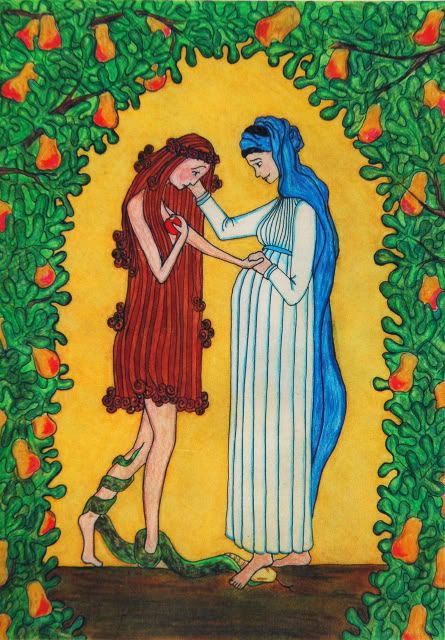
    Can you even imagine what it must have been like for Mary, eight months pregnant (you mothers out there can identify!) and suddenly you have to travel on donkey-back to another town? Not to mention you are carrying within you the only home mankind has ever had and will ever have!

    It is popular in our culture on the secular New Year (the very day when the Church worldwide honors the Mother of God with a great solemnity!) to make resolutions. 

    Why not take this Advent to make just one resolution, one thing you’d like to work on during the year? Something you start with in preparation for Christ’s coming anew into the manger of your heart, something to work on while you hold your newfound Joy Incarnate through to the Feast of the Epiphany, through a brief period of Ordinary time until Lent begins and your Lord is all grown up and headed through the desert for Jerusalem, something to have purified in that journey with Him to the Cross, something to offer Him at Easter time? Something to keep asking for His help on in the ordinary time that follows until the Feast of Christ the King next year when you come before Him and lay your progress at His feet? Ponder your work together with the Carpenter’s Son for a week before Advent begins again and you take up another part of yourself to work on alongside Christ; let the liturgical year, its seasons and feasts draw you deeply into the Gospel!

    What are some of your resolutions for the new liturgical year? What about yourself would you like to bring to Christ’s workbench of the heart?

  • Lessons in the School of Christ

    I know a few of you read my last post when I reflected on an experience I had as a hospital chaplain this summer, and those same people may be wondering, “Where did it go?”

    Well!

    A very dear sister here on Xanga very kindly messaged me her concern that despite the heavy cloak of anonymity provided in my account, it may yet violate HIPPA policy so rather than take a chance, I deleted the entry. Oh well! So thank you (you know who you are)!

    I do not think, however, that reflecting on what I learned will anger the HIPPApotamus at all.

    During the summer I saw death unexpected and expected, criminal and tragic, and I have seen death approaching in ways that terrified people or brought them tremendous peace. I have seen grown men fall to the floor weeping, people trying to invoke the power of Christ to bring people back, I’ve seen people so hysterical that they vomit in the trash bin, so weak with sadness that they cannot stand. I witnessed and experienced things as a young chaplain I thought would be the accumulation of years of ministry as opposed to a mere three months. But in each circumstance there I was, waltzing with death, unsure of where the next dance step was, if the tempo was about to speed up or slow down, or if I would step on someone else’s toes.

    I would say that there are three main lessons I learned as a chaplain, at least as they regard death.

    1.)    As a chaplain, you face death alone.

    On my first day as chaplain, without any formal preparation or training, I was sent to the ER to be with a family who suddenly lost a loved one to a lightning strike. “Are you kidding me?” was my initial reaction. My only experience with death was the safe and at-a-distance kind like at a funeral, where there is the cushion of time having passed as well as the undertaker’s work with makeup and nice clothes. Standing there with the family as they viewed what remained of their loved one was incredibly humbling, and while I was certainly not physically alone I definitely found myself standing in a lonely spot. I did not know the victim or any of the family yet because of the life I have chosen, they were suddenly my people, so I loved them. On the other side there was Death, this enormous something, like a giant tidal wave towering over me and while I was with that family I was the only one facing it while they comforted each other, reminisced about the lost one, and considered the future. Certainly they were dealing with the aftermath of Death’s work, they were not facing it.

    Part of the grace of being a chaplain, I found, is knowing that while your “job” per se often leaves you to face the hard stuff alone, you aren’t actually alone. You stand there, ideally, as a sort of anchor, a deeply rooted tree in the face of a terrifying wind your people are otherwise helpless against. When they are tossed about by sudden realities, by pain and despair, they automatically turn to you (whether you are a 26 year-old college student or not!) for guidance, comfort and prayer and a reminder that death is not the final say. You are supported in this by Jesus Christ, for you are His minister, you are supported by the Holy Spirit that, if you are humble and get out of His way, will guide you in everything you are to do and say. You have a Father looking out for you and a myriad of saints who have “been there, done that” and are constantly praying for you. Death can be intimidating but, with all this help, particularly the company of the One who has subjected Death to Eternal Life, amazing things are utterly possible. With such help I was able to lift those weeping, grown men from off the floor,  hold the trash bin for those sick with sadness, bring peace to those in utter hysterics, and so on. Being a chaplain is letting the tidal wave of Death break around your back, letting the cold soak you to the bone so that the brute reality doesn’t strike those on the other side of you quite so hard in their moment of vulnerability. It leaves you exhausted and shaking at the end of the day, but you go to bed praising God and remembering that regardless and with His help, you stood your ground.


    2.) As a chaplain, the hardest thing to do is to do nothing.

    As a man in particular, there is an innate drive to be helpful, to “do something about it,” “it” being whatever is “wrong.” But sometimes even when we are intending to be helpful we can end up being quite the opposite. I learned this summer that it is better to be harmless than helpful.

    For example, most of the extreme situations I found myself in this summer were utterly insane and as a reaction my man-instinct said, “Do something!” Praise God, who created me with enough sense to ask myself “What can I do?” instead of just trying things out until something worked! Instead of assuming that I could somehow pray the perfect prayer that would calm everyone down, I just remained silent until someone would ask, “Oh chaplain, would you say a prayer for us?” When offering that prayer instead of bulldozing through any tears, interruptions or overriding anyone else who tried to pray, letting things happen as they may. What is a “perfect” prayer anyways? In such circumstances I found the perfect prayers were not the ones I offered but the ones I fostered, encouraging those present to pray as they were moved. My God, brothers and sisters of Xanga, I heard some of the most beautiful prayers of my life from the lips of people in the pits of despair, for those prayers were written with the blood of love and the tears of anguish, all eloquently penned with the very Cross.

                    Nine times out of ten, however, my “job” was filling cups of water (or ice if they were so upset they could not swallow anything), holding a box of tissues, going to get the nurse, holding a hand, pushing a wheel chair, and other very simple tasks. As simple as all this seems on the surface, though, it taught me so much about Christ who, “though he was in the form of God…emptied himself, taking the form of a slave…” (Phil. 2:6-7) Sure I’m well-educated, healthy, young and strong, but as a minister I have to be humble enough to let Christ do His work, and oftentimes His work is so simple and seemingly useless—almost insulting to the one doing the work. This is exactly the paradox of Christ, the beautiful, perfect and divine God come to earth to toil in our human mess. While I delivered no life-changing sermons, performed no miracles, saved no lives but rather did tiny and forgettable things, I know that there is an account being taken, and it is in His Ledger that I want my deeds to be remembered in!

    3.)    As a chaplain, the most important thing you can do is be there.

    As I mentioned, there were situations this summer that were completely off-the-wall insane, at least compared to anything else I had experience in life up to that point. The natural urge in every circumstance was to get out of there as fast as humanly possible! However, there is a reason why Catholic priests and religious (generally) wear distinctive garb: to witness conspicuously to the God we serve and have given our lives to and remind His people that God took on flesh and dwelt among us. The blacks and the collar of the clerical attire stands out in a crowd, and hopefully when someone sees that they instantly are reminded of God, of Church of Jesus Christ our High Priest. When I am standing in a small waiting room with fifteen hot, sweaty and upset people with a small garbage can full of vomit and a chair soaked with urine, nearly deaf from all the screaming and feeling utterly corned, I am standing right where Christ wants me, because I am standing right where He is standing, in the midst of His suffering people. Certainly a priest ministers the Sacraments which, God-willing, I will too one day, but this summer I was also engaged in sacramental ministry: that of ministering Christ’s presence. I was sent to people, places and situations which no nurse or doctor in the entire hospital was capable of or willing to do. I would be paged and come charging down the hall, encountering a very kind and capable nurse who would shake her head and say, “Chaplain, please go to them; there isn’t anything I can do, I’m just helpless!” Then I would think, “Well, sister, there is nothing I can do either except to be there.” This was often the hardest thing to do, even more challenging than the previous topic of “doing nothing!”

    Being present to those people is more than being a warm body in a room. Being present requires attentiveness so that you are sensitive to possible needs (someone who has cried for thirty minutes straight will need water and likely will not ask for it) but also requires a humility on your part so you don’t assume needs and upset someone. Being present means constant and instant availability for prayer, comfort and service, even for very menial things. Being present, most importantly, serves as a reminder to those people who have lost a loved one that they are not alone, that you are there because God is. You, as a chaplain, are an incarnational reminder of the Incarnate God who, by virtue of your baptism and vocation, has delegated you to stand in His privileged place in that beautiful and heart-wrenching moment; you remind those people simply by your presence that God is also there with them. Who am I—a perfect stranger, a young kid—to stand there knee-deep in these personal, life-altering, private moments? Such times are intensely holy ground upon which only Christ Himself has any right to tread. Yet, for love of me and His people He sent me each time to remind them of His constant love and presence. I may have walked into those rooms feeling helpless and useless, but at the end of those experiences it was often that I was blessed with the gratitude of the people and the staff in the simple offering of, “Thank you so much, Chaplain, for being here.”

    There is something intensely rewarding and consoling when capable and experienced medical professionals, when venerable elders who have seen and done it all, when other people who deserve far more respect for their life accomplishments than anything I’ve yet to add to my resume, are thanking me for what on the surface seems like a simple task—mere presence. But each time when that phone or pager rang it was because, regardless of the qualification, skill, capability or self-confidence of the other, I was the absolute only one that had any chance of success. Isn’t Christ simply amazing? This can only be Christ at work, for who else could bring peace, hope and love to a situation simply by being there? I certainly can’t!


  • Eternal Rest Grant Unto Them, O Lord…

    I have learned a great deal about death this year.

    I would not by any means suggest I have learned everything; what an arrogant act that would be! But I learned far more in this short amount of time than I thought I would at this point in my life. November has been set aside as a month of memorial and prayer for the dead for many centuries, so I thought I might share some of this past year’s experiences with death. I hope that these posts are not only interesting but consoling to anyone out there in Xangania that is mourning the loss of a loved one. Know that the Catholic Church prays for you and for them especially during this month, and outside of this month remembers them at each and every Mass, every hour of the day somewhere in the world, every day of the year (except Good Friday of course), and has been for well over a thousand years.

    (My grandfather and I, just a few weeks before he passed away. I no longer have that long hair, btw!)

    For ten years my maternal grandfather battled cancer that began with his prostate and moved into his bones and everywhere else. When it was first diagnosed he was given several months at best. Similar diagnoses would be given over the coming years, but time and again he would show signs of remission, recovering t-cell counts and other positive little victories.

    No one in our family was really expecting a full cure but what we did take joy in was the opportunity to see the death of this man coming far in advance and trying to relish our remaining time with him. It was hard for me to do not emotionally but practically, because I was in college/religious formation for eight of those years. Over those years, as I came to love and understand God more and more I began to love everyone in my life and no longer take them for granted. When I entered religious life especially I made extra efforts to visit my grandparents and, praise God, last year was granted permission to come home for Thanksgiving and Christmas- our last with grandpa. They were very simple celebrations: on Thanksgiving, because even the smell of food cooking would make him sick, we had cocktail wienies in barbeque sauce and macaroni and cheese, and it was PERFECT.

    In December, after I had already been home for our little Christmas with him, I was preparing to go on a silent three-day retreat when I got a phone call from my mother that grandpa was not doing well, and that he could go at any time. That retreat I was praying for him every day, asking that God draw him to himself in peace.

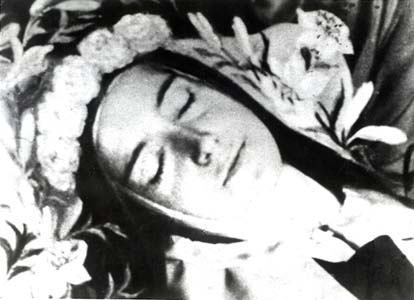
    I had also begun reading the autobiography of St. Therese of Lisieux, who not only blessed us with a beautiful snow during the retreat (just as I was reading about the snow she prayed for and received on her vow day) but promised to spend her time in heaven sending roses to those on earth who desired them and to whom God granted such a favor. So, presuming upon the love of God and the generous offer of my new-found friend in Christ, I asked her for a special favor: should my grandfather die, St. Therese, please ask Jesus to bless me with a sign. If he passes and is in purgatory, please send me a red rose and if he is in heaven, a white one. To my relief, no roses on that retreat, save for my daily “Rose of Sharon” at Mass every day!

    I last saw my grandfather alive in January when I was home for Christmas break. As always, it was a simple little visit, and during that past retreat I had written my last letter to my grandfather, which he had by this visit received. It was a very different letter, I think, from the ones he was used to receiving. In it I talked about some of my favorite memories of us together, of my continual prayers for him, but also my joy and excitement for him that, at any moment, he could find himself face-to-face with the God we desire to encounter our whole lives and invest our whole Christian lives hoping in. We talked about that letter and I was so moved at how important it was to both my grandparents; they finally felt like someone “got it.” They aren’t Catholic (Baptist) and are pretty simple, God-fearing folk, but they understood the beautiful side of death and were feeling a bit alone in that sentiment.

    A couple of weeks later, in the first few days of February, I kept having this little “nag” in my mind that I should call my grandpa, so I finally did. We had a very brief chat because he was very tired, but he was otherwise doing all right and I was able to say goodbye and that I loved him before he handed the phone off to my aunt who was visiting at the time. Several days later on a Friday he entered into an intense period of pain and suffering, Saturday he rested quietly and Sunday morning as the sun was rising he passed away. My mother, a nurse of thirty years and the witnesses of many deaths said his was the most peaceful she had ever witnessed.

    That evening, while I was at Mass, I was standing with the choir and this beautiful young woman with long red hair, a perpetual smile and a joyful spirit, took her place in front of me and stopped my heart: she was wearing a red rose in her hair! I praised God quietly, thanking Him for His infinite mercy, for I knew that my grandfather was being prepared, even now, to meet Him!

    My grandmother decided that there would be no funeral but a simple burial service, and due to time and weather I was unable to attend. There was a family get-together/memorial in April that I came to though, and it was nice to see my grandmother and other family members I don’t often see.

    On October 1st, the Feast of St. Therese of Lisieux, I spoke to my friend, standing so close to Christ, and asked her again for a favor. For my grandparents were married for 52 years (they met and eloped after only 9 weeks of knowing each other!) and she was having an absolutely terrible time coping with his loss. I asked St. Therese to ask Christ for another favor, another rose to let me know how my grandfather is doing. That night was also the night when I was attending the symphony (Copland’s Appalachian Spring and Gershwin’s Rhapsody in Blue). As I was entering the performance hall, a stunning young woman in an ivory dress walked by, wearing a white rose in her hair. I realized again not only God’s love and mercy, but that instead of sending me a plucked and good-as-dead rose such as those in the grocery store, He sent to me beautiful, vibrant and living roses, reminding me that in Christ, there is no death but a super-abundance of life. Praise God!

    My grandmother is still suffering tremendously with depression and mental illness now, so I am awaiting an opportunity to share all of this with her. I keep praying for her and I write when I can and call as well, and if you could spare a prayer for Maxine during this solemn month when the Earth about us fades into the gray and white of winter. Remember, though, that winter is not so much the end of summer as it is the preparation of SPRING.

    For my next blog I hope to share some of my experiences as a hospital chaplain this summer. Until then, know that you are all loved and prayed for, some of you by name even, but all of you nonetheless. God bless!

    (St. Therese; beautiful in life…………and beautiful in death.)


  • Hi-(bye)-atus

    Hello my dear Xangans!

    Just a very quick note: I am diving headlong into a couple of papers I must write for classes. My days are already pretty full, so in an effort to squeeze water from the stone I will have to put aside Xanga for a few weeks. Please know that none of you are forgotten and all of you are prayed for. Please please please do not feel intrusive if you wish to message me, or if you post a blog that you would very much like me to read/comment on. Again, such things will not be a bother whatsoever; in fact they will likely be very welcome! 

    Until next time, God be with you (not that He ever isn’t)!


    -Ancient_Scribe (soon to be an ancient AND busy scribe!)

  • Part V: Erov Returns to the Forest King

    Erov had was yonder questing for so long that all the king’s court, especially poor Annaléa, thought that he had either perished or abandoned his quest, exiling himself for shame. She prayed fervently to the Three, begging their mercy and protection for him.

    Day and night passed over and over again, but eventually dawned the day when Erov was within the king’s hidden hall once again. He was streaked in dirt and mud, his hair tangled with twigs and leaves, his skin bruised and scraped. He heaved with exhaustion and shivered in his near-nakedness, and all who laid eyes upon him pitied him. Erov stumbled towards the king’s throne and all parted to make way.

    “Majesty,” he began. All were silent and the entirety of the forest seemed to hold its breath, standing on tip-toe, tip-claw, wingtip and twig. “I have wrestled a demon, but I could not defeat him.”

    “Was it not you,” the king answered sternly, “who claimed that you could not fail?”

    “It was I,” Erov answered. The king nodded thoughtfully before motioning to Erov to continue speaking.

    “I also drank of the Bitter Cup, and found that all of my strength was taken, that even as I tried to obtain the treasure of the final task I failed and fell into utter loss. It is that I bear only my worthless flesh and my sorry heart, for I have been stripped of all else.”

    The courtiers looked down at the grass with sadness, for in the depths of their hearts they had truly hoped he would be victorious in at least one task, that the king might show mercy.

    “So,” the king said softly, “you have deeds of telling, no strength, and no treasure? He who was so sure of victory has nothing but defeat.”

    Erov flung himself at the foot of the Forest King’s throne.

    “Oh King!” he cried as a child, “With the last drop of my strength I offer this plea, and when I have spoken it I shall have nothing left but the love I bear for your daughter, Annaléa! Banish me for all eternity if you must, but let me look upon her, my sun, before I depart into darkness forever!”

    The king stood, looking down upon the low-lying Erov with pity and deep love.

    “Erov, son of man, you have now laid before my feet the greatest treasure I could desire: a true heart full of love for my daughter. You are thus victorious in the third task.”

    Erov’s sobs ceased in surprise as all present gasped and began to whisper excitedly. One of the king’s aids quickly ran off to fetch Annaléa. The king held up his hand to hush everyone and then continued.

    “You have come to me with the strength to admit your weakness and poverty, a power that arose only after drinking the Bitter Cup. I would have a man who knows his strength to wed my daughter, for I need not some fool who thinks that doing great deeds will win her hand! In this you have proven your victory in the first fold of the second task and have revealed victory in the second fold as well, revealing to me the nature of your heart.”

    “Majesty,” Erov said, “forgive me, but I do not understand.”

    “Erov, you were sent to drink from the Bitter Cup and gain strength. You have done this, but in order to tap into this reservoir of strength you needed to know your own heart. The nymphs were not there to test your fidelity and chastity, but to reveal the heart which resides within you. The third nymph, all hidden in heavy furs, was not modesty but rather the guarded heart, too afraid of being wounded to reveal herself to the light of love. She stands idly by until someone reaches out to her, and only when they have proven their devotion does she reach back, and grasps only when she is utterly convinced that no harm can befall her. Thus she is the heart that cannot be known. The second nymph has been wounded several times by love, each instance becoming more and more guarded, clothing herself to hide her wounds not only from others, but from herself as well. She is cautious and skeptical of love and is quick to turn away at the slightest chance of harm and will one day, for lack of courage, become like the third and hidden away, never to be loved again, as unknown as the very roots of the mountains.”

    “What of the first nymph, Majesty?” Erov asked.

    “She is the heart that, though many times wounded, opens up to love again and again despite the fear of harm and rejection. She has been broken many times, but the promise of love restores her anew though she must always bear her scars. Always for love she will reveal herself, open herself completely and without reserve lest the object of her love receive only a pale shadow of love, which is not true love but only a false likeness of love that cannot be long sustained and cannot give life. She is no fool and does not merely offer her love to any passersby! But neither does she fear love in its offering or its withdrawal; do we fear the sun for its dawning or its setting, the tide for its ebb and flow? Even had you not chosen her, the wound you caused would have healed and she would have been ready to love again, would that love find her. It is she that your heart resonated with, revealing to me that you are of like heart, and it is this courageous and open heart that I wish to belong to my beloved daughter, not some hard half-heart afraid of weakness and flaw, too afraid of passing things to open itself to what is evergreen.”

    “Majesty, it is hers by your blessing!” Erov exclaimed, rising to his knees.

    “Remember these lessons well, Erov son of man,” the king responded, stooping over to raise Erov to his feet. He then placed his hands upon Erov’s shoulders and spoke to him as a father to a son, “For I see a long life full of much trial yet much love ahead of you. Again, noble son of man, you have passed the second trial. Walk with me.”

    Erov walked beside the king as they left the courtyard and followed a well made path to some other part of the forest. The king continued speaking.

    “When you first came to me, you were full of pride, and I will not wed my daughter to a man so in love with himself that she would have to contend with it. Therefore, I sent you to wrestle the Demon of Pride. The only path to victory is to overcome yourself and admit your weakness, accepting defeat. Many a proud man has gone into that cave and unto his death, unwilling to surrender and instead choosing death over some small shame. You, however, chose shame over death, and in that choice you are truly victorious.”

    “My lord,” Erov began, dumbfounded, “I do not understand.”

    “Erov, most humble Erov, in failing at each task you have truly succeeded in them, as I had secretly hoped you would. The Erov that stands before me now is worthy of both being her husband and my son. Return to your home and prepare yourself and your gifts. In three days, in the meadow where your love for each other first took root, you will be wed to Annaléa.”

    All the forest erupted in joy at the king’s words and Erov wept, embracing the king without shame. The good elf embraced him in kind, laughing heartily.

    As he stood in the embrace, Erov spied afar his love Annaléa, standing atop the trail far ahead, her blue dress like a violet amidst green grass, her hair outstretched as a banner of beauty’s triumph. She raised one hand in greeting, wiping tears with the other, and Erov raised a hand to her as well as the king hurried him off to find food and clothing, for much was to be prepared for.

    Three days passed swiftly by and lo! what a sight was there to see in that blessed meadow, where was arrayed the mighty family of Erov, men and women of renown and the regal Elven kin of Annaléa, splendid in silks so fine as to have been spun from rainbow and gem. Their joining that day was cause for celebration throughout heaven and earth, and only one event in all of history has surpassed it in splendor and won so great a victory for Good in this world.


  • Part IV: Erov Seeks a Great Treasure

    Erov awoke to find himself alone in the beautiful glade, the soft song of the fountain’s water filling the air about him as a bird chirped softly here and there. The nymphs were nowhere to be seen, and though he was utterly spent, he rose to his feet and departed in search of a great treasure that would, perhaps, purchase for him the hand of Annaléa despite his previous failures. Muscles once near bursting with strength were now begging him for rest, though for all he knew he very well may have been asleep for the entire passing of a moon. No rest would rejuvenate him, no root, nut or berry would rekindle the flame of his prowess; Erov walked upright and forward on naught but love, with desperation prodding him along at the spearpoint of fear.

    Many days of wandering through the forest and then across a great and hilly plain brought Erov to a grove-crowned hillock where met a noble centaur. From this vantage point he could see the foothills of mountains from which flowed a broad river.

    “Good creature!” said Erov, “I seek the world’s most valuable treasure. Do you know where it lies?”

    “Of course!” the centaur replied, “Follow the river into the toes of the mountains and go until you reach a great and thundering waterfall, and there beneath the curtain of foam, within an ancient dragon’s nest, you will find a great golden egg filled and heavy with jewels!”

    Erov thanked him and followed the river into the foothills, and two tiring days later he came to the waterfall of which the centaur spoke. The remnants of the ancient dragon’s talon marks, which served Erov nicely as handholds, brought him up a steep, slippery cliff face just behind the falling water. Though his strength, still weak from the Bitter Cup, nearly failed him he was able to reach the hidden cave and discovered the nest within which sat a great golden egg, large enough to birth a young boy were boys born of such things.

    Taking vines from the walls of the cave, he wove them around the egg as a basket, and he fashioned also two straps by which he could wear the it on his back and climb back to the riverbank far below.

    As he began his decent, Erov spent the absolute last of his strength, encountering for the first time in his life the utter limit of his humanity. He fell, plummeting like a stone and so robbed of strength he had not even a scream within his lungs, plunging eventually into the murky depths of the river, the egg’s great weight dragging him quickly to the muddy bottom.

    Erov thought quickly as to his next action. Should he try to drag the egg up to the bank, holding his breath as he trudged across the river bottom? Or should he release himself from the treasure and surrender, living long enough to perhaps see his dear Annaléa again even if it was only to tell her goodbye forever?

    The prospect of seeing her again, even if only for a moment, even if only to view her blurred shape through an ocean of tears, drove him to release himself, and in an instant the furious current of the river drew him swiftly away from any possible success and further into certain failure. Eventually the river spat him onto the shore amidst the weeds and detritus, and Erov wept for an entire day, knowing that he had failed in a quite final and irredeemable way and had only this failure to offer the father of his beloved. Even the scroll of his charge had been lost, the river leaving him only his loincloth and his life; what remained to him once his tears had been released was naught but a heartbeat, an ache that waxed and waned with each of its sorry pulses, and the promise of a weary journey with only a deeper loss at its end. 


  • Part III: Erov Drinks From the Bitter Cup

    Erov wandered far for many days, hardly able to lift one foot in front of the other, and he slept much on the way to regain what little strength remained in him. The match with the demon had drawn on reserves of might he did not know he possessed, but now those too were depleted. No sweet water could slake his thirst, and no fruit or root could fill his belly.

    When it seemed that his hope was lost, Erov stumbled into a glade, in the center of which was an ancient nymph-made fountain. The enormous trees at the edges of the glade towered overhead and seemed to curve toward each other like a living dome, the height of which was nearly open to the sky save for a thin veil of leaves lacing the oculus. Through this a great dappled beam of golden light pierced the slight dimness of the [lace, illuminating any bird that flew or leaf that fell through the shaft in a sudden flaring flit, or a gentle shimmering as a fish in clear water.

    At this time it was that the light shone most upon the fountain, which was carved from a single great piece of stone into three bowls of gradual sizes beginning with the smallest at the top and the largest at the bottom. Water burbled from a spout at the height and filled up the smallest bowl, which spilt into the next in a crystalline curtain of water, which caused that bowl to do the same until the largest relinquished its supply into the deep basin that seemed never to fill quite to overflowing, for the vines that reached into its transparent depths and crawled all about the various ornamentations of the fountain drank enough to keep the surrounding earth dry.

    Beside the fountain there was a grotto of sorts built up, a shrine of smooth river rocks cemented together to venerate a simple wooden cup with a handle on each side of the bowl. Vines climbed all upon this structure and partially veiled the cup’s alcove, adding an air of sacred mystery that confirmed in Erov’s heart that this was indeed the Bitter Cup of which the Forest King spoke.

    The son of man approached the grotto and, parting the curtain of vines, took the cup by both handles. Turning toward the fountain Erov stopped, for suddenly before him stood three nymphs.

    Each was as rich in beauty as they were in mystery, and Erov gazed long and thoughtfully at each, kneeling in awe. The first nymph rose from the water and was completely uncovered, her body young, firm and slender, her skin the color of clean beach sand, and the clear water ran in rivulets over every curve of her beauteous landscape. The nymph’s hair was a pale gold as is the noon sun on a clear winter’s day, the ends dark and curled from the water though all else was dry, and her eyes were silver as ice in the same light. She smiled in a manner that seemed as one step away from a cry for joy, and the very corners of her lips quivered with self-restraint.

    The second nymph reclined on the edge of the water, her shapely legs tangling in the coolness of the pool. She was dressed in a simple gown of unadorned deerskins, and her skin was near to that of the House of Endéa, for it was darkened by the sun. However, it was not reddened but rather enriched from the color of the first nymph’s skin to one like the color of the skins she wore, though slightly darker. Her hair was the color of a deer’s fur and long, flowing gracefully onto her shoulders and spilling down her back. Her eyes were dark and doe-like and watched him intently, as if to see whether he would bring her harm.

    The third nymph stood silently by the fountain, clothed entirely in thick furs, her face obscured by a great hood. The furs spilled all about her feet so as to hide them also, and there was nothing to be perceived of her but for the fact that she was there.

    “We are the Ways of the Heart,” they spoke as one, “You must choose one of us to fill the cup for you.”

    “Oh please, choose me!” the first nymph burst, holding out her arms to invite him to her. Her limbs trembled as she stood in the waist-deep pool, and Erov noticed that she seemed to stand somewhat uncertainly, but from weakness or fright he could not tell. Yet, her stance generally displayed confidence and certainly expressed all of her physical beauty as courageously and unashamedly as does the sun.

    “Choose me,” said the second nymph said in a rich voice. She brought her feet out of the water and onto the edge of the pool, drawing a knee near to her breast so as to lean her head upon it. She was relaxed and confident, but spoke and displayed herself with little or no passion.

    “Choose,” said the third nymph in a near whisper. She stood as mighty and imposing as a mountain, and it seemed to him that she was as strong as any creature he’d ever met.

    It is obvious to me, Erov thought, that this is a test of my fidelity to Annaléa. I must, therefore, choose the third and modest nymph.

    He took a step toward the nymph bedecked in furs, who in turn stretched out her hand. As it came out from beneath the furs he saw that her flesh was fine and strong and her skin flawless, but pale and yellowed as if deprived too long of sunlight. The second nymph sighed and the first nymph whimpered and fought her trembling lip as a tear rolled down her face.

    Erov thought for certain that these things were to cause him to falter, for his own father had warned him of nymphs. He therefore boldly took another step toward the third nymph, bearing the Bitter Cup before him. At this moment, too, the third nymph prepared to step toward him, the fur robes parting as a ribbon of perfect but pale flesh was revealed, showing him a view stretching from her shapely waist all the way down her thigh to her foot. Her head lifted and the light shone partly into the recess of her hood, and though her sallow face was beautiful in shape, her eyes were encircled in darkness as if they had only beheld the moon and nothing else. Excepting her pale skin, she was the most perfect creature he had ever seen.

    The second nymph turned her face away from Erov, clutching her legs before her as she looked intently into the waters. As he was approaching the third nymph, he could also better see the second and though she too was perfect and looked healthier and more sun-kissed than the third, Erov could see a few dozen scars, all partially hidden by her dress. She sensed his gaze and pulled on various parts of her dress in order to better hide not her nakedness but what was truly hid, until the scars were no longer visible. The second nymph then turned so that her back faced him and her feet dangled in the water, her arms to either side of her as she hung her head low from her shoulders. Long hair enshrouded her face like a veil, and she sighed softly to herself.

    Much to his heart’s distress Erov could better see the first nymph as well, and at this time her eyes were overflowing with tears and she trembled weakly as she continued holding out her arms to him in silent begging, bearing them aloft on courage alone. The nymph’s seemingly flawless skin was in fact etched in every place with a variety of scars, some very fine while others were large and jagged. Upon her cheek glared the red of a fresh cut and he somehow knew it to be of his own doing by making the third nymph his apparent choice; a wound of rejection.

    “Please… I beg you choose me,” the first nymph managed to whisper to him.

    “Choose as you will,” the second nymph said in resignation, looking over her shoulder to speak to him before away again to peer into the waters.

    “Choose,” stated the third.

    His mind said to take the third and final step toward the modest nymph, but everything in his heart cried out for the first. Trusting his heart Erov strode quickly to the fountain, splashing into the water and to the waiting arms of the first nymph who sang in delight and joy at his coming, weeping without cease upon his shoulder. He held the poor creature as she went limp and wept and wept in his arms, saying to him over and over again, “Oh Master, oh Master!”

    The other two nymphs vanished without a trace, and finally the remaining nymph took a step back and placed a warm and gentle hand upon his cheek.

    “Of the three of us, you chose me. Now you must drink of the Bitter Cup and receive your strength!”

    Erov offered the cup to her and, accepting it she kissed it and placed it beneath the curtain of water spilling from the bottom bowl. It filled quickly, and soon it was that she offered it to him, grasping both handles. He took it and she watched with silver eyes wide as he drained the contents into himself. The water was indeed bitter, but so thirsty was he that it yet quenched him.

    When the cup was empty, the nymph received it from him and together they walked to the grotto and placed the Bitter Cup back in its alcove. Nearby, previously hidden by the grotto, was a long stone partially buried in the ground like unto the manner of a reclining couch. She led him to this stone and he lay upon it while she knelt beside him, whispering into his ear. As she spoke, he felt what little strength he had regained fade as if leeched from him, and sleep rushed in upon him as an avalanche of darkness.

    “Oh Master, sweet Master, it is indeed a bitter cup, but great strength will come when you are most in need of it. Rest, for you have much labor before you.”

    As she bent over to kiss his forehead, Erov saw that the cut upon her face had healed, and when she stood again it seemed that all the strength that had fled him had entered into her! Before he was overcome by sleep he wondered if, perhaps, he had not chosen wisely…


  • Part II: Erov Seeks a Demon

    Upon waking, Erov found himself refreshed and ready in body and spirit to conquer any foul creature he might stumble across. As he continued along until the sun was at the peak of the sky before he met a fairy that was sitting upon a dandelion near the trail’s edge. She was tiny, her skin was carnation pink and her eyes solid black and large, and she wore a small dress made of daisy petals. Her hair was long and silver and flowed like corn silk over her delicate shoulders, and she smiled up at him without fear of his largeness, completely unconcerned at her littleness.

    “Son of man!” she said in a voice like birdsong, “Is it true that you seek a demon?”

    “It is true, little fey,” he replied, squatting down to peer more closely at the beautiful creature, “Do you know of one nearby?”

    “I know many things, and this does happen to be one of them!” the fairy exclaimed, flying up to his face with a deep buzzing hum as her gossamer wings became a blur, “Oh yes indeed! Follow the stream and then the bones to his cave; the stench will guide you the rest of the way!”

    Erov’s heart raced as he leapt into the nearby stream, causing a great explosion of diamondine droplets with every footfall. Birds fled from the noise and deer leapt into deeper brush for fear of some mad creature. Soon enough the son of man came to a barren bank littered with bones of various kinds. Here and there a set of antlers reached toward him, or a ribcage blossomed in a sickly way, or a skull grinned maniacally. The sight chilled him, but it did not frost his courage in the least. Dripping with water, chest heaving, Erov left the stream and began walking up the trail of death, gnawed and cracked bones writing with worms and swarming with flies, until it ended and all that remained to follow was the stench of decay that brought him to the mouth of a dark cave. It was a dreadful sight, gaping wide like a toothless mouth waiting to swallow him in a single, cold gulp and send him tumbling through the dark into the bowels of the earth.          

    Long did Erov pass through the black and stench before he came to a large cavern filled with the red light of a great fire, its smoke rising into a vast crack in the vault high above. At the far end was a crude wooden throne adorned with bones and skins, upon which sat a creature of darkness with glistening black eyes. It looked man enough save for its complete achromaticity, its coarse long hair greased and matted, and the manner in which its skin seemed to peel in many places, curling away in oily flecks and flakes. It grinned, showing teeth that shone like obsidian.

    “Who dares enter the heart of this cave while the master is present?” the demon seemed to exhale.

    Mustering all his courage about him, Erov puffed up his chest and declared, “It is I, Erov son of man. I have come to claim victory over you!”

    The demon laughed in a manner resembling a belching cough and then rose to its feet in one fluid motion, rising a head again above brave Erov.

    “You seem very sure of your strength, Man-child. Tell me, then: how do you intend to defeat me?”

    “It is love by which I come, and love by which I will put your back to the ground!”

    “Well,” hissed the demon, “we shall see, Boldling. Many a champion, whether by love or hate, has come here only to meet their doom. Only One has e’er defeated me, and it is He Who placed me here upon the earth and sundered me from Heaven’s height. Yet you seek to bring me even lower?”

    Erov said nothing and stared deep into the demon’s eyes and saw nothing but the reflection of his own determined but clearly fearful face, as though reflected in a pool of oil.. Then it was that he engaged the demon in a great show of strength, and the two grappled with one another for hours and hours. Much to Erov’s dismay, however, it seemed that the harder Erov strove for the victory, the stronger the demon became! Soon Erov was pinned to the ground, the demon’s foul arm around his neck and twilight began to descend upon his vision.

    “Concede!” the beast breathed in his face, tightening his hold.

    “Never!” Erov croaked, struggling with what remained of his strength.

    Concede!” the demon roared into his ear, pressing Erov’s face into the dust. Erov shook his head weakly, unable to speak, and the demon began to sink its claws into his back.

    “Concede…” the creature hissed menacingly. Erov began to weep, knowing that he had failed and that he would surely be slain if he did not obey the demon.

    “You have the victory,” Erov said with the last of his strength.

    The demon vanished with a harsh chuckle, and poor Erov left the cave in the hope that perhaps finding the Bitter Cup will strengthen him enough for a second match. Surely this would be so! he thought. With a new determination he wandered a great portion of the land known to him, searching for the Bitter Cup from which he would drink his victory.